Crittendenceratops
"Fort Crittenden horned face"
Type species Crittendenceratops krzyzanowskii
- Lived
- 84 to 72 million years ago, Late Cretaceous
- Diet
- Herbivore
- Group
- Ceratopsians, Ceratopsidae
- Found in
- United States
- Named by
- Dalman et al. 2018
Where its fossils were found
The evidence
Today

80 million years ago
Habitat
The Fort Crittenden Formation in Arizona records river plains, lakes and deltas within basins. Other plant-eating dinosaurs and meat eaters lived in this landscape.
Field notes
About Crittendenceratops
What it was like
Crittendenceratops was a small horned dinosaur known from part of a skull and frill. Its frill had curved hooks pointing inward.
Its world
It lived in the Late Cretaceous in what is now Arizona, in the United States. Its bones come from the Fort Crittenden Formation.
How it was found
Dalman and colleagues named Crittendenceratops in 2018, from two finds. It was the first dinosaur named from this formation.
Field gallery
More views of Crittendenceratops
Scenes reconstructed from the available fossil evidence.
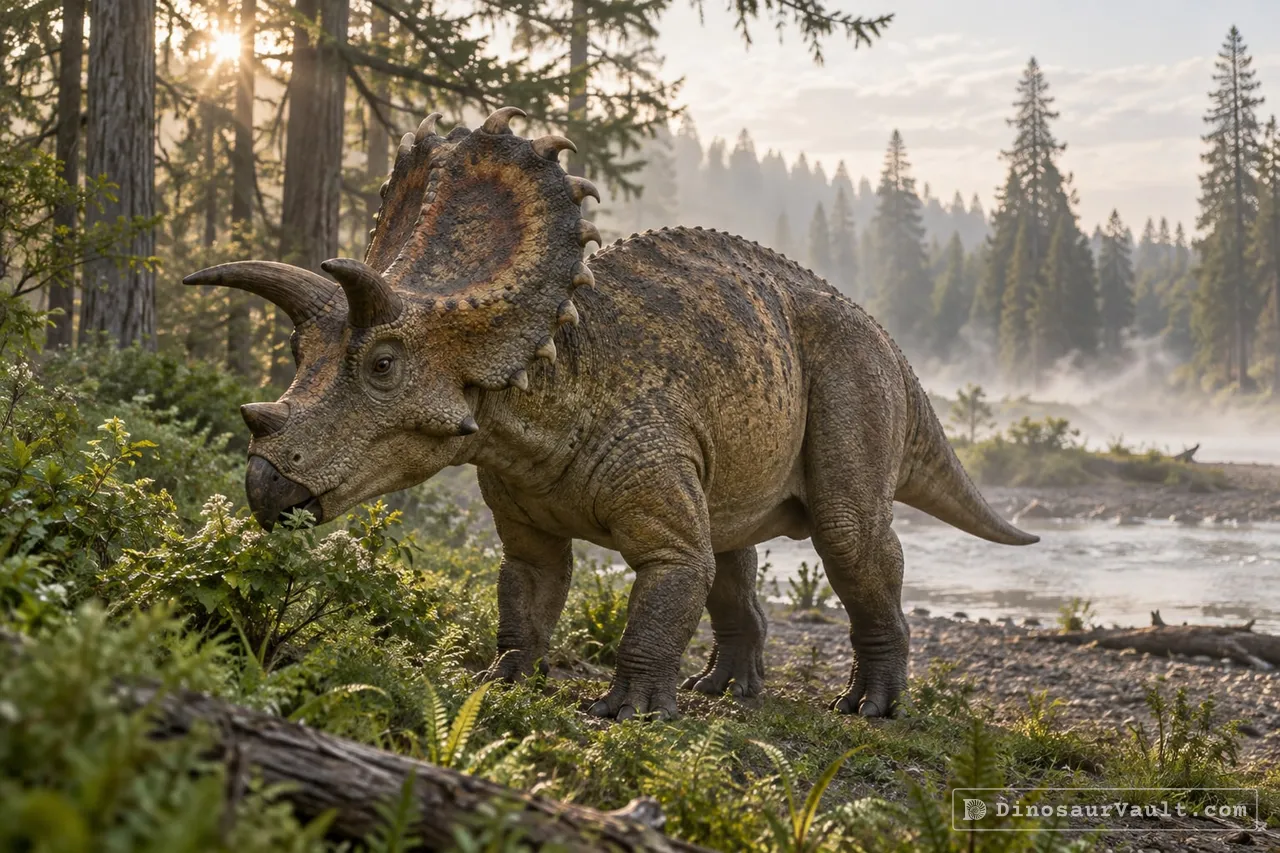
1 of 3
The evidence
The science behind Crittendenceratops
Which parts of the picture come from its own bones, and which come from its relatives.
From its own fossils
- The type specimen is part of the frill: a piece of the right parietal and a nearly complete left squamosal. Other bones assigned to it add frill pieces, the back of a lower jaw and teeth.
- The thick parietal carries triangular and rectangular ornaments along its edge and a broad, forward-curving, hook-like flange on its inner edge, only partly preserved.
- The squamosal, at the side of the frill, has low, broad waves along its edge and a short ridge ending near a rounded bump.
Borrowed from relatives
- The missing face and body are restored by comparison with Nasutoceratops, a close relative known from a skull.
- The hands follow Triceratops, and the feet follow Triceratops and Chasmosaurus.
Still unknown
- The shape of its face and the size of its facial horns.
- Its closest relative. Its describers placed it next to an unnamed horned dinosaur, but with weak support.
- Its full body proportions.
Discovery timeline
- 2013Close relativeSampson et al.
- 2017Family treeRyan et al.
- 2018Named itDalman et al.
Key papers
The research behind what we know of Crittendenceratops
Close relative
Described Nasutoceratops, a short-faced relative with long brow horns and a comparatively simple frill.
A remarkable short-snouted horned dinosaur from the Late Cretaceous (late Campanian) of southern Laramidia. Proceedings of the Royal Society B: Biological Sciences 280: 20131186
Read the paper : A remarkable short-snouted horned dinosaur from the Late Cretaceous (late Campanian) of southern Laramidia (opens in a new tab)Family tree
Established the horned dinosaur branch that later included Crittendenceratops and documented a member from Canada.
A basal ceratopsid (Centrosaurinae: Nasutoceratopsini) from the Oldman Formation (Campanian) of Alberta, Canada. Canadian Journal of Earth Sciences 54: 1-14
Read the paper : A basal ceratopsid (Centrosaurinae: Nasutoceratopsini) from the Oldman Formation (Campanian) of Alberta, Canada (opens in a new tab)Named it
Named a horned dinosaur from skull fragments and identified a distinctive hooked frill with triangular ornaments.
A new ceratopsid dinosaur (Centrosaurinae: Nasutoceratopsini) from the Fort Crittenden Formation, Upper Cretaceous (Campanian) of Arizona. New Mexico Museum of Natural History and Science Bulletin 79: 141-164
No link available
Close relatives
Other members of Ceratopsidae


Sources: Wikidata