Coahuilaceratops
"Coahuila horned face"
Type species Coahuilaceratops magnacuerna
- Lived
- 72 to 71 million years ago, Late Cretaceous
- Diet
- Herbivore
- Group
- Ceratopsians, Ceratopsidae
- Found in
- Mexico
- Named by
- Loewen et al. 2010
Where its fossils were found
The evidence
Today

70 million years ago
Habitat
It lived in what is now northern Mexico, in a landscape with lakes and inland plains.
Field notes
About Coahuilaceratops
What it was like
Coahuilaceratops was a horned dinosaur with very long horns over its eyes, among the longest of any horned dinosaur. It is known from part of a skull and skeleton.
Its world
It lived in the Late Cretaceous, around 72 million years ago, in what is now northern Mexico.
How it was found
Loewen and colleagues named Coahuilaceratops in 2010, from a single find. Its species name means "big horn".
Field gallery
More views of Coahuilaceratops
Scenes reconstructed from the available fossil evidence.
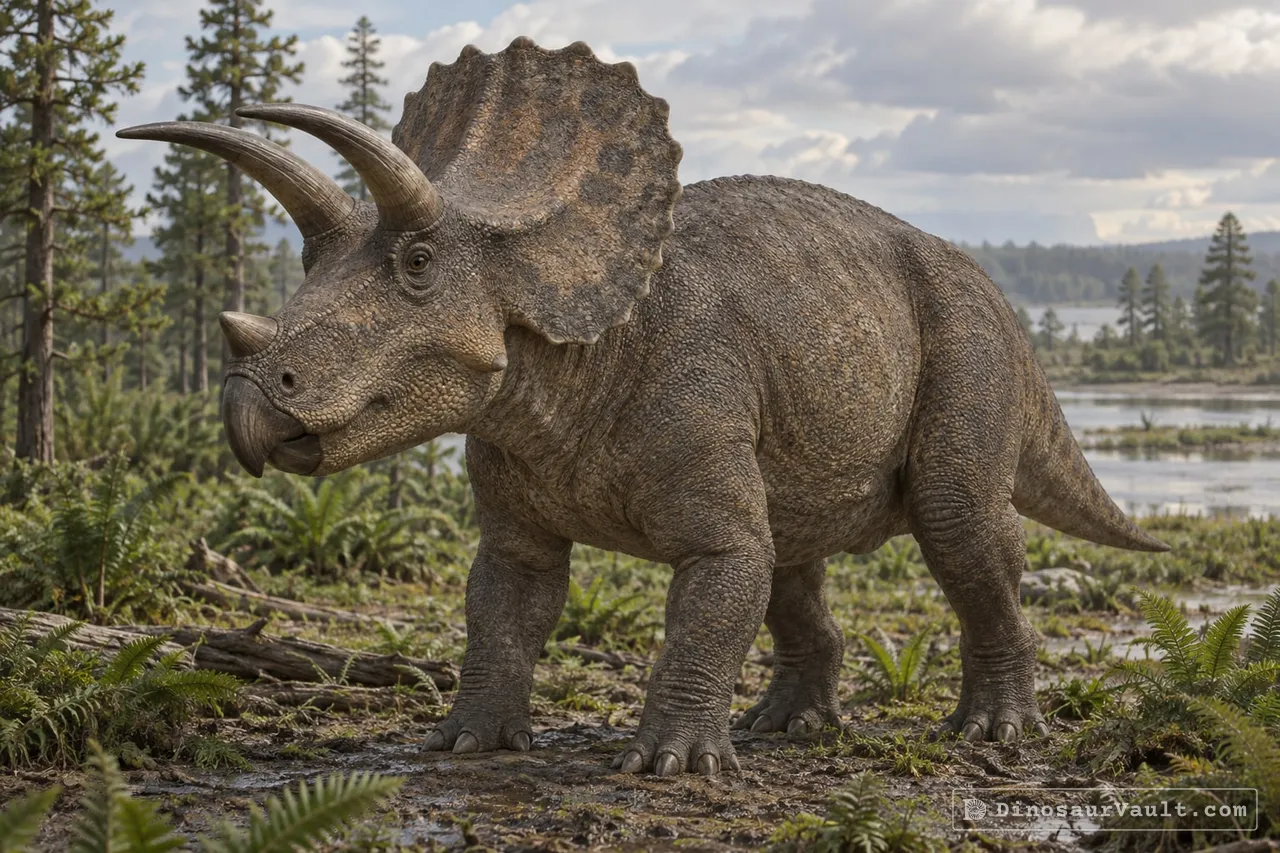
The evidence
The science behind Coahuilaceratops
Which parts of the picture come from its own bones, and which come from its relatives.
From its own fossils
- The partial skull has a deep snout and a small, low nasal horn pointing forward.
- The preserved brow horns are thick and taper only slightly along their surviving lengths.
- Parts of the front of the frill preserve enlarged edge ornaments and low bumps near the midline.
Borrowed from relatives
- Chasmosaurus and Pentaceratops provide comparisons for the missing rear of the frill and parts of the beak.
- Vagaceratops supplies a comparison for the trunk and short forearms, while Triceratops helps restore the supporting hands.
Still unknown
- The full length and direction of the brow horns, whose tips are missing.
- The outline and edge ornaments of the rear of the frill.
- Its skin color.
Often drawn wrong
- A large upright nose horn replaces its own small, forward-pointing horn.
- Open holes through the living frill leave out the skin covering its bony openings.
Discovery timeline
- 2009Close relativeFujiwara
- 2010Named itLoewen et al.
- 2024Fossil sitesBarrera Guevara et al.
Key papers
The research behind what we know of Coahuilaceratops
Close relative
Reconstructed the supporting hand of Triceratops with strong inner digits and smaller outer ones, a comparison for the missing hands of Coahuilaceratops.
A reevaluation of the manus structure inTriceratops(Ceratopsia: Ceratopsidae). Journal of Vertebrate Paleontology 29: 1136-1147
Read the paper : A reevaluation of the manus structure inTriceratops(Ceratopsia: Ceratopsidae) (opens in a new tab)Named it
Named a horned dinosaur with thick brow horns, a deep snout and a small nasal horn from a partial skull.
Horned dinosaurs (Ornithischia: Ceratopsia) from the Upper Cretaceous (Campanian) Cerro del Pueblo Formation, Coahuila, Mexico. New Perspectives on Horned Dinosaurs: The Royal Tyrrell Museum Ceratopsian Symposium. Indiana University Press, Bloomington.
No link available
Fossil sites
Reassigned the fossil quarry to a younger rock unit deposited in an inland landscape with lakes.
Stratigraphic Reassessment of the Mexican Chasmosaurine Coahuilaceratops magnacuerna as the First Diagnostic Dinosaur Remains from the Cerro Huerta Formation (Lower Maastrichtian) Supporting the Southern Origin of the Triceratopsini. Diversity 16: 390
Read the paper : Stratigraphic Reassessment of the Mexican Chasmosaurine Coahuilaceratops magnacuerna as the First Diagnostic Dinosaur Remains from the Cerro Huerta Formation (Lower Maastrichtian) Supporting the Southern Origin of the Triceratopsini (opens in a new tab)
Close relatives
Other members of Ceratopsidae


Sources: Wikidata