Cardiodon
"heart tooth"
Type species Cardiodon rugulosus
- Lived
- 168 to 165 million years ago, Middle Jurassic
- Diet
- Herbivore
- Group
- Sauropods
- Found in
- United Kingdom
- Named by
- Owen 1841
Where its fossils were found
The evidence
Today

165 million years ago
Habitat
It probably lived on land near the shallow seas recorded by the Forest Marble Formation in England. Megalosaurus and Cetiosaurus are also recorded from these rocks.
Field notes
About Cardiodon
What it was like
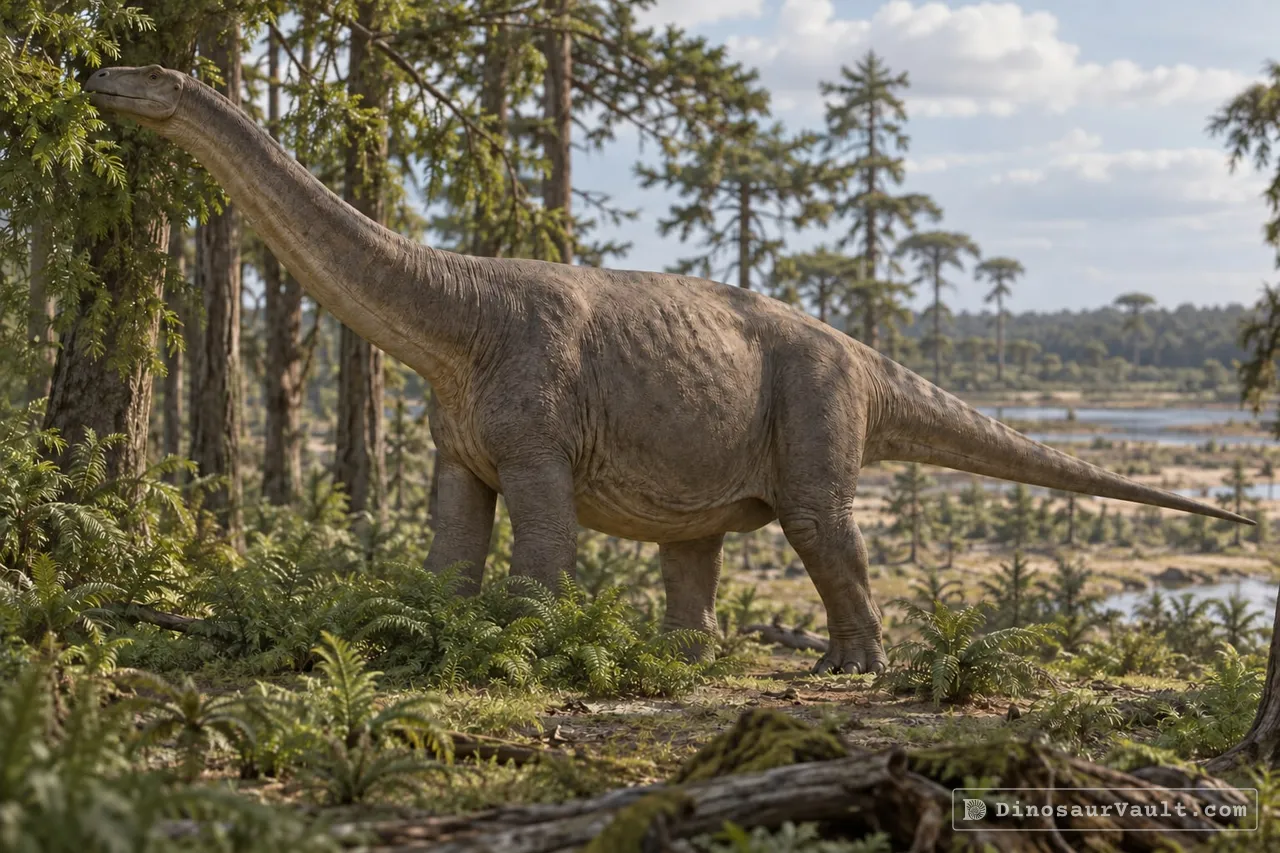
Cardiodon is known only from sauropod teeth shaped like a heart in cross section. It was a long-necked plant eater.
Its world
It lived in the Middle Jurassic, in what is now England. It comes from the Forest Marble Formation, where Megalosaurus and the sauropod Cetiosaurus have also been found.
How it was found
Owen named Cardiodon in 1841, making it one of the first sauropods ever named. The type species is Cardiodon rugulosus.
Field gallery
More views of Cardiodon
Scenes reconstructed from the available fossil evidence.
Lived alongside
Found in the same rock formations


A rock formation can hold fossils laid down millions of years apart, so not every animal here met Cardiodon.
The evidence
The science behind Cardiodon
Which parts of the picture come from its own bones, and which come from its relatives.
From its own fossils
- Only isolated teeth have been assigned to Cardiodon; the tooth on which Owen based the name is now lost.
- The surviving tooth has finely wrinkled enamel and a rounded inner surface, rather than the hollow inner face seen in many broad sauropod teeth.
Borrowed from relatives
- Its long neck, bulky body and four-legged stance are restored from other sauropods, such as Cetiosaurus.
- The heart-shaped tooth crowns resemble those of Turiasaurus, a possible relative.
Still unknown
- Its body size and proportions.
- Its exact place among the sauropods.
- Its skin color and scale pattern.
Discovery timeline
- 1841Named itOwen
- 2003Family treeUpchurch & Martin
- 2006Close relativeRoyo-Torres, Cobos & Alcalá
Key papers
The research behind what we know of Cardiodon
Named it
Named Cardiodon from an isolated tooth with a heart-shaped crown.
Odontography; or, a Treatise on the Comparative Anatomy of the Teeth; Their Physiological Relations, Mode of Development, and Microscopic Structure, in the Vertebrate Animals. Part II. Dental System of Reptiles.
No link available
Family tree
Compared the teeth and rejected the proposed merger of Cardiodon with Cetiosaurus.
The anatomy and taxonomy ofCetiosaurus(Saurischia, Sauropoda) from the Middle Jurassic of England. Journal of Vertebrate Paleontology 23: 208-231
Read the paper : The anatomy and taxonomy ofCetiosaurus(Saurischia, Sauropoda) from the Middle Jurassic of England (opens in a new tab)Close relative
Described Turiasaurus and suggested that Cardiodon's similar heart-shaped teeth might place it in the same sauropod group.
A Giant European Dinosaur and a New Sauropod Clade. Science 314: 1925-1927
Read the paper : A Giant European Dinosaur and a New Sauropod Clade (opens in a new tab)
Close relatives
Other members of Eusauropoda


Sources: Wikidata