Ferganasaurus
"Fergana lizard"
Type species Ferganasaurus verzilini
- Lived
- 165 to 162 million years ago, Middle Jurassic
- Diet
- Herbivore
- Group
- Sauropods
- Found in
- Kyrgyzstan
- Named by
- Alifanov and Averianov 2003
Where its fossils were found
The evidence
Today

165 million years ago
Habitat
It lived on coastal plains beside the Tethys in what is now Kyrgyzstan. The Balabansai Formation also contains Alpkarakush and Ferganocephale.
Field notes
About Ferganasaurus
What it was like
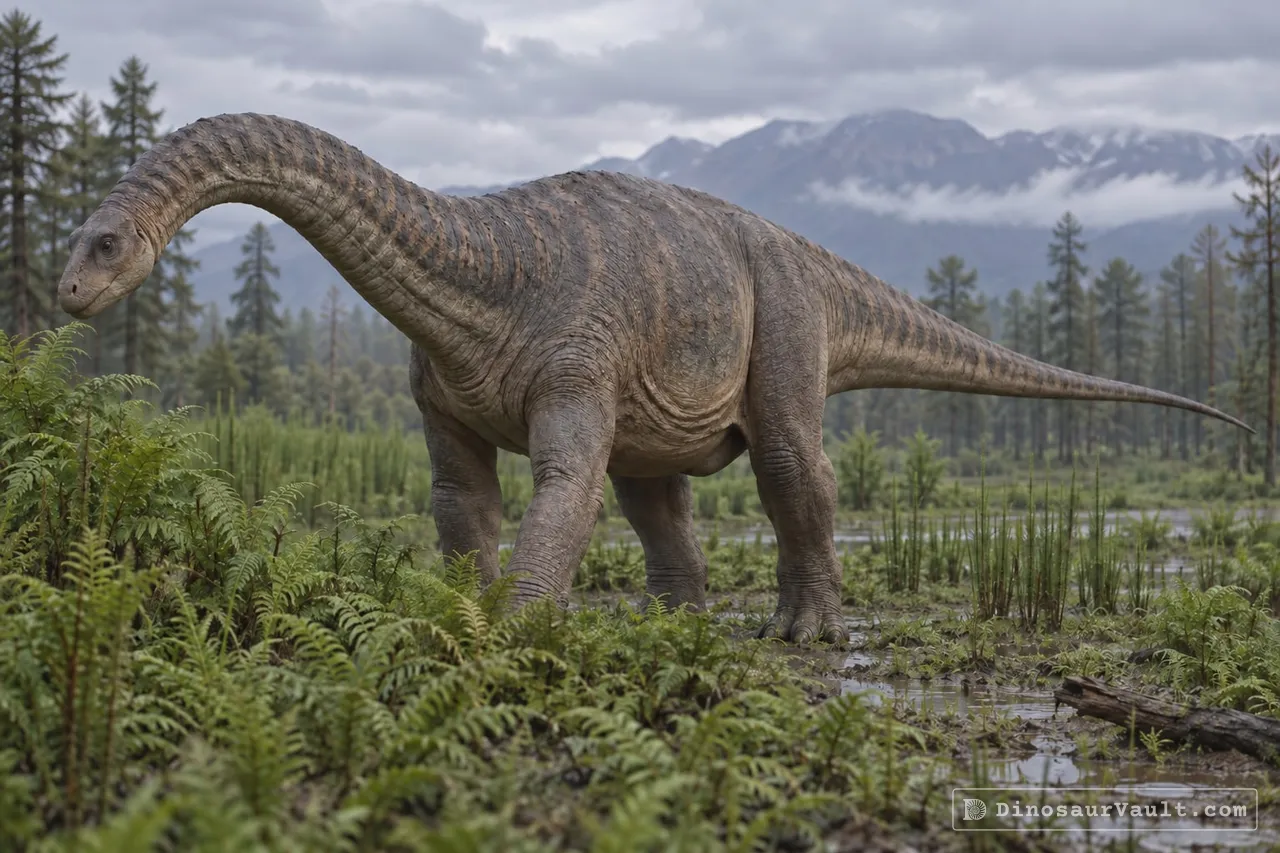
Ferganasaurus was a long-necked, four-legged plant eater, known from part of a skeleton. It was similar to Rhoetosaurus from Australia.
Its world
It lived in the Middle Jurassic in what is now Kyrgyzstan. Its bones come from the Balabansai Formation, where it shared the land with the hunter Alpkarakush.
How it was found
Alifanov and Averianov named Ferganasaurus in 2003, from a single find. The bones had been dug up decades earlier.
Field gallery
More views of Ferganasaurus
Scenes reconstructed from the available fossil evidence.
Lived alongside
Found in the same rock formations


A rock formation can hold fossils laid down millions of years apart, so not every animal here met Ferganasaurus.
The evidence
The science behind Ferganasaurus
Which parts of the picture come from its own bones, and which come from its relatives.
From its own fossils
- The type skeleton includes back and tail vertebrae, hip bones and limb bones.
- Its lost hand bones were recorded in drawings, with upright hand supports arranged in a semicircle and short, stout finger bones.
Borrowed from relatives
- Its missing head is restored by comparison with Bagualia, and its missing hindfeet with Camarasaurus.
Still unknown
- The shape of its skull, the length of its neck and whether the recorded claws came from the hands or feet.
- Its exact position in the sauropod family tree, which differs between studies.
- Its skin texture and color.
Discovery timeline
- 2003Named itAlifanov & Averianov
- 2005Same rocksAVERIANOV, MARTIN & BAKIROV
- 2024Same rocksRauhut et al.
Key papers
The research behind what we know of Ferganasaurus
Named it
Described a partial sauropod skeleton from Kyrgyzstan and compared its vertebrae and limbs with other sauropods.
Ferganasaurus verzilini, gen. et sp. nov., a new neosauropod (Dinosauria, Saurischia, Sauropoda) from the Middle Jurassic of Fergana Valley, Kirghizia. Journal of Vertebrate Paleontology 23: 358-372
Read the paper : Ferganasaurus verzilini, gen. et sp. nov., a new neosauropod (Dinosauria, Saurischia, Sauropoda) from the Middle Jurassic of Fergana Valley, Kirghizia (opens in a new tab)Same rocks
Described pterosaur and dinosaur remains from the same formation, including the teeth named Ferganocephale.
Pterosaur and dinosaur remains from the Middle Jurassic Balabansai Svita in the northern Fergana Depression, Kyrgyzstan (Central Asia). Palaeontology 48: 135-155
Read the paper : Pterosaur and dinosaur remains from the Middle Jurassic Balabansai Svita in the northern Fergana Depression, Kyrgyzstan (Central Asia) (opens in a new tab)Same rocks
Named Alpkarakush from the same formation and reviewed the local dinosaur discoveries, including the surviving Ferganasaurus bones.
A new theropod dinosaur from the Callovian Balabansai Formation of Kyrgyzstan. Zoological Journal of the Linnean Society 201
Read the paper : A new theropod dinosaur from the Callovian Balabansai Formation of Kyrgyzstan (opens in a new tab)
Close relatives
Other members of Eusauropoda


Sources: Wikidata