Blasisaurus
"Blasi lizard"
- Lived
- 72 to 66 million years ago, Late Cretaceous
- Diet
- Herbivore
- Group
- Ornithopods, Hadrosauridae
- Found in
- Spain
- Named by
- Cruzado-Caballero et al. 2010
Where its fossils were found
The evidence
Today

70 million years ago
Habitat
Coastal plains with lagoons, tidal flats and marshes in what is now Spain. Other duckbills in the region included Arenysaurus and Pararhabdodon.
Field notes
About Blasisaurus
What it was like
Blasisaurus was a crested duck-billed plant eater, a relative of Parasaurolophus and Corythosaurus. It is known from part of a skull and skeleton.
Its world
It lived about 72 to 66 million years ago, at the very end of the Late Cretaceous, in what is now Spain. Europe was then a chain of islands. Its bones come from the Arén Formation.
How it was found
Cruzado-Caballero and colleagues named it in 2010. It is named after the site where it was found.
Field gallery
More views of Blasisaurus
Scenes reconstructed from the available fossil evidence.
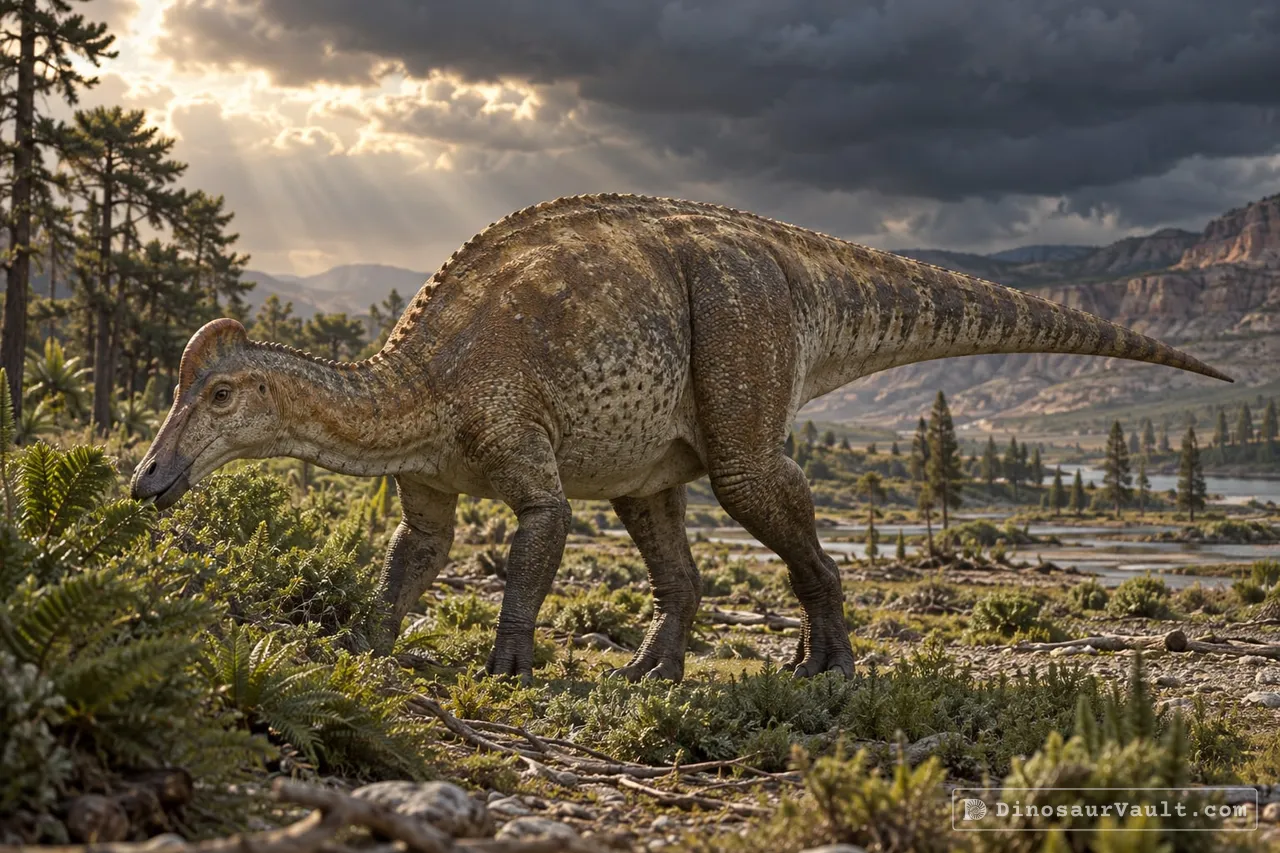
The evidence
The science behind Blasisaurus
Which parts of the picture come from its own bones, and which come from its relatives.
From its own fossils
- The type specimen is a cheekbone with a hook-shaped projection at the back. Other skull and lower-jaw bones are referred to Blasisaurus.
- A lower jaw referred to Blasisaurus has a straight tooth-bearing edge and a front end that bends downward.
Borrowed from relatives
- The missing body, limbs and tail can be compared with more complete crested duckbills such as Corythosaurus and Parasaurolophus.
Still unknown
- The shape of its head crest.
- Its skin texture and color.
- Whether Blasisaurus and Arenysaurus were separate species is unresolved, because their diagnostic skull bones do not overlap.
Discovery timeline
- 2010Named itCruzado-Caballero, Pereda-Suberbiola & Ruiz-Omeñaca
- 2013RedescriptionPrieto-Márquez et al.
- 2013Family treeCruzado-Caballero et al.
- 2024Family treeLongrich et al.
Key papers
The research behind what we know of Blasisaurus
Named it
Named a crested duckbill from skull and jaw bones, recognizing a distinctive hook-shaped projection on the cheekbone.
Blasisaurus canudoigen. et sp. nov., a new lambeosaurine dinosaur (Hadrosauridae) from the Latest Cretaceous of Arén (Huesca, Spain). Canadian Journal of Earth Sciences 47: 1507-1517
Read the paper : Blasisaurus canudoigen. et sp. nov., a new lambeosaurine dinosaur (Hadrosauridae) from the Latest Cretaceous of Arén (Huesca, Spain) (opens in a new tab)Redescription
Revised the identifying skull features and questioned whether Blasisaurus and Arenysaurus were separate species.
Diversity, Relationships, and Biogeography of the Lambeosaurine Dinosaurs from the European Archipelago, with Description of the New Aralosaurin Canardia garonnensis. PLoS ONE 8: e69835
Read the paper : Diversity, Relationships, and Biogeography of the Lambeosaurine Dinosaurs from the European Archipelago, with Description of the New Aralosaurin Canardia garonnensis (opens in a new tab)Family tree
Compared Arenysaurus with Blasisaurus and placed both near Parasaurolophus in the duckbill family tree.
New material and phylogenetic position ofArenysaurus ardevoli, a lambeosaurine dinosaur from the late Maastrichtian of Arén (northern Spain). Journal of Vertebrate Paleontology 33: 1367-1384
Read the paper : New material and phylogenetic position ofArenysaurus ardevoli, a lambeosaurine dinosaur from the late Maastrichtian of Arén (northern Spain) (opens in a new tab)Family tree
Compared Blasisaurus jaw and teeth with Minqaria and proposed relationships among European and African crested duckbills.
A new small duckbilled dinosaur (Hadrosauridae: Lambeosaurinae) from Morocco and dinosaur diversity in the late Maastrichtian of North Africa. Scientific Reports 14
Read the paper : A new small duckbilled dinosaur (Hadrosauridae: Lambeosaurinae) from Morocco and dinosaur diversity in the late Maastrichtian of North Africa (opens in a new tab)
Close relatives
Other members of Hadrosauridae


Sources: Wikidata