Beg
Type species Beg tse
- Lived
- 106 to 94 million years ago, Early Cretaceous to Late Cretaceous
- Diet
- Herbivore
- Group
- Ceratopsians
- Found in
- Mongolia
- Named by
- Yu et al. 2020
Where its fossils were found
The evidence
Today

100 million years ago
Habitat
Its skull was buried in reddish sand and gravel in the Ulaanoosh Formation of Mongolia. The same formation preserves turtles, fragmentary sauropods and dinosaur eggs.
Field notes
About Beg
What it was like
Beg was an early horned dinosaur, a small plant eater known from a partial skull. Its face was covered in rough, bumpy bone.
Its world
It lived in the Cretaceous in what is now Mongolia. Its bones come from the Ulaanoosh Formation.
How it was found
Yu and colleagues named it in 2020. The type species is Beg tse. It is named after a guardian figure of Mongolian tradition.
Field gallery
More views of Beg
Scenes reconstructed from the available fossil evidence.
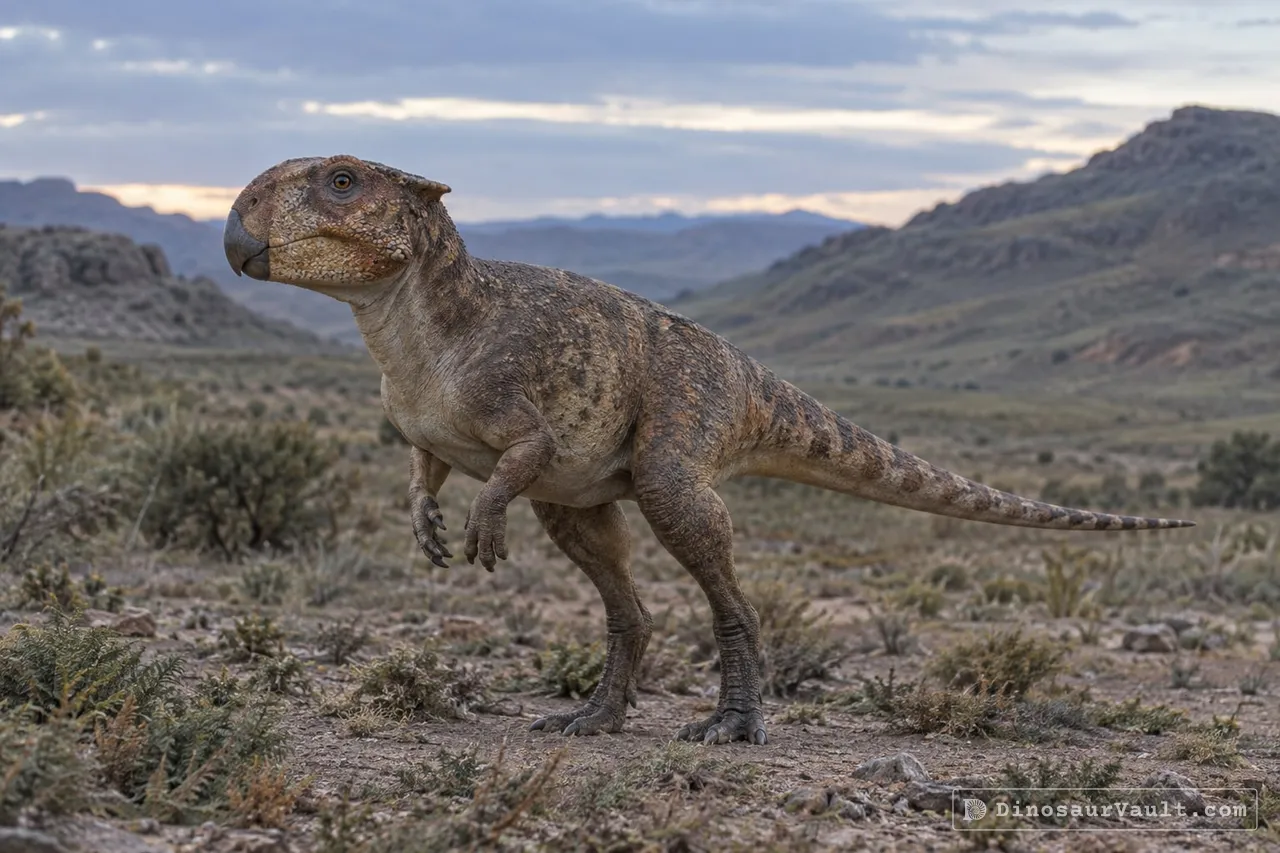
The evidence
The science behind Beg
Which parts of the picture come from its own bones, and which come from its relatives.
From its own fossils
- A partial skull preserves a deep snout, a short lower jaw and teeth near the front of the upper jaw.
- The cheek and rear of the lower jaw have rough surfaces and a row of rounded bumps.
- A rib and fragments of the shoulder blade and pelvis were found with the skull.
Borrowed from relatives
- The missing body is restored from small early horned dinosaurs such as Liaoceratops; most of its own body bones are missing.
Still unknown
- The shape of the back of its skull and frill.
- Its complete body proportions.
- Its skin covering and color.
Discovery timeline
- 2002Close relativeXu et al.
- 2014Family treeFarke et al.
- 2020Named itYu et al.
Key papers
The research behind what we know of Beg
Close relative
Described Liaoceratops, an early horned dinosaur that helps explain the skull features shared by Beg and its relatives.
A ceratopsian dinosaur from China and the early evolution of Ceratopsia. Nature 416: 314-317
Read the paper : A ceratopsian dinosaur from China and the early evolution of Ceratopsia (opens in a new tab)Family tree
Described Aquilops and traced the spread of early horned dinosaurs between Asia and North America.
A Ceratopsian Dinosaur from the Lower Cretaceous of Western North America, and the Biogeography of Neoceratopsia. PLoS ONE 9: e112055
Read the paper : A Ceratopsian Dinosaur from the Lower Cretaceous of Western North America, and the Biogeography of Neoceratopsia (opens in a new tab)Named it
Described the partial skull and placed Beg near the beginning of the neoceratopsian family tree.
A neoceratopsian dinosaur from the early Cretaceous of Mongolia and the early evolution of ceratopsia. Communications Biology 3
Read the paper : A neoceratopsian dinosaur from the early Cretaceous of Mongolia and the early evolution of ceratopsia (opens in a new tab)
Close relatives
Other members of Neoceratopsia


Sources: Wikidata