Baotianmansaurus
"Baotianman lizard"
- Lived
- 94 to 72 million years ago, Late Cretaceous
- Diet
- Herbivore
- Group
- Sauropods
- Found in
- China
- Named by
- Zhang et al. 2009
Where its fossils were found
The evidence
Today

80 million years ago
Habitat
It lived in an inland landscape in Late Cretaceous China. Mosaiceratops, a small horned dinosaur, lived in the same region.
Field notes
About Baotianmansaurus
What it was like
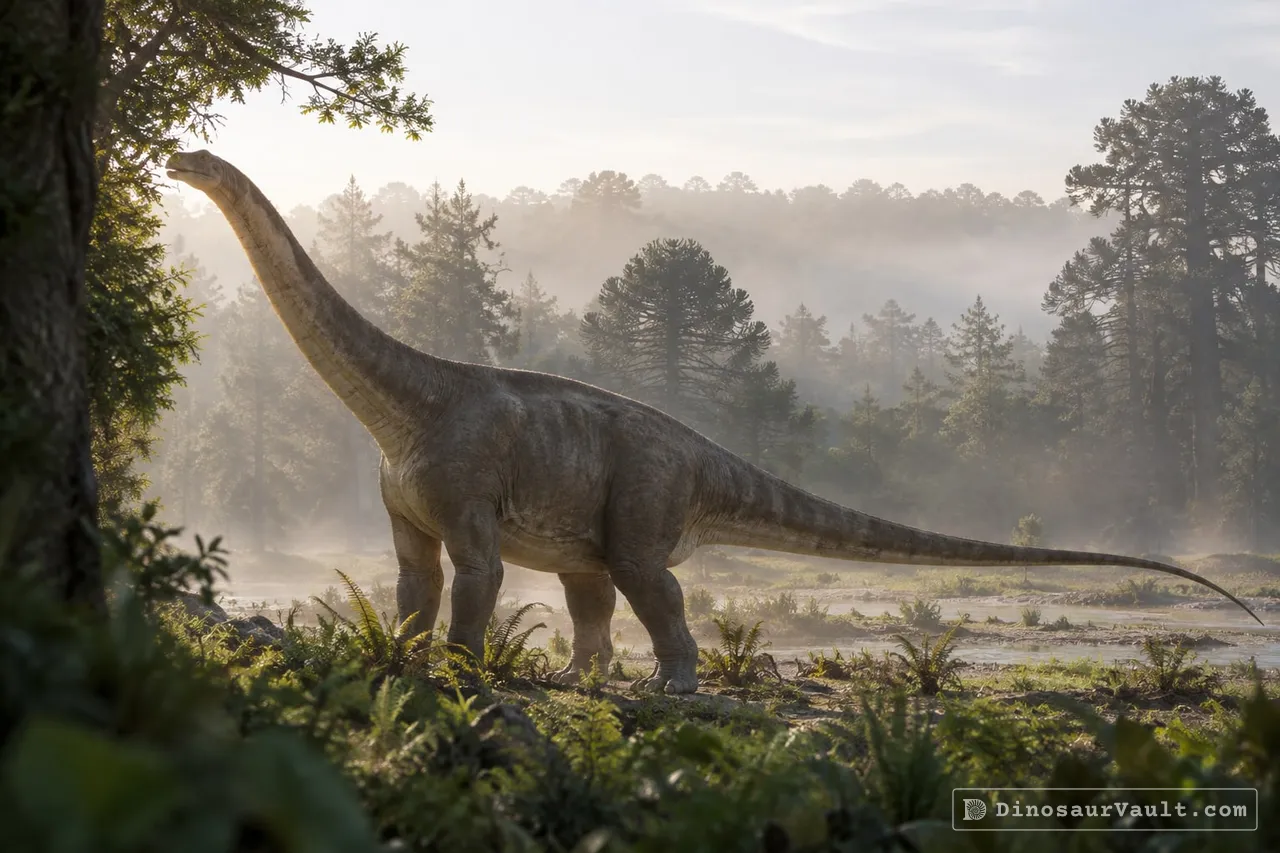
Baotianmansaurus was a long-necked sauropod, a relative of the titanosaurs. It is known from backbones, ribs and part of a shoulder.
Its world
It lived in the Late Cretaceous in what is now central China. The small horned dinosaur Mosaiceratops lived in the same region.
How it was found
Zhang and colleagues named it in 2009. It is named after a nature reserve near where it was found.
Field gallery
More views of Baotianmansaurus
Scenes reconstructed from the available fossil evidence.
1 of 3
Lived alongside
Found in the same rock formations

A rock formation can hold fossils laid down millions of years apart, so not every animal here met Baotianmansaurus.
The evidence
The science behind Baotianmansaurus
Which parts of the picture come from its own bones, and which come from its relatives.
From its own fossils
- Parts of the backbone, ribs and shoulder of a sauropod.
- Its back vertebrae have a network of thin bony braces supporting the projections that held the ribs, and air spaces inside the bone.
- Its tail vertebrae show no openings for air sacs on the surface of the bone.
Borrowed from relatives
- Its skull is unknown, so restorations borrow a broad, boxy snout and low skull roof from Euhelopus, a sauropod from China.
- The neck and shoulders follow Mnyamawamtuka, an African titanosaur.
Still unknown
- Its full length and weight.
- The shape of its head and the length of its neck.
- Its closest kin. Different family trees place it among the titanosaurs, near Euhelopus, or among earlier relatives of the titanosaurs.
Discovery timeline
- 2009Named itZHANG et al.
- 2013Family treeMannion et al.
- 2019Family treeMannion et al.
- 2025Family treeDíaz et al.
Key papers
The research behind what we know of Baotianmansaurus
Named it
Named a sauropod distinguished by the branching bony braces on its back vertebrae.
A New Sauropod Dinosaur from the Late Cretaceous Gaogou Formation of Nanyang, Henan Province. Acta Geologica Sinica - English Edition 83: 212-221
Read the paper : A New Sauropod Dinosaur from the Late Cretaceous Gaogou Formation of Nanyang, Henan Province (opens in a new tab)Family tree
Included Baotianmansaurus in a broad family tree and grouped it with Dongyangosaurus and Opisthocoelicaudia in some analyses.
Osteology of the Late Jurassic Portuguese sauropod dinosaurLusotitan atalaiensis(Macronaria) and the evolutionary history of basal titanosauriforms. Zoological Journal of the Linnean Society 168: 98-206
Read the paper : Osteology of the Late Jurassic Portuguese sauropod dinosaurLusotitan atalaiensis(Macronaria) and the evolutionary history of basal titanosauriforms (opens in a new tab)Family tree
Reexamined Chinese sauropods and found that their positions among titanosaurs and their relatives changed with the method used to build the family tree.
New information on the Cretaceous sauropod dinosaurs of Zhejiang Province, China: impact on Laurasian titanosauriform phylogeny and biogeography. Royal Society Open Science 6: 191057
Read the paper : New information on the Cretaceous sauropod dinosaurs of Zhejiang Province, China: impact on Laurasian titanosauriform phylogeny and biogeography (opens in a new tab)Family tree
A large titanosaur family tree in which Baotianmansaurus sometimes joined Andesaurus and its kin, though its position shifted between analyses.
Revision of Romanian sauropod dinosaurs reveals high titanosaur diversity and body-size disparity on the latest Cretaceous Haţeg Island, with implications for titanosaurian biogeography. Journal of Systematic Palaeontology 23
Read the paper : Revision of Romanian sauropod dinosaurs reveals high titanosaur diversity and body-size disparity on the latest Cretaceous Haţeg Island, with implications for titanosaurian biogeography (opens in a new tab)
Close relatives
Other members of Titanosauria


Sources: Wikidata