Bambiraptor
- Lived
- Late Cretaceous
- Diet
- Carnivore
- Length
- about 1 m (3 ft)
- Group
- Theropods, Dromaeosauridae
- Named by
- Burnham et al. 2000
Size comparison
To scale

Scale in metersOutline: typical theropod shape
Where its fossils were found
The evidence
Fossil record
Two Medicine Formation, Montana, United States
Late Cretaceous
The original skeleton comes from the Two Medicine Formation of Montana. Its precise age within that formation remains uncertain.
No finds with map coordinates are recorded yet.
Habitat
It lived on the river plains of western North America. Other dinosaurs in the same regional succession included Maiasaura, Hypacrosaurus and Daspletosaurus.
Field notes
About Bambiraptor
What it was like
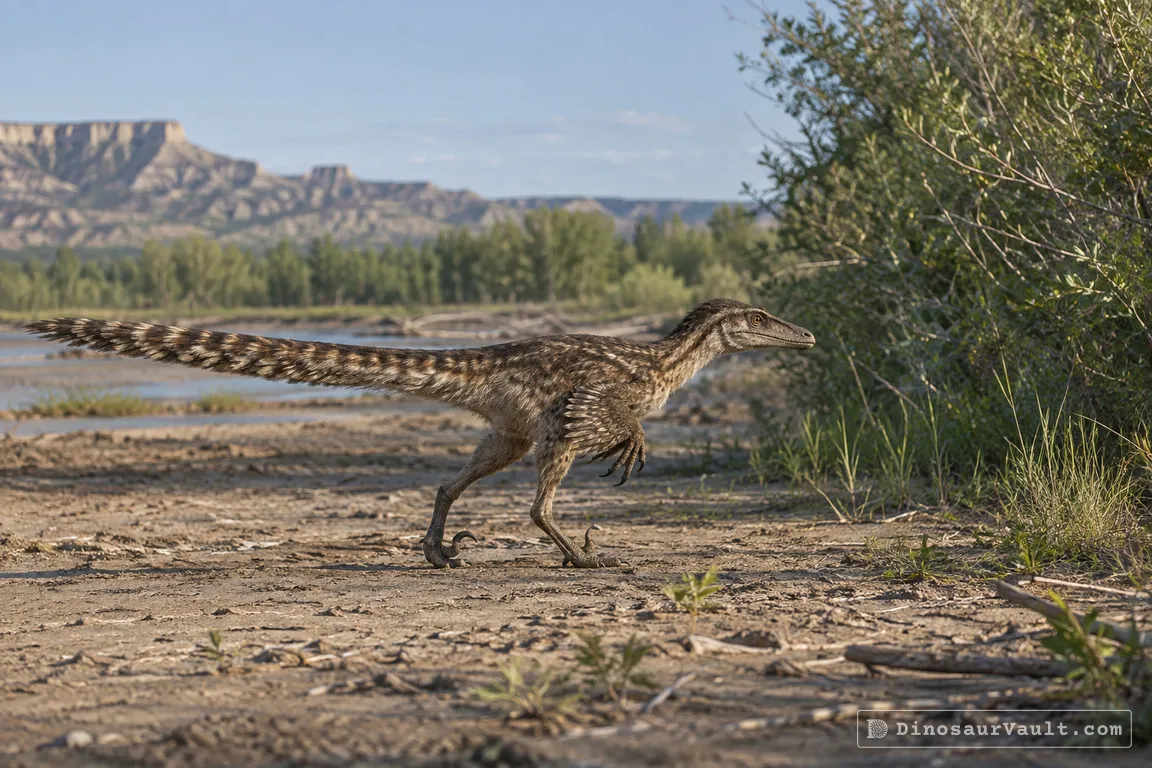
Bambiraptor was a small feathered hunter from the same family as Velociraptor. The known skeleton is only about 1 meter (3 feet) long and seems to be a young animal, so adults were probably bigger.
It had long arms, a sickle claw on each foot and a relatively large brain for a dinosaur. Some scientists think it may be a young Saurornitholestes rather than a separate genus.
Its world
Its original skeleton comes from the Late Cretaceous Two Medicine Formation of Montana, in western North America.
How it was found
Burnham and colleagues named Bambiraptor in 2000. Its playful name comes from its small size.
Field gallery
More views of Bambiraptor
Scenes reconstructed from the available fossil evidence.
The evidence
The science behind Bambiraptor
Which parts of the picture come from its own bones, and which come from its relatives.
From its own fossils
- A nearly complete skeleton preserves the skull, long arms and hind legs of a small hunter.
- It had an enlarged sickle claw on each foot.
Borrowed from relatives
- Most of its skeleton is known from its own bones.
- Feathers are restored by comparison with feathered relatives such as Microraptor.
Still unknown
- Whether Bambiraptor is a separate genus or a young Saurornitholestes.
- Its adult size.
- The arrangement and color of its feathers.
Discovery timeline
- 2000Named itBurnham et al.
- 2003Close relativeXu et al.
- 2012Family treeTurner, Makovicky & Norell
Key papers
The research behind what we know of Bambiraptor
Named it
Described a nearly complete young skeleton with many birdlike features and named Bambiraptor.
Remarkable new birdlike dinosaur (Theropoda: Maniraptora) from the Upper Cretaceous of Montana. University of Kansas Paleontological Contributions 13: 1-14
No link available
Close relative
Described long feathers on the arms, legs and tail of Microraptor, supporting feathered reconstructions of related small raptors.
Four-winged dinosaurs from China. Nature 421: 335-340
Read the paper : Four-winged dinosaurs from China (opens in a new tab)Family tree
Reviewed the raptor family and its relationships with birds through a large comparison of skeletal features.
A Review of Dromaeosaurid Systematics and Paravian Phylogeny. Bulletin of the American Museum of Natural History 371: 1-206
Read the paper : A Review of Dromaeosaurid Systematics and Paravian Phylogeny (opens in a new tab)
Close relatives
Other members of Dromaeosauridae


Sources: Wikidata