Augustynolophus
- Lived
- 72 to 66 million years ago, Late Cretaceous
- Diet
- Herbivore
- Group
- Ornithopods, Hadrosauridae
- Found in
- United States
- Named by
- Prieto-Márquez et al. 2015
Where its fossils were found
The evidence
Today

70 million years ago
Habitat
It probably lived on coastal land in California, with carcasses washed into the sea where the Moreno Formation accumulated. Nearby waters held plesiosaurs and mosasaurs.
Field notes
About Augustynolophus
What it was like
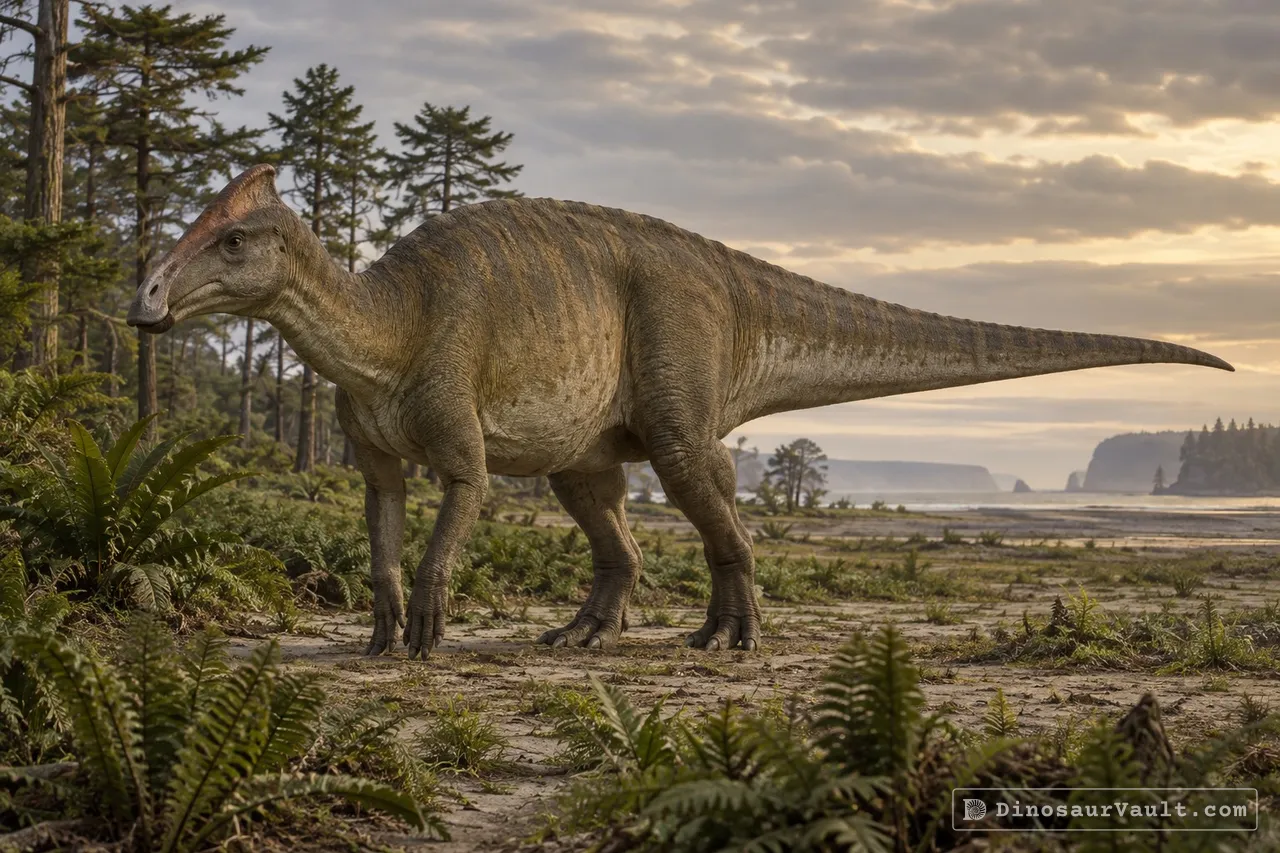
Augustynolophus was a hadrosaur, or duck-billed dinosaur, a plant eater with a broad beak and many grinding teeth. It was a close relative of Saurolophus and had a flat, crestless skull.
Its world
It lived about 72 to 66 million years ago, near the very end of the age of dinosaurs, in what is now California. Its bones come from the Moreno Formation, which formed in the sea: its carcasses were probably washed out from the coast.
How it was found
Prieto-Márquez and colleagues named Augustynolophus in 2015, from bones first placed in Saurolophus. It is the official state dinosaur of California.
Field gallery
More views of Augustynolophus
Scenes reconstructed from the available fossil evidence.
1 of 3
The evidence
The science behind Augustynolophus
Which parts of the picture come from its own bones, and which come from its relatives.
From its own fossils
- The known specimens preserve parts of the skull, jaws, shoulder girdle and limbs.
- A bone behind the eye carries a broad, slanting groove that helps distinguish this animal from other hadrosaurs.
Borrowed from relatives
- Saurolophus and Prosaurolophus guide the restoration of missing parts of the body.
- Its broad feeding beak and tightly packed tooth rows follow the pattern shared by these hadrosaurs.
Still unknown
- Its color and skin pattern.
- How its appearance changed as it grew.
- Whether it nested or traveled in groups.
Discovery timeline
- 2011Full descriptionPrieto-Márquez & Wagner
- 2015Named itPrieto-Márquez et al.
- 2016Same rocksO'Gorman
Key papers
The research behind what we know of Augustynolophus
Full description
Described the specimens as Saurolophus morrisi and identified a distinctive groove in the bone behind the eye.
Saurolophus morrisi, a new species of hadrosaurid dinosaur from the Late Cretaceous of the Pacific coast of North America. Acta Palaeontologica Polonica
Read the paper : Saurolophus morrisi, a new species of hadrosaurid dinosaur from the Late Cretaceous of the Pacific coast of North America (opens in a new tab)Named it
Recognized Augustynolophus as a separate genus after further preparation revealed distinctive features of its skull roof.
The late-surviving ‘duck-billed’ dinosaur Augustynolophus from the upper Maastrichtian of western North America and crest evolution in Saurolophini. Geological Magazine 152: 225-241
No link available
Same rocks
Reexamined a young plesiosaur from the same formation and described additional material belonging to another plesiosaur.
Reappraisal of Fresnosaurus drescheri (Plesiosauria; Elasmosauridae) from the Maastrichtian Moreno Formation, California, USA. Cretaceous Research 68: 9-20
Read the paper : Reappraisal of Fresnosaurus drescheri (Plesiosauria; Elasmosauridae) from the Maastrichtian Moreno Formation, California, USA (opens in a new tab)
Close relatives
Other members of Hadrosauridae


Sources: Wikidata