Atacamatitan
"Atacama titan"
Type species Atacamatitan chilensis
- Lived
- 101 to 66 million years ago, Late Cretaceous
- Diet
- Herbivore
- Group
- Sauropods
- Found in
- Chile
- Named by
- Kellner et al. 2011
Where its fossils were found
The evidence
Today

80 million years ago
Habitat
It lived on land in what is now northern Chile. The Tolar Formation preserves red sandstone and beds of rounded stones.
Field notes
About Atacamatitan
What it was like
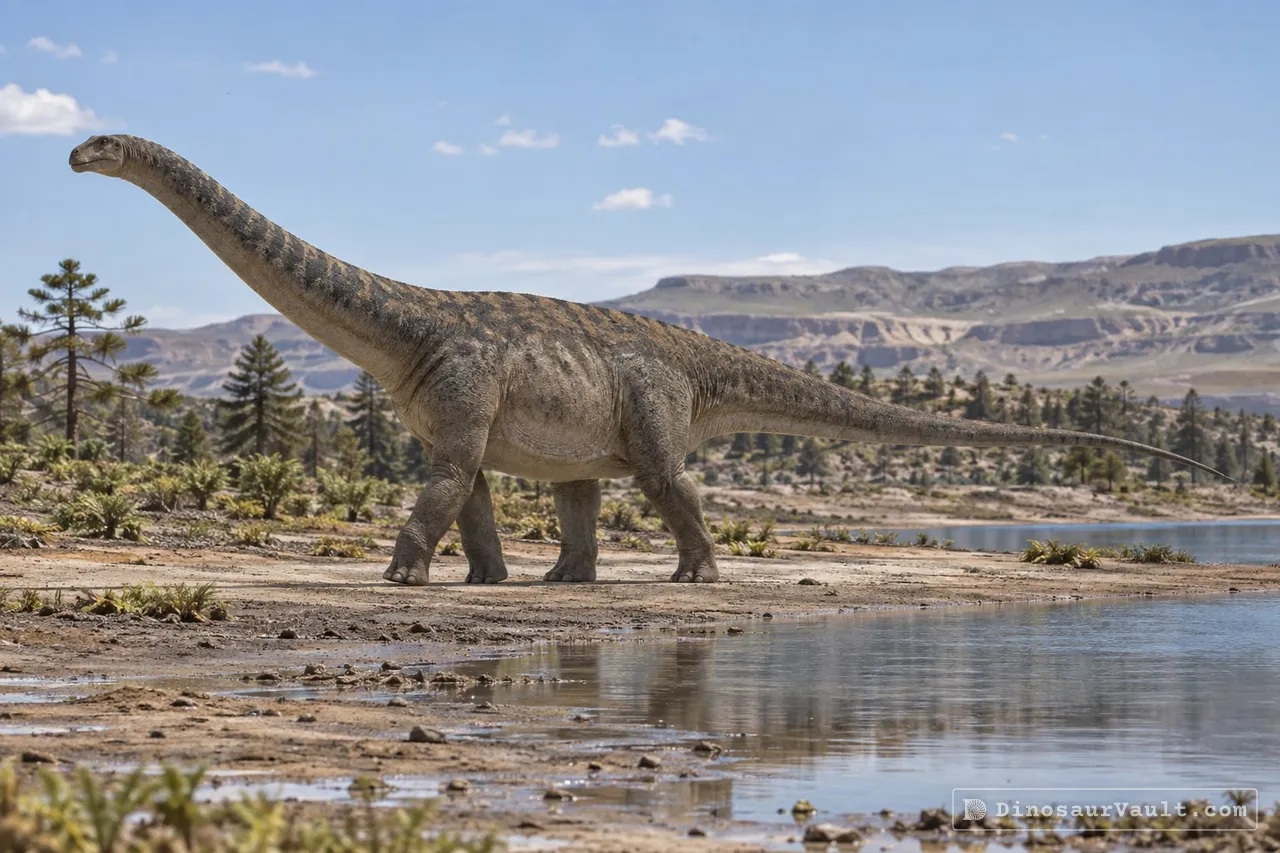
Atacamatitan was a titanosaur, a long-necked plant eater. It is known from a few bones of the back, hips and legs.
Its world
It lived in the Late Cretaceous in what is now northern Chile. Its bones come from the Tolar Formation.
How it was found
Kellner and colleagues named it in 2011. The type species is Atacamatitan chilensis. It is named after the desert where it was found.
Field gallery
More views of Atacamatitan
Scenes reconstructed from the available fossil evidence.
The evidence
The science behind Atacamatitan
Which parts of the picture come from its own bones, and which come from its relatives.
From its own fossils
- The type bones include back and tail vertebrae, ribs, part of an upper arm bone and a thigh bone, probably from the same individual.
- The back vertebrae have rounded openings in their sides and deeply hollowed undersides.
- Its thigh bone narrows along much of the shaft, while the preserved upper arm bone is relatively robust.
Borrowed from relatives
- Tapuiasaurus offers a comparison for the missing skull, and Mnyamawamtuka for the missing neck and chest.
Still unknown
- The shape of its skull and the length of its neck.
- Its skin texture and color.
- Which other dinosaurs shared its habitat.
Discovery timeline
- 2011Named itKellner et al.
- 2012Fossil sitesRubilar-Rogers et al.
- 2019Family treeGorscak & O’Connor
Key papers
The research behind what we know of Atacamatitan
Named it
Described the partial skeleton and established a dinosaur-bearing Cretaceous age for its fossil beds.
A new titanosaur sauropod from the Atacama Desert, Chile. Anais da Academia Brasileira de Ciências 83: 211-219
Read the paper : A new titanosaur sauropod from the Atacama Desert, Chile (opens in a new tab)Fossil sites
Reviewed dinosaur finds across Chile, including Atacamatitan among the country's rare skeletal remains.
An overview of the dinosaur fossil record from Chile. Journal of South American Earth Sciences 37: 242-255
Read the paper : An overview of the dinosaur fossil record from Chile (opens in a new tab)Family tree
Described Mnyamawamtuka with neck, back and limb bones that provide broader titanosaur comparisons for missing body regions.
A new African Titanosaurian Sauropod Dinosaur from the middle Cretaceous Galula Formation (Mtuka Member), Rukwa Rift Basin, Southwestern Tanzania. PLOS ONE 14: e0211412
Read the paper : A new African Titanosaurian Sauropod Dinosaur from the middle Cretaceous Galula Formation (Mtuka Member), Rukwa Rift Basin, Southwestern Tanzania (opens in a new tab)
Close relatives
Other members of Lithostrotia


Sources: Wikidata