Arackar
"skeleton"
Type species Arackar licanantay
- Lived
- 84 to 66 million years ago, Late Cretaceous
- Diet
- Herbivore
- Group
- Sauropods
- Found in
- Chile
- Named by
- Rubilar-Rogers et al. 2021
Where its fossils were found
The evidence
Today

75 million years ago
Habitat
Lakes and river plains covered the part of northern Chile recorded in the Hornitos Formation. Its bones were buried in lake mud between layers of river-plain sandstone.
Field notes
About Arackar
What it was like
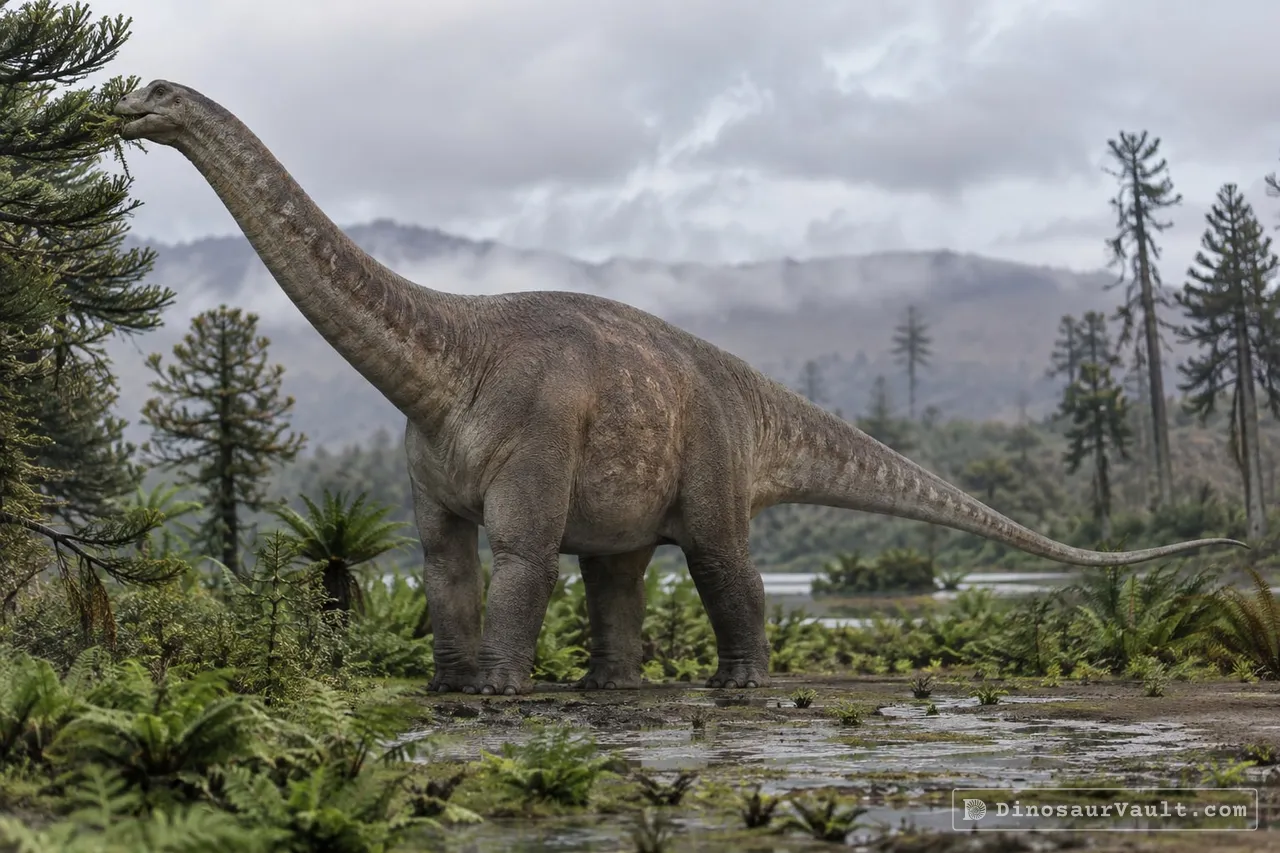
Arackar was a small titanosaur, a long-necked plant eater. It is known from bones of the neck, back, hips and legs.
Its world
It lived in the Late Cretaceous in what is now northern Chile.
How it was found
Rubilar-Rogers and colleagues named it in 2021. The type species is Arackar licanantay. Its name comes from a local language.
Field gallery
More views of Arackar
Scenes reconstructed from the available fossil evidence.
1 of 3
The evidence
The science behind Arackar
Which parts of the picture come from its own bones, and which come from its relatives.
From its own fossils
- One partial skeleton from a single animal: parts of two neck vertebrae, three back vertebrae, the right upper arm bone, the left thigh bone, a hip bone called the ischium, and fragments.
- Its back vertebrae set it apart from other titanosaurs, with hollows around the front joints and shortened ridges running from the spine to the rear joints.
- The two neck vertebrae are short and flattened top to bottom, and the upper arm bone is slender in the middle and widens at both ends.
Borrowed from relatives
- The missing skull is restored after titanosaurs whose heads are known, such as Tapuiasaurus and Rapetosaurus.
- The chest and shoulder are compared with Mnyamawamtuka, whose ribs, shoulder blade and arm bones are preserved.
- Rapetosaurus, known from a far more complete skeleton, guides the rest of the body, but it had a relatively longer neck than Arackar.
Still unknown
- Its adult size and full neck and tail proportions.
- The shape of its skull, hands and feet.
- Its closest relatives. The naming study's main analysis put it next to Isisaurus, a second dataset left its place unresolved, and a later study dropped it from one analysis as unstable.
Discovery timeline
- 2004Close relativeRogers & Forster
- 2009Close relativeRogers
- 2021Named itRubilar-Rogers et al.
Key papers
The research behind what we know of Arackar
Close relative
Described adult and young Rapetosaurus skulls with long snouts, a comparison for the missing head of Arackar.
The skull ofRapetosaurus krausei(Sauropoda: Titanosauria) from the Late Cretaceous of Madagascar. Journal of Vertebrate Paleontology 24: 121-144
Read the paper : The skull ofRapetosaurus krausei(Sauropoda: Titanosauria) from the Late Cretaceous of Madagascar (opens in a new tab)Close relative
Described a well-preserved young Rapetosaurus skeleton, providing a comparison for restoring the missing body parts of Arackar.
The postcranial osteology of Rapetosaurus krausei (Sauropoda: Titanosauria) from the Late Cretaceous of Madagascar. Journal of Vertebrate Paleontology 29: 1046-1086
Read the paper : The postcranial osteology of Rapetosaurus krausei (Sauropoda: Titanosauria) from the Late Cretaceous of Madagascar (opens in a new tab)Named it
Named a titanosaur from a partial subadult skeleton and placed it close to Isisaurus and Rapetosaurus.
Arackar licanantay gen. et sp. nov. a new lithostrotian (Dinosauria, Sauropoda) from the Upper Cretaceous of the Atacama Region, northern Chile. Cretaceous Research 124: 104802
Read the paper : Arackar licanantay gen. et sp. nov. a new lithostrotian (Dinosauria, Sauropoda) from the Upper Cretaceous of the Atacama Region, northern Chile (opens in a new tab)
Close relatives
Other members of Lithostrotia


Sources: Wikidata