Sanxiasaurus
"Three Gorges lizard"
- Lived
- 184 to 171 million years ago, Early Jurassic to Middle Jurassic
- Diet
- Herbivore
- Group
- Early ornithischians
- Found in
- China
- Named by
- Hu Dai et al. 2019
Where its fossils were found
The evidence
Today

180 million years ago
Habitat
Its bones were buried in lake sediments in China. Turtles, crocodiles, fish and freshwater reptiles inhabited this landscape, and Yunyangosaurus is known from the same formation.
Field notes
About Sanxiasaurus
What it was like
Sanxiasaurus was a small, two-legged plant eater, known from a partial skeleton of the body and limbs.
Its world
It lived in the Jurassic, between about 184 and 171 million years ago, in what is now southwestern China. Its bones come from the Xintiangou Formation, where it shared the land with the hunter Yunyangosaurus.
How it was found
Hu Dai and colleagues named Sanxiasaurus in 2019, from a single find.
Field gallery
More views of Sanxiasaurus
Scenes reconstructed from the available fossil evidence.
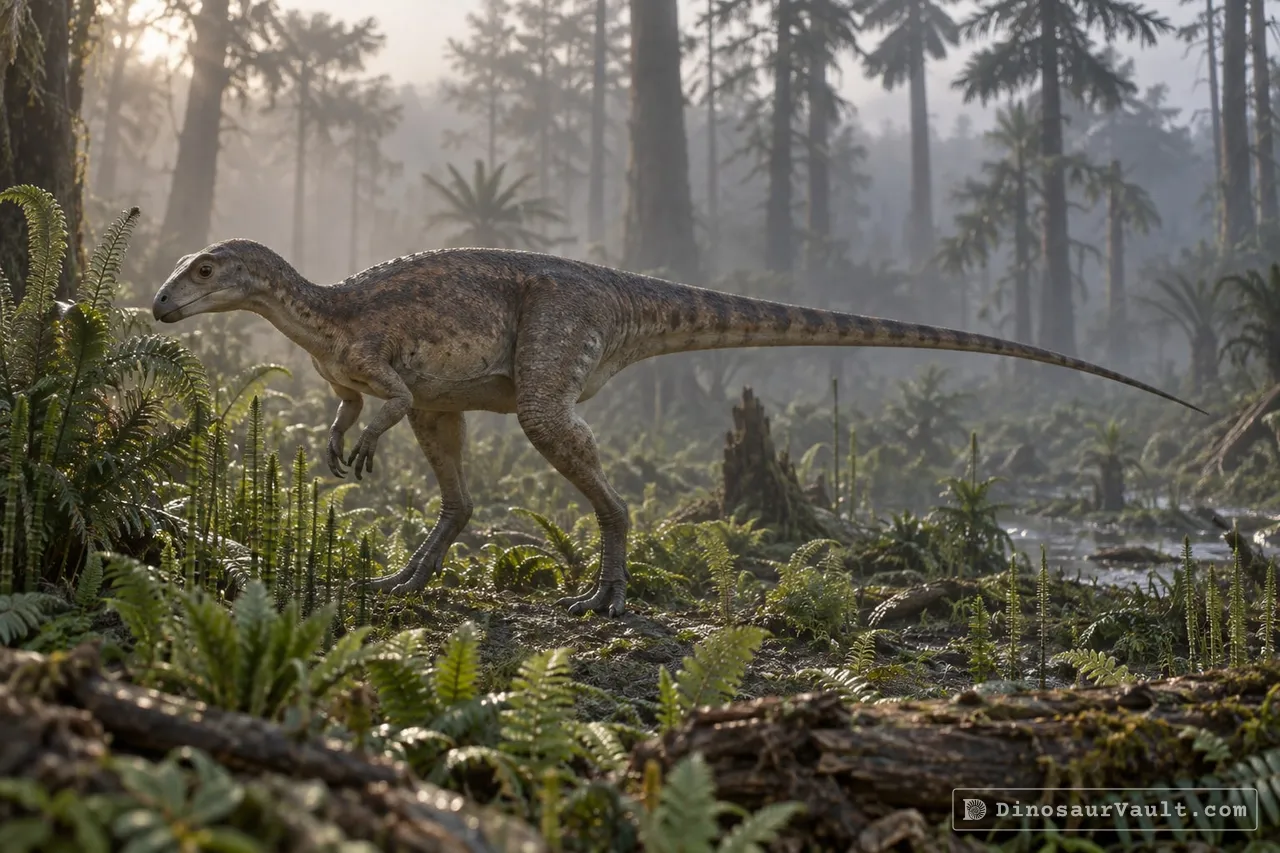
1 of 3
Lived alongside
Found in the same rock formations

A rock formation can hold fossils laid down millions of years apart, so not every animal here met Sanxiasaurus.
The evidence
The science behind Sanxiasaurus
Which parts of the picture come from its own bones, and which come from its relatives.
From its own fossils
- A partial skeleton, found scattered but probably from one animal, preserves bones from the neck, back and tail, along with parts of the hips, arms and legs. No skull or hand bones were found with it.
- The upper arm bone bows outward, the thigh bone bows forward, and the shin bone is long and slender.
- A broadened ridge near the top of the thigh bone and a projection halfway along a lower hip bone help set it apart from its relatives.
Borrowed from relatives
- The missing head is restored after Lesothosaurus, and the hands, knees, ankles and feet after Minimocursor.
- The missing end of the tail is restored after Pulaosaurus.
Still unknown
- The shape of its skull and teeth.
- Its adult size.
- Its closest relatives. One analysis paired it with Pulaosaurus, while others left its position unresolved.
Discovery timeline
- 2019Named itDai et al.
- 2023Close relativeManitkoon et al.
- 2025Family treeYang, King & Xu
Key papers
The research behind what we know of Sanxiasaurus
Named it
Described a partial skeleton of a small plant eater and placed it near the base of Neornithischia.
A neornithischian dinosaur from the Middle Jurassic Xintiangou Formation of Yunyang, Chongqing, China: the earliest record in Asia. Historical Biology.
No link available
Close relative
Described Minimocursor, another small early neornithischian, and compared the anatomy and early history of this group.
A New Basal Neornithischian Dinosaur from the Phu Kradung Formation (Upper Jurassic) of Northeastern Thailand. Diversity 15: 851
Read the paper : A New Basal Neornithischian Dinosaur from the Phu Kradung Formation (Upper Jurassic) of Northeastern Thailand (opens in a new tab)Family tree
One family-tree analysis placed Pulaosaurus as the closest relative of Sanxiasaurus.
A new neornithischian dinosaur from the Upper Jurassic Tiaojishan Formation of northern China. PeerJ 13: e19664
Read the paper : A new neornithischian dinosaur from the Upper Jurassic Tiaojishan Formation of northern China (opens in a new tab)
Close relatives
Other members of Neornithischia


Sources: Wikidata