Yamanasaurus
Type species Yamanasaurus lojaensis
- Lived
- 72 to 66 million years ago, Late Cretaceous
- Diet
- Herbivore
- Group
- Sauropods, Saltasauridae
- Found in
- Ecuador
- Named by
- Apesteguía et al. 2020
Where its fossils were found
The evidence
Today

70 million years ago
Habitat
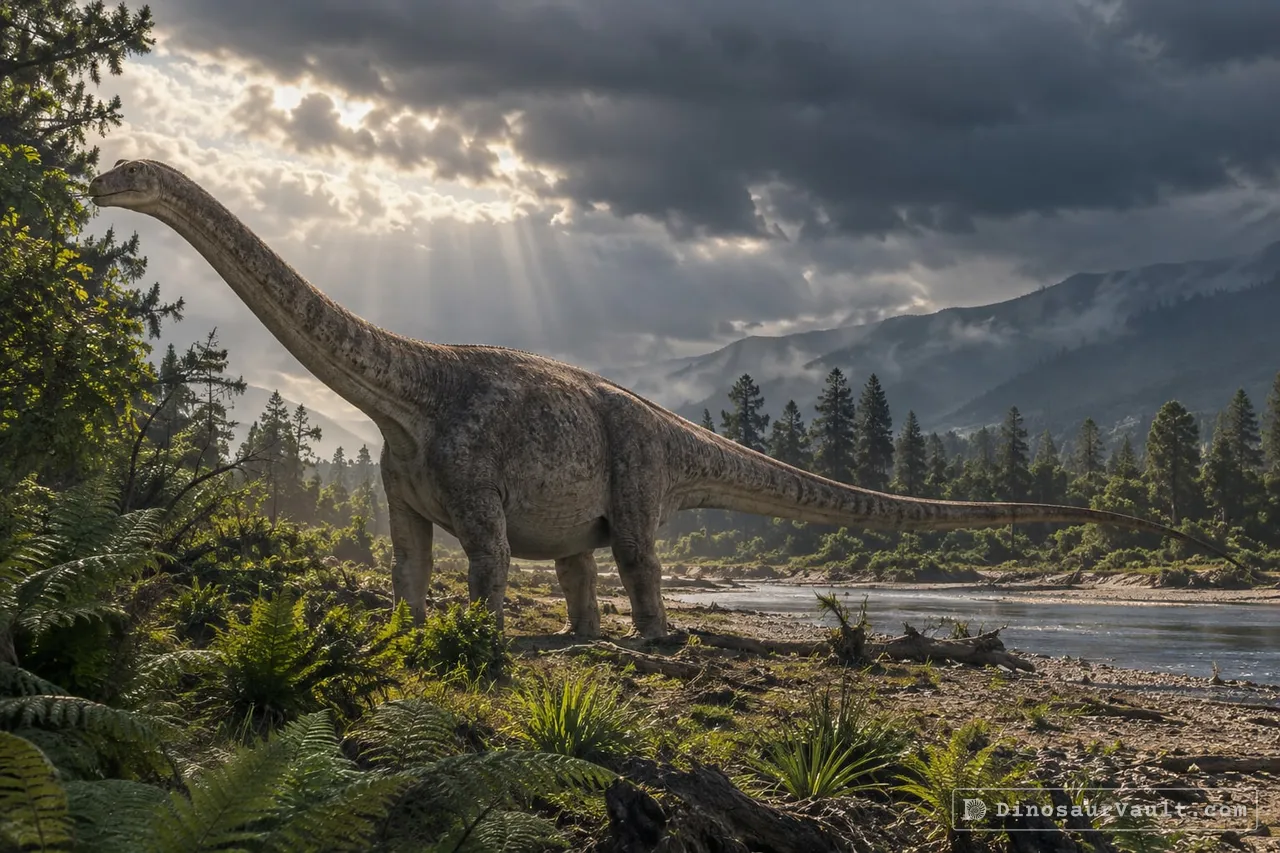
Yamanasaurus probably lived in a coastal landscape in what is now Ecuador, where sand and gravel accumulated near the sea.
Field notes
About Yamanasaurus
What it was like
Yamanasaurus was a titanosaur, a long-necked plant eater related to Saltasaurus. It is known from a few bones, including a back bone and a leg bone.
Its world
It lived about 72 to 66 million years ago, at the end of the Late Cretaceous, in what is now Ecuador. Its bones come from the Río Playas Formation.
How it was found
Apesteguía and colleagues named it in 2020. The type species is Yamanasaurus lojaensis. It was the first dinosaur named from Ecuador.
Field gallery
More views of Yamanasaurus
Scenes reconstructed from the available fossil evidence.
The evidence
The science behind Yamanasaurus
Which parts of the picture come from its own bones, and which come from its relatives.
From its own fossils
- The type includes fused hip vertebrae, part of a tail vertebra and limb fragments thought to belong to the same animal.
- Its tail vertebra had a flattened ball-shaped joint at the back. A later scan found dense bone inside its main body, rather than air chambers.
- The preserved arm bones are short and robust.
Borrowed from relatives
- Neuquensaurus guides the missing neck, trunk and tail, while Tapuiasaurus offers a comparison for the missing skull.
- Rapetosaurus offers comparisons for the missing hands and curved foot claws.
Still unknown
- Its full length and body proportions.
- Whether it had bony plates in its skin.
- Its skin color and markings.
Discovery timeline
- 2005Family treeSalgado, Apesteguía & Heredia
- 2010Family treeOtero
- 2020Named itApesteguía et al.
- 2026Inside the bonesBeeston et al.
Key papers
The research behind what we know of Yamanasaurus
Family tree
Described a Neuquensaurus skeleton with backbone, hip and limb bones, along with bony plates from its skin.
A new specimen ofNeuquensaurus australis, a Late Cretaceous saltasaurine titanosaur from north Patagonia. Journal of Vertebrate Paleontology 25: 623-634
Read the paper : A new specimen ofNeuquensaurus australis, a Late Cretaceous saltasaurine titanosaur from north Patagonia (opens in a new tab)Family tree
Described the limbs and hips of Neuquensaurus, an important comparison for the fragmentary bones of Yamanasaurus.
The Appendicular Skeleton ofNeuquensaurus, a Late Cretaceous Saltasaurine Sauropod from Patagonia, Argentina. Acta Palaeontologica Polonica 55: 399-426
Read the paper : The Appendicular Skeleton ofNeuquensaurus, a Late Cretaceous Saltasaurine Sauropod from Patagonia, Argentina (opens in a new tab)Named it
Described the first dinosaur bones from Ecuador and identified a titanosaur with similarities to Neuquensaurus.
The first dinosaur remains from the Cretaceous of Ecuador. Cretaceous Research 108: 104345
Read the paper : The first dinosaur remains from the Cretaceous of Ecuador (opens in a new tab)Inside the bones
Scans found dense bone inside the preserved Yamanasaurus tail vertebra, revising an earlier interpretation of air chambers.
Computed tomography reveals multiple origins of extreme caudal vertebral pneumaticity in sauropod dinosaurs. Journal of Anatomy
Read the paper : Computed tomography reveals multiple origins of extreme caudal vertebral pneumaticity in sauropod dinosaurs (opens in a new tab)
Close relatives
Other members of Saltasauridae


Sources: Wikidata