Volgatitan
"Volga titan"
- Lived
- 133 to 126 million years ago, Early Cretaceous
- Diet
- Herbivore
- Group
- Sauropods, Mamenchisauridae
- Found in
- Russia
- Named by
- Averianov and Efimov 2018
Where its fossils were found
The evidence
Today

130 million years ago
Habitat
It was a land-dwelling plant eater in Early Cretaceous western Russia. Its tail bones were buried in sea sediments.
Field notes
About Volgatitan
What it was like
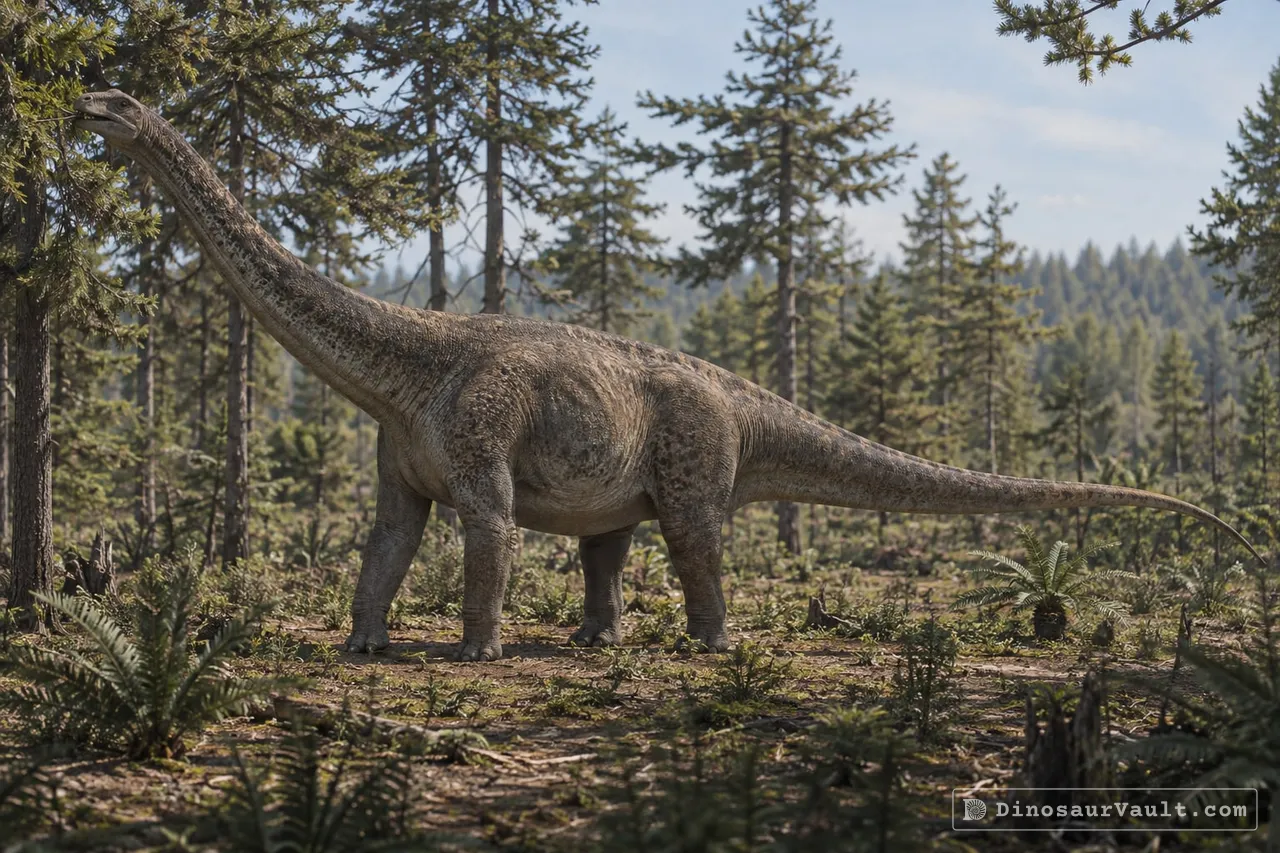
Volgatitan was a long-necked, four-legged plant eater known only from tail bones. It was first described as a titanosaur, but later study suggests it may be a relative of Mamenchisaurus instead.
Its world
It lived in the Early Cretaceous in what is now western Russia, near the river it was named after.
How it was found
Averianov and Efimov named Volgatitan in 2018, from a single find.
Field gallery
More views of Volgatitan
Scenes reconstructed from the available fossil evidence.
1 of 2
The evidence
The science behind Volgatitan
Which parts of the picture come from its own bones, and which come from its relatives.
From its own fossils
- A series of partial tail vertebrae belongs to a single animal.
- The tail vertebrae have deeply hollow front faces and rounded rear faces.
- Extra joints link the bony arches above the front tail vertebrae.
Borrowed from relatives
- Mamenchisaurus youngi is a possible comparison for the missing head, neck, trunk and upper limbs, if Volgatitan belongs with mamenchisaurids.
Still unknown
- Whether it belongs with Mamenchisaurus or with titanosaurs.
- Its neck length, head shape and complete body size.
- Its skin texture and color.
Discovery timeline
- 2018Named itAverianov & Efimov
- 2023Family treeMoore et al.
- 2026Family treeMannion & Carvalho
Key papers
The research behind what we know of Volgatitan
Named it
Described tail vertebrae from Russia and proposed that Volgatitan was an early titanosaur.
The oldest titanosaurian sauropod of the Northern Hemisphere. Biological Communications 63: 145-162
No link available
Family tree
Studied neck bones and relationships of mamenchisaurids, the group Volgatitan may belong to.
Re-assessment of the Late Jurassic eusauropod Mamenchisaurus sinocanadorum Russell and Zheng, 1993, and the evolution of exceptionally long necks in mamenchisaurids. Journal of Systematic Palaeontology 21
Read the paper : Re-assessment of the Late Jurassic eusauropod Mamenchisaurus sinocanadorum Russell and Zheng, 1993, and the evolution of exceptionally long necks in mamenchisaurids (opens in a new tab)Family tree
Placed Volgatitan among mamenchisaurids under different weighting methods, while calling for further tests of its relationships.
Re-evaluation of the Early Cretaceous titanosauriform sauropod dinosaur Triunfosaurus leonardii from the Triunfo Basin, Brazil: implications for the initial radiations of Somphospondyli and Titanosauria. Zoological Journal of the Linnean Society 207
Read the paper : Re-evaluation of the Early Cretaceous titanosauriform sauropod dinosaur Triunfosaurus leonardii from the Triunfo Basin, Brazil: implications for the initial radiations of Somphospondyli and Titanosauria (opens in a new tab)
Close relatives
Other members of Mamenchisauridae


Sources: Wikidata