Minimocursor
"smallest runner"
- Lived
- 149 to 137 million years ago, Late Jurassic to Early Cretaceous
- Diet
- Herbivore
- Group
- Early ornithischians
- Found in
- Thailand
- Named by
- Manitkoon et al. 2023
Where its fossils were found
The evidence
Today

145 million years ago
Habitat
Rivers crossed a floodplain with ponds and abandoned river channels in the Phu Kradung Formation. Long-necked neighbors included Mamenchisaurus and Uragasaurus.
Field notes
About Minimocursor
What it was like
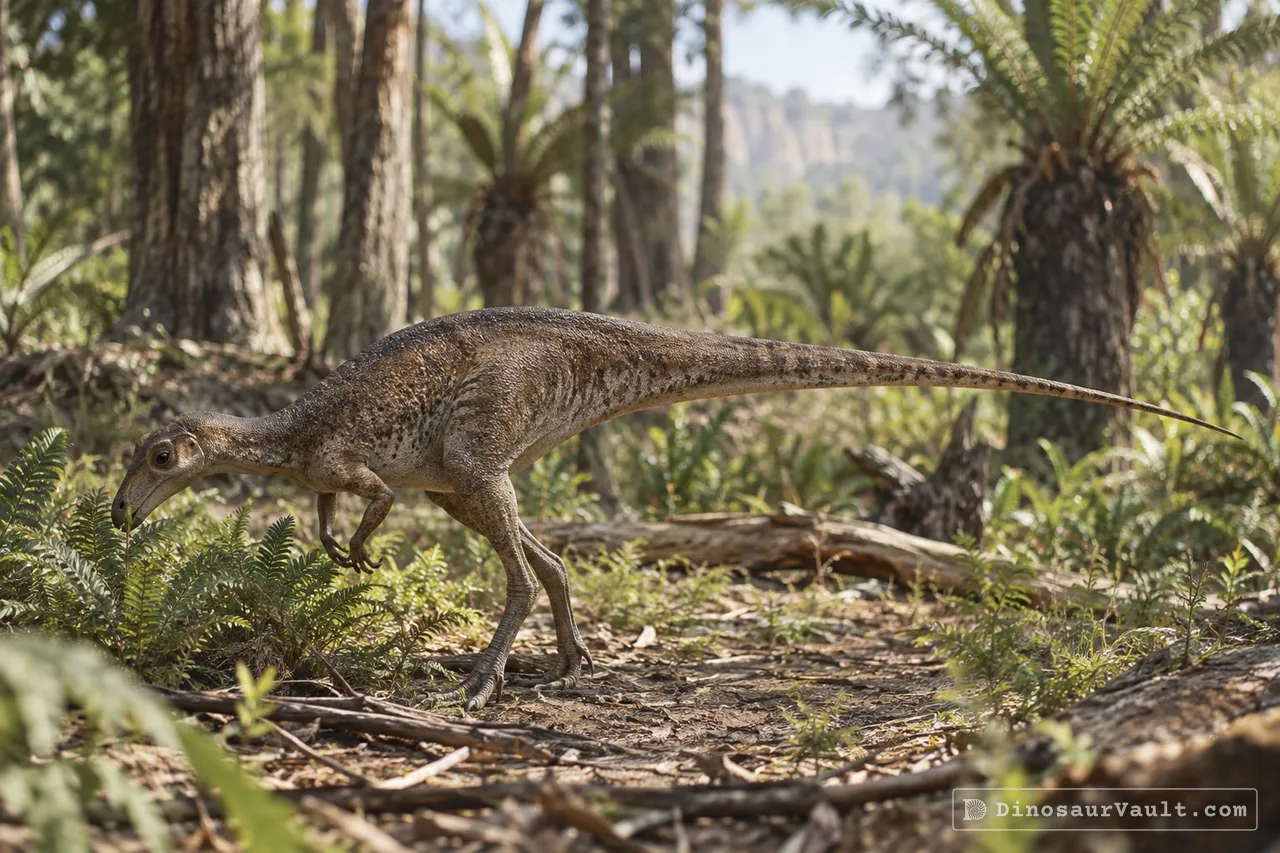
Minimocursor was a small, two-legged plant eater known from a nearly complete skeleton. It had long legs and a long tail and was probably a quick runner.
Its world
It lived in the Late Jurassic or Early Cretaceous in what is now Thailand. Its bones come from the Phu Kradung Formation, where the long-necked Uragasaurus also lived.
How it was found
Manitkoon and colleagues named it in 2023. It is one of the best preserved small bird-hipped dinosaurs from that part of Asia.
Field gallery
More views of Minimocursor
Scenes reconstructed from the available fossil evidence.
1 of 3
Lived alongside
Found in the same rock formations


A rock formation can hold fossils laid down millions of years apart, so not every animal here met Minimocursor.
The evidence
The science behind Minimocursor
Which parts of the picture come from its own bones, and which come from its relatives.
From its own fossils
- A well-preserved skeleton retains much of the backbone, the hips, a hand and the hind legs, along with a few skull bones.
- The cheek bone has a small outward swelling below the eye.
- Open seams in the vertebrae show that the first described skeleton was still growing.
Borrowed from relatives
- The missing parts of the skull are restored by comparison with small plant eaters such as Agilisaurus and Hexinlusaurus.
Still unknown
- The complete shape of its skull.
- Its skin covering and color.
- Its growth from hatchling to adult.
Discovery timeline
- 2021Close relativeBarta & Norell
- 2023Named itManitkoon et al.
- 2023Same rocksTong et al.
Key papers
The research behind what we know of Minimocursor
Close relative
Described the skeleton and growth of Haya, a small plant eater used in anatomical comparisons with Minimocursor.
The Osteology of Haya griva (Dinosauria: Ornithischia) from the Late Cretaceous of Mongolia. Bulletin of the American Museum of Natural History 445
Read the paper : The Osteology of Haya griva (Dinosauria: Ornithischia) from the Late Cretaceous of Mongolia (opens in a new tab)Named it
Described a small plant eater from a well-preserved young skeleton with a cheek swelling and detailed hand and foot bones.
A New Basal Neornithischian Dinosaur from the Phu Kradung Formation (Upper Jurassic) of Northeastern Thailand. Diversity 15: 851
Read the paper : A New Basal Neornithischian Dinosaur from the Phu Kradung Formation (Upper Jurassic) of Northeastern Thailand (opens in a new tab)Same rocks
Described freshwater turtle shells from the same fossil site and outlined a landscape of river channels, floodplains, ponds and abandoned channels.
New material of turtles from the Upper Jurassic of Phu Noi, NE Thailand: Phylogenetic implications. Annales de Paléontologie 109: 102656
Read the paper : New material of turtles from the Upper Jurassic of Phu Noi, NE Thailand: Phylogenetic implications (opens in a new tab)
Close relatives
Other members of Neornithischia


Sources: Wikidata