Tonganosaurus
- Lived
- 201 to 175 million years ago, Early Jurassic
- Diet
- Herbivore
- Group
- Sauropods, Mamenchisauridae
- Found in
- China
- Named by
- Li et al. 2010
Where its fossils were found
The evidence
Today

190 million years ago
Habitat
Its fossils come from the Yimen Formation in China, in rocks assigned to the Early Jurassic.
Field notes
About Tonganosaurus
What it was like
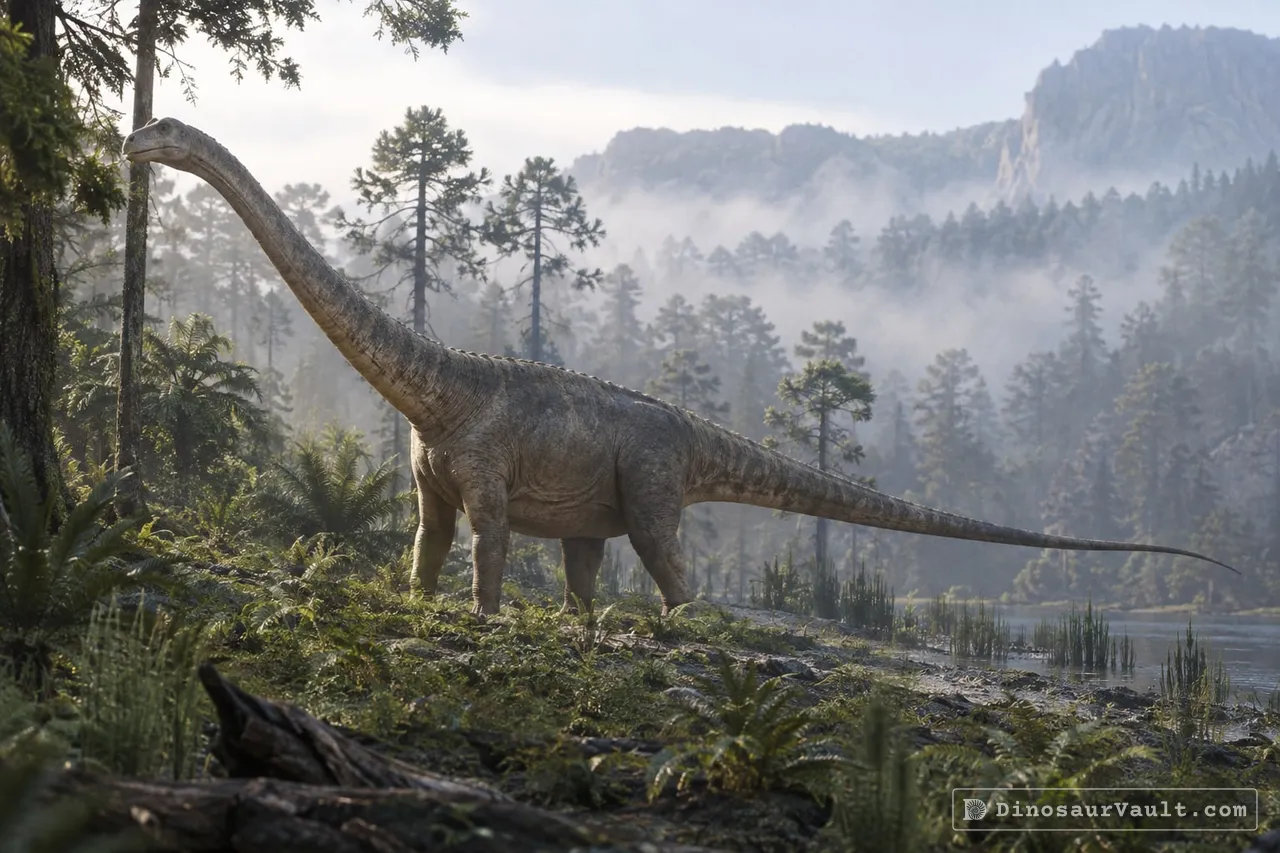
Tonganosaurus was a mamenchisaurid, a long-necked sauropod related to Omeisaurus. It is known from part of the skeleton.
Its world
It lived in the Early Jurassic, in what is now China. It comes from the Yimen Formation. It is one of the oldest known mamenchisaurids.
How it was found
Li and colleagues named Tonganosaurus in 2010. Its name comes from the town where it was found.
Field gallery
More views of Tonganosaurus
Scenes reconstructed from the available fossil evidence.
1 of 2
The evidence
The science behind Tonganosaurus
Which parts of the picture come from its own bones, and which come from its relatives.
From its own fossils
- The type material includes vertebrae, right shoulder and arm bones, a pair of ischia, leg bones, foot bones and a foot claw. The authors inferred that they belong to one animal.
- Its neck vertebrae were elongated and had hollows along their sides.
- Its upper arm and thigh bones were robust and straight, while the radius was slender beside the ulna. A preserved foot claw has a curved point and a stout, rounded cross section.
Borrowed from relatives
- Its missing neck, trunk, hips and tail are restored after Mamenchisaurus youngi, the missing foot bones after Rhoetosaurus, and the missing hand ends after Tazoudasaurus.
- Its missing head is restored after Mamenchisaurus youngi.
Still unknown
- The shape of its skull and teeth.
- The full length and proportions of its neck.
- Its skin color.
Discovery timeline
- 2010Named itLi et al.
- 2023Family treeMoore et al.
- 2023Inside the bonesAn et al.
Key papers
The research behind what we know of Tonganosaurus
Named it
Described a partial sauropod skeleton and linked Tonganosaurus to Omeisaurus through the shapes of its neck and tail vertebrae.
[A new sauropod from the Lower Jurassic of Huili, Sichuan, China]. Vertebrata PalAsiatica 48: 185-202
No link available
Family tree
Reexamined Mamenchisaurus and explored how air-filled bones and long neck ribs helped its relatives evolve exceptionally long necks.
Re-assessment of the Late Jurassic eusauropod Mamenchisaurus sinocanadorum Russell and Zheng, 1993, and the evolution of exceptionally long necks in mamenchisaurids. Journal of Systematic Palaeontology 21
Read the paper : Re-assessment of the Late Jurassic eusauropod Mamenchisaurus sinocanadorum Russell and Zheng, 1993, and the evolution of exceptionally long necks in mamenchisaurids (opens in a new tab)Inside the bones
Compared a young sauropod's neck vertebrae with Tonganosaurus, whose vertebrae were longer and lacked partitions in their side hollows.
A new juvenile sauropod specimen from the Middle Jurassic Dongdaqiao Formation of East Tibet. PeerJ 11: e14982
Read the paper : A new juvenile sauropod specimen from the Middle Jurassic Dongdaqiao Formation of East Tibet (opens in a new tab)
Close relatives
Other members of Mamenchisauridae


Sources: Wikidata