Tiamat
Type species Tiamat valdecii
- Lived
- 113 to 94 million years ago, Early Cretaceous to Late Cretaceous
- Diet
- Herbivore
- Group
- Sauropods
- Found in
- Brazil
- Named by
- Pereira et al. 2024
Where its fossils were found
The evidence
Today

105 million years ago
Habitat
Rivers, floodplains and tidal estuaries in what is now northeastern Brazil. Other fossils from these rocks include rebbachisaurid sauropods, spinosaurs and megaraptoran hunters.
Field notes
About Tiamat
What it was like
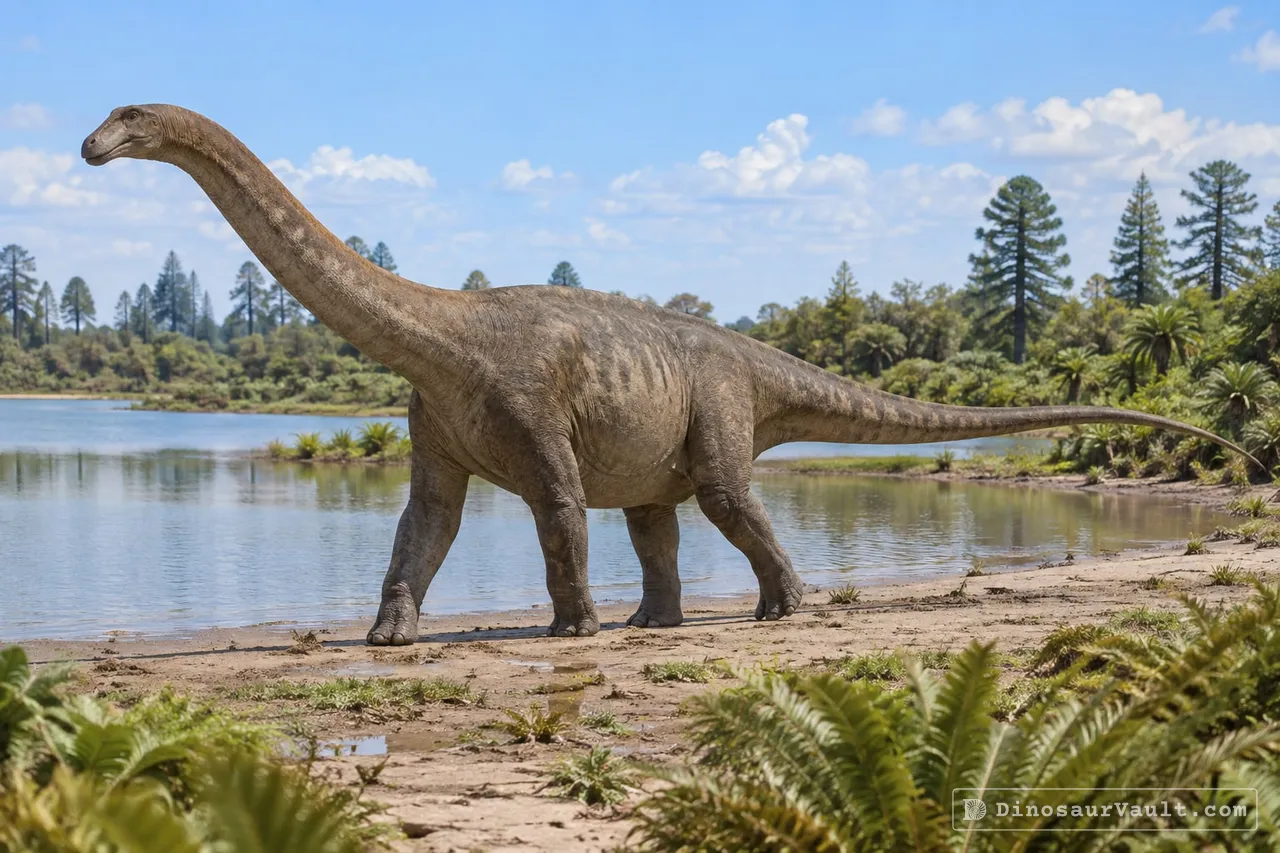
Tiamat was a titanosaur, a long-necked plant eater. It is known from part of one skeleton.
Its world
It lived in the Cretaceous, in what is now Brazil. It comes from the Açu Formation.
How it was found
Pereira and colleagues named Tiamat in 2024. The type species is Tiamat valdecii. The name comes from a goddess of ancient myth.
Field gallery
More views of Tiamat
Scenes reconstructed from the available fossil evidence.
1 of 2
The evidence
The science behind Tiamat
Which parts of the picture come from its own bones, and which come from its relatives.
From its own fossils
- Associated vertebrae preserve parts of the front and middle of the tail.
- The tail bones have extra bumps and deeply hollowed joint surfaces that helped stabilize the tail as it bent sideways.
- A preserved tail spine is low, elongated and robust.
Borrowed from relatives
- Its missing shoulders, pelvis and legs are restored after Mnyamawamtuka, and its missing forearms and hands after Camarasaurus and Apatosaurus.
- Its missing skull is restored by comparison with Tapuiasaurus.
- Its missing neck is restored after Futalognkosaurus and Mnyamawamtuka.
Still unknown
- Its complete body size, head shape and the full length of its tail.
- Whether a bony skin plate found in the same rocks belongs to Tiamat.
- Its color.
Discovery timeline
- 2011Family treeMANNION & CALVO
- 2020Same rocksPereira et al.
- 2024Named itPereira et al.
Key papers
The research behind what we know of Tiamat
Family tree
Redescribed the vertebrae, limbs and pelvis of Andesaurus, an early titanosaur that the naming study compared with Tiamat.
Anatomy of the basal titanosaur (Dinosauria, Sauropoda) Andesaurus delgadoi from the mid-Cretaceous (Albian-early Cenomanian) Río Limay Formation, Neuquén Province, Argentina: implications for titanosaur systematics. Zoological Journal of the Linnean Society: no-no
Read the paper : Anatomy of the basal titanosaur (Dinosauria, Sauropoda) Andesaurus delgadoi from the mid-Cretaceous (Albian-early Cenomanian) Río Limay Formation, Neuquén Province, Argentina: implications for titanosaur systematics (opens in a new tab)Same rocks
Identified several groups of meat-eating dinosaurs from isolated teeth and vertebrae in the rocks that also contain Tiamat.
Theropod (Dinosauria) diversity from the Açu Formation (mid-Cretaceous), Potiguar Basin, Northeast Brazil. Cretaceous Research 114: 104517
Read the paper : Theropod (Dinosauria) diversity from the Açu Formation (mid-Cretaceous), Potiguar Basin, Northeast Brazil (opens in a new tab)Named it
Named Tiamat from tail bones, placed it among early titanosaurs and studied how its unusual joints stabilized the tail.
A new sauropod species from north-western Brazil: biomechanics and the radiation of Titanosauria (Sauropoda: Somphospondyli). Zoological Journal of the Linnean Society 202
Read the paper : A new sauropod species from north-western Brazil: biomechanics and the radiation of Titanosauria (Sauropoda: Somphospondyli) (opens in a new tab)
Close relatives
Other members of Titanosauria


Sources: Wikidata