Laquintasaura
"La Quinta lizard"
- Lived
- 201 to 200 million years ago, Early Jurassic
- Diet
- Herbivore
- Found in
- Venezuela
- Named by
- Barrett et al. 2014
Where its fossils were found
The evidence
Today

200 million years ago
Habitat
A tropical river plain near the equator had alternating wet and dry seasons. Tachiraptor lived in the same part of the La Quinta Formation.
Field notes
About Laquintasaura
What it was like
Laquintasaura was a small plant eater, about the size of a small dog. It walked on two legs and had teeth with rough edges for slicing plants.
It is one of the earliest members of the line that later produced armored dinosaurs such as Stegosaurus and Ankylosaurus.
Its world
It lived about 201 to 200 million years ago, at the very start of the Early Jurassic, in what is now Venezuela. Its bones come from the La Quinta Formation.
How it was found
Barrett and colleagues named Laquintasaura in 2014. It was the first dinosaur named from Venezuela. The bones of several animals were found together, which suggests it may have lived in groups.
Field gallery
More views of Laquintasaura
Scenes reconstructed from the available fossil evidence.
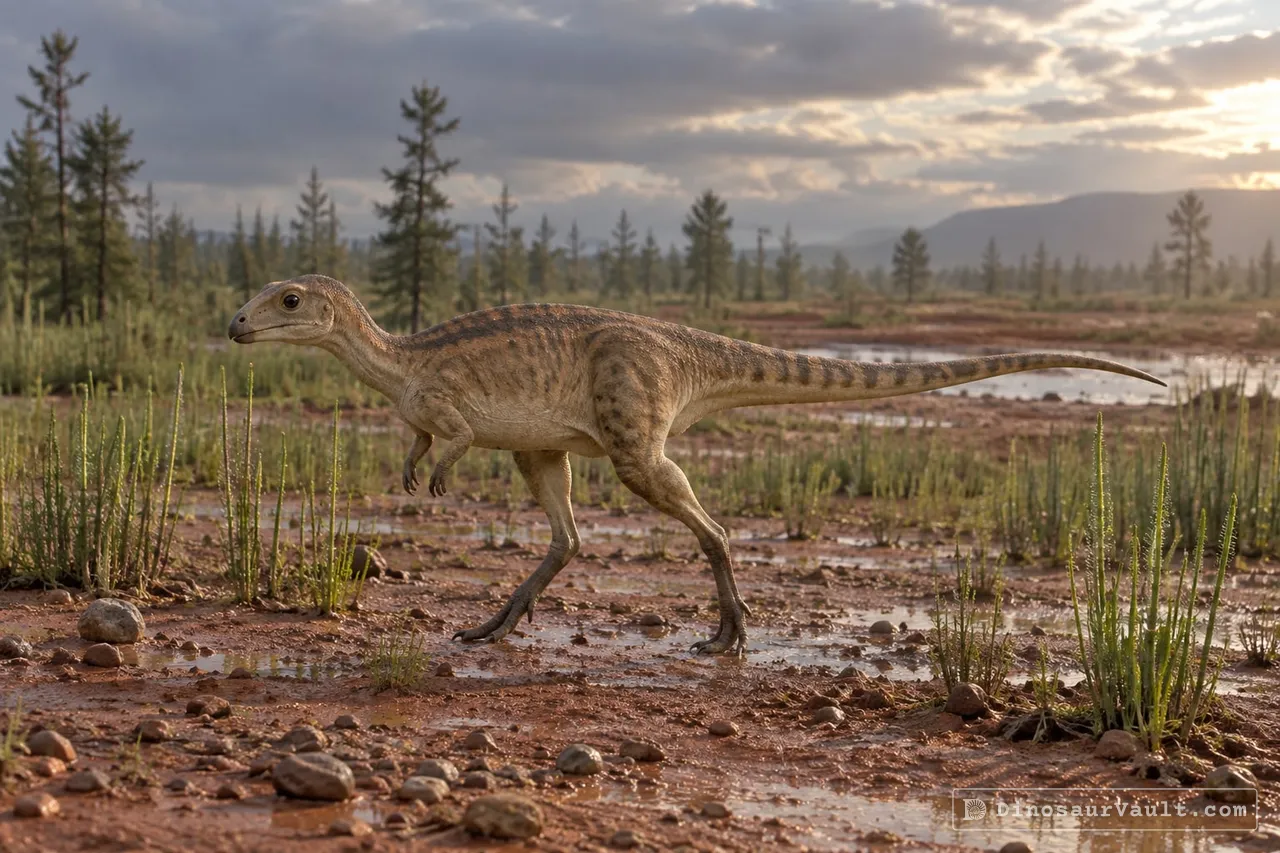
1 of 3
The evidence
The science behind Laquintasaura
Which parts of the picture come from its own bones, and which come from its relatives.
From its own fossils
- Hundreds of bones and teeth from several animals in a bonebed include skull fragments, vertebrae, shoulder blades, hips and hind legs assigned to Laquintasaura.
- Its tall, triangular tooth crowns have coarse serrations and ridges running down their surfaces.
- A left premaxilla, a bone at the front of the upper jaw, preserves a narrow mouth margin and a small nostril opening.
Borrowed from relatives
- Missing parts of the skull and lower jaw are restored by comparison with Lesothosaurus.
- The missing upper arms and forearms are restored by comparison with Agilisaurus, and the hands with Minimocursor.
Still unknown
- Its complete skull shape and exact place among the earliest plant-eating dinosaurs.
- Whether its diet included small animals as well as plants.
- Its skin covering and color.
Discovery timeline
- 2014Named itBarrett et al.
- 2014Same rocksLanger et al.
- 2025Family treeYao et al.
Key papers
The research behind what we know of Laquintasaura
Named it
Named Laquintasaura from a bonebed of small plant eaters near the ancient equator, with bones from young animals and adults.
A palaeoequatorial ornithischian and new constraints on early dinosaur diversification. Proceedings of the Royal Society B: Biological Sciences 281: 20141147
Read the paper : A palaeoequatorial ornithischian and new constraints on early dinosaur diversification (opens in a new tab)Same rocks
Described a small meat eater from the same local rock sequence and documented a seasonal tropical river plain.
New dinosaur (Theropoda, stem -Averostra) from the earliest Jurassic of the La Quinta formation, Venezuelan Andes. Royal Society Open Science 1
Read the paper : New dinosaur (Theropoda, stem -Averostra) from the earliest Jurassic of the La Quinta formation, Venezuelan Andes (opens in a new tab)Family tree
Recovered Laquintasaura and Lesothosaurus as early members of the armored-dinosaur line in a broader analysis of early plant eaters.
New evidence for the earliest ornithischian dinosaurs from Asia. iScience 28: 111641
Read the paper : New evidence for the earliest ornithischian dinosaurs from Asia (opens in a new tab)
Close relatives
Other members of Thyreophora


Sources: Wikidata