Qingxiusaurus
- Lived
- 101 to 66 million years ago, Late Cretaceous
- Diet
- Herbivore
- Group
- Sauropods, Saltasauridae
- Found in
- China
- Named by
- Mo et al. 2008
Where its fossils were found
The evidence
Today

80 million years ago
Habitat
It lived on land in southern China, where red sediments buried its bones. Nanningosaurus, a duck-billed plant eater, also lived in this region during the Late Cretaceous.
Field notes
About Qingxiusaurus
What it was like
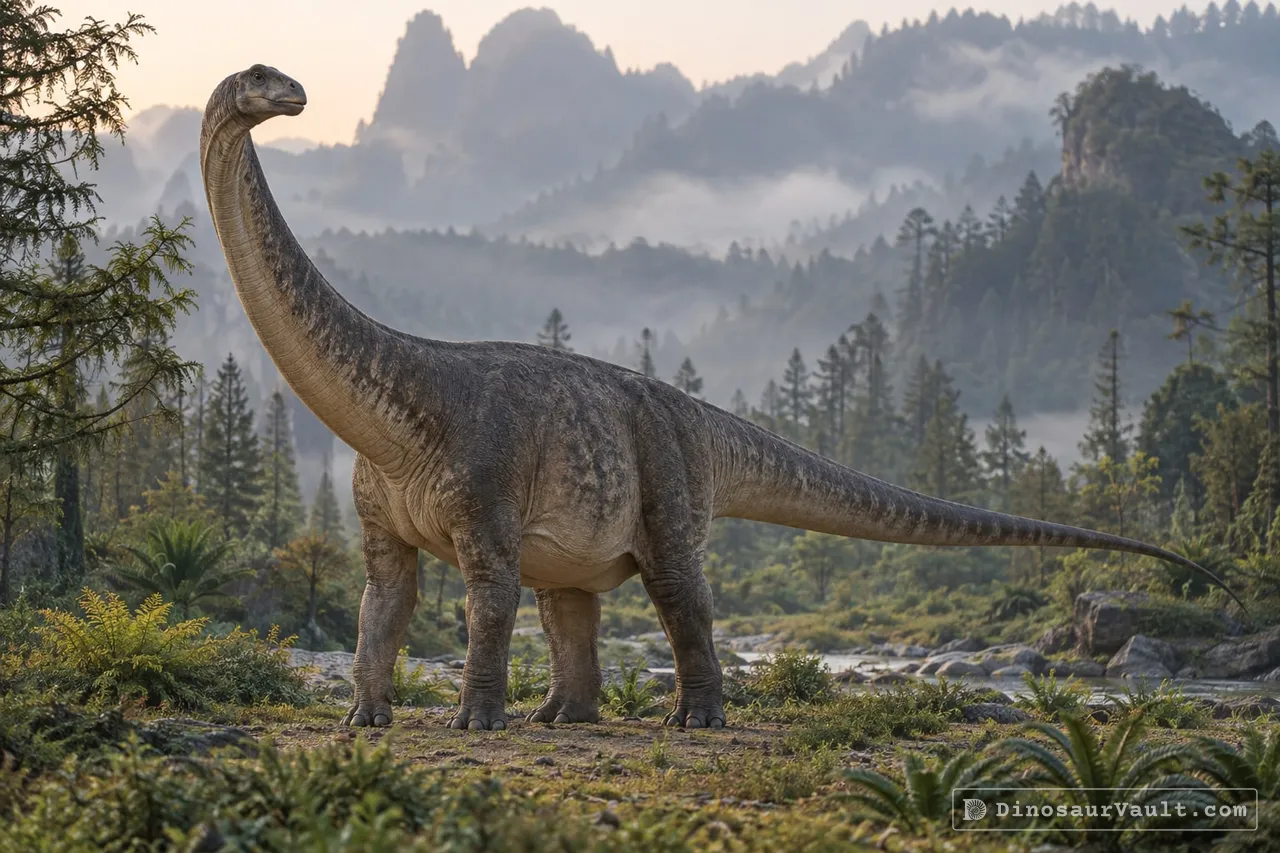
Qingxiusaurus was a titanosaur, a long-necked plant eater. It is known from two upper arm bones, two breastbone plates and a spine from a tail vertebra.
Its world
It lived in the Late Cretaceous, in what is now China.
How it was found
Mo and colleagues named Qingxiusaurus in 2008.
Field gallery
More views of Qingxiusaurus
Scenes reconstructed from the available fossil evidence.
1 of 3
The evidence
The science behind Qingxiusaurus
Which parts of the picture come from its own bones, and which come from its relatives.
From its own fossils
- The known bones, from one partial skeleton, include a pair of upper arm bones, a pair of breastbone plates and a spine from a vertebra near the front of the tail.
- The tail spine is tall and paddle-shaped, with a simple structure and a rounded top.
- The upper arm bones are broad at the top, with a prominent ridge for the chest muscles. The breastbone plates are short compared with them.
Borrowed from relatives
- The missing head is restored by comparison with Tapuiasaurus, and the neck, body, legs and tail with Mnyamawamtuka.
- The hands follow those of other sauropods such as Camarasaurus and Apatosaurus.
Still unknown
- The shape of its skull, the length of its neck and its full size.
- Its skin covering and color.
- Its exact relationships. The scientists who named it tentatively placed it close to Saltasaurus and its relatives, and said more fossils are needed.
Discovery timeline
- 2007Its worldJinyou et al.
- 2008Named itMo et al.
- 2019Close relativeHan et al.
Key papers
The research behind what we know of Qingxiusaurus
Its world
Described Nanningosaurus, a duck-billed plant eater from Late Cretaceous red beds in southern China.
The First Hadrosaurid Dinosaur from Southern China. Acta Geologica Sinica - English Edition 81: 550-554
Read the paper : The First Hadrosaurid Dinosaur from Southern China (opens in a new tab)Named it
Named Qingxiusaurus from upper arm bones, breastbone plates and a tall, paddle-shaped tail spine.
A new titanosaur (Dinosauria: Sauropoda) from the Late Cretaceous of Guangxi, China. Vertebrata PalAsiatica 46: 147-156
No link available
Close relative
Compared newly found sauropod arm bones from southern China with Qingxiusaurus, including the prominent muscle ridge on its upper arm bone.
New titanosauriform (Dinosauria: Sauropoda) specimens from the Upper Cretaceous Daijiaping Formation of southern China. PeerJ 7: e8237
Read the paper : New titanosauriform (Dinosauria: Sauropoda) specimens from the Upper Cretaceous Daijiaping Formation of southern China (opens in a new tab)
Close relatives
Other members of Saltasauridae


Sources: Wikidata