Mongolosaurus
"Mongolia lizard"
- Lived
- 121 to 101 million years ago, Early Cretaceous
- Diet
- Herbivore
- Group
- Sauropods
- Found in
- China
- Named by
- Gilmore 1933
Where its fossils were found
The evidence
Today

110 million years ago
Habitat
It lived on land in northern China during the Early Cretaceous. Its fossils come from the On Gong Formation.
Field notes
About Mongolosaurus
What it was like
Mongolosaurus was a long-necked, four-legged plant eater, known from teeth, part of the skull and a few neck bones. Its teeth were long and pencil-shaped.
Its world
It lived in the Early Cretaceous in what is now northern China. Its fossils come from the On Gong Formation.
How it was found
Gilmore named Mongolosaurus in 1933, from a single find.
Field gallery
More views of Mongolosaurus
Scenes reconstructed from the available fossil evidence.
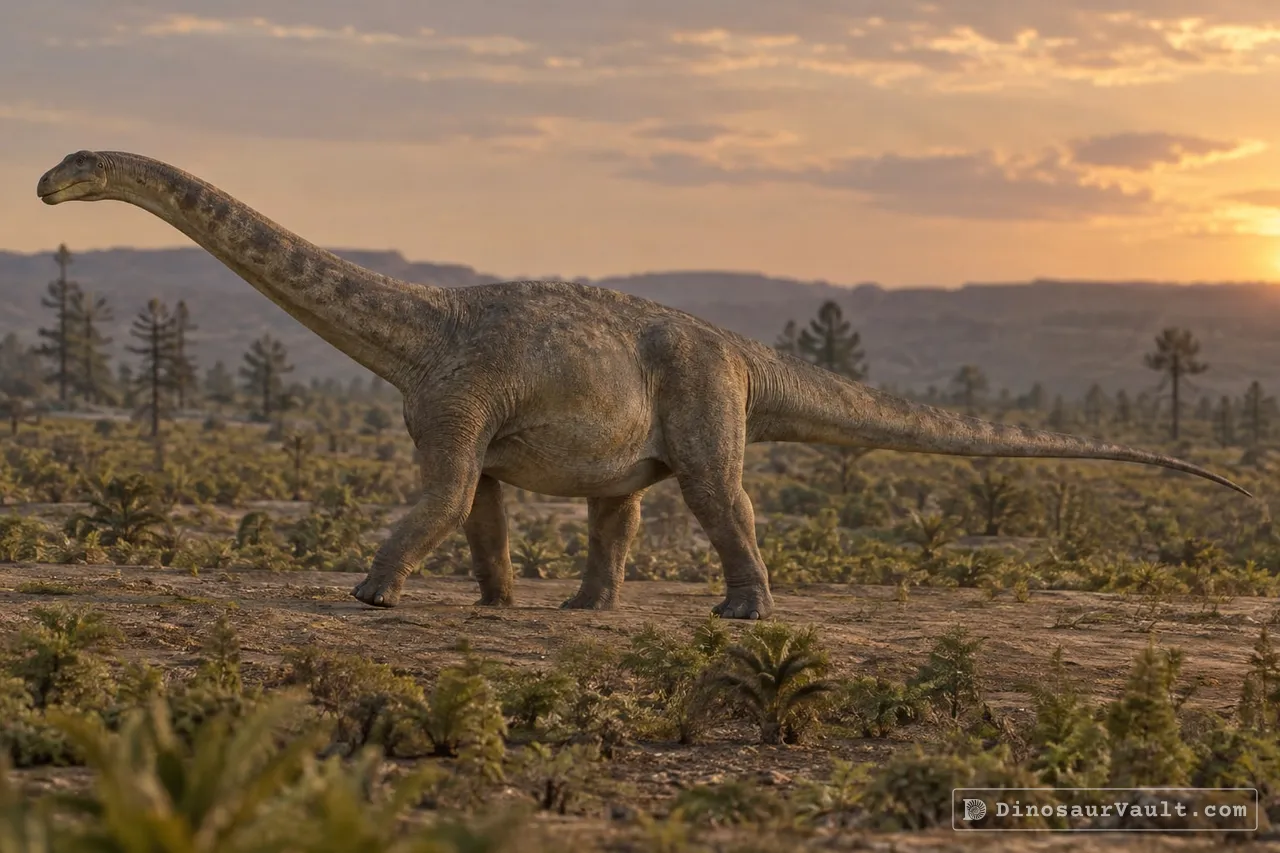
The evidence
The science behind Mongolosaurus
Which parts of the picture come from its own bones, and which come from its relatives.
From its own fossils
- Its fossils consist of teeth, the base of the skull and the first few neck vertebrae.
- The slender tooth crowns taper toward their tips, with low ridges along their edges.
- The preserved neck bones have low spines and a distinctive arrangement of supporting bony ridges.
Borrowed from relatives
- The missing trunk, legs and tail are restored from other titanosauriform sauropods, such as Andesaurus.
Still unknown
- Its exact position among titanosauriform sauropods.
- Its full body proportions and adult size.
- The detailed landscape around its fossil site.
Discovery timeline
- 1933Named itGilmore
- 2011RedescriptionMannion
- 2012Family treeD'EMIC
Key papers
The research behind what we know of Mongolosaurus
Named it
Named Mongolosaurus from unusual teeth found with skull and neck bones.
Two new dinosaurian reptiles from Mongolia with notes on some fragmentary specimens. American Museum Novitates 679: 1-20
No link available
Redescription
Restudied the skull and neck bones, found distinctive features supporting Mongolosaurus as a valid genus, and argued for titanosaur relationships.
A reassessment ofMongolosaurus haplodonGilmore, 1933, a titanosaurian sauropod dinosaur from the Early Cretaceous of Inner Mongolia, People's Republic of China. Journal of Systematic Palaeontology 9: 355-378
Read the paper : A reassessment ofMongolosaurus haplodonGilmore, 1933, a titanosaurian sauropod dinosaur from the Early Cretaceous of Inner Mongolia, People's Republic of China (opens in a new tab)Family tree
Compared early titanosauriforms and established skeletal features for distinguishing their main branches, providing a framework for assessing fragmentary genera such as Mongolosaurus.
The early evolution of titanosauriform sauropod dinosaurs. Zoological Journal of the Linnean Society 166: 624-671
Read the paper : The early evolution of titanosauriform sauropod dinosaurs (opens in a new tab)
Close relatives
Other members of Titanosauria


Sources: Wikidata