Malarguesaurus
"Malargüe lizard"
- Lived
- 90 to 86 million years ago, Late Cretaceous
- Diet
- Herbivore
- Group
- Sauropods
- Found in
- Argentina
- Named by
- González Riga et al. 2009
Where its fossils were found
The evidence
Today

90 million years ago
Habitat
A floodplain crossed by winding rivers in what is now western Argentina, with episodes of dry weather.
Field notes
About Malarguesaurus
What it was like
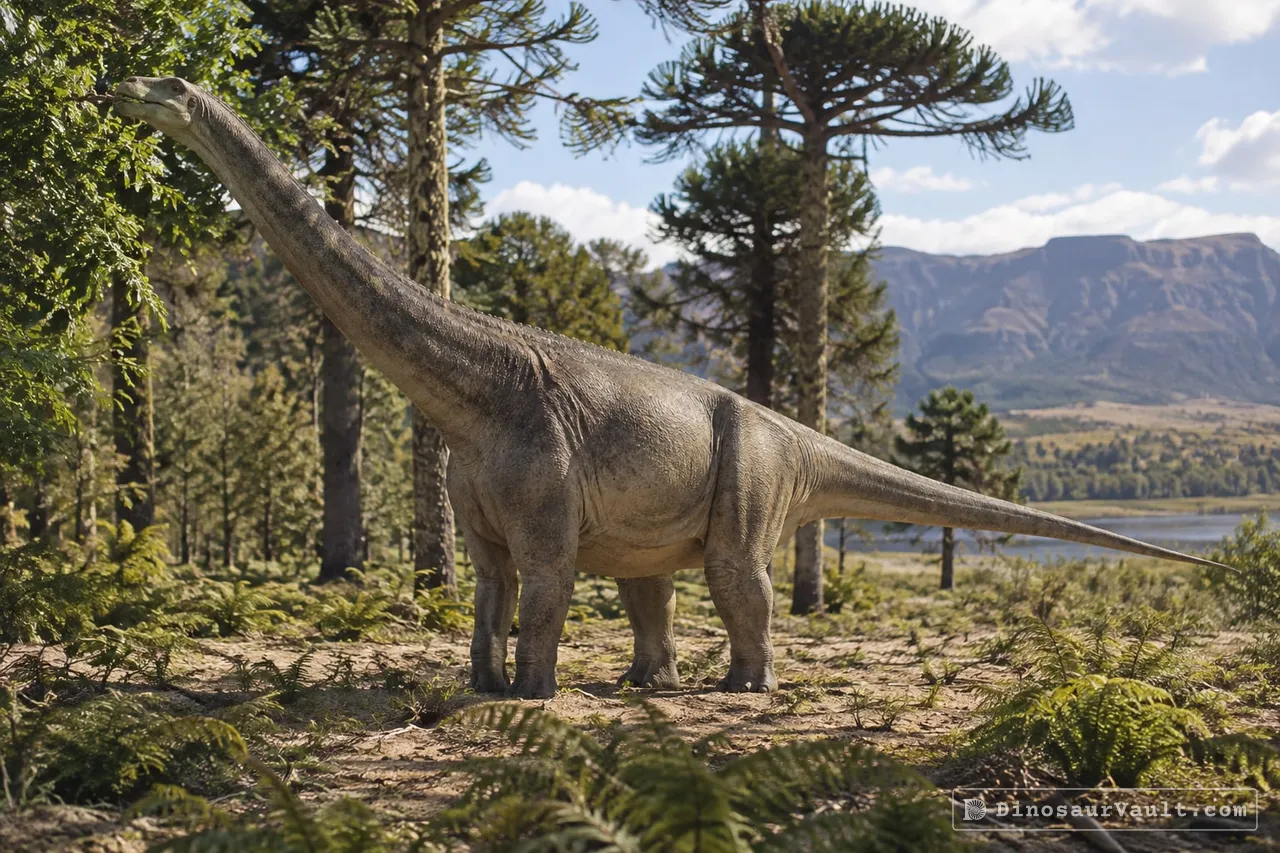
Malarguesaurus was a long-necked, four-legged plant eater, a relative of the titanosaurs. It is known from tail bones, ribs and limb bones.
Its world
It lived in the Late Cretaceous in what is now western Argentina. Its bones come from the Los Bastos Formation.
How it was found
González Riga and colleagues named Malarguesaurus in 2009. Two finds are known.
Field gallery
More views of Malarguesaurus
Scenes reconstructed from the available fossil evidence.
1 of 3
The evidence
The science behind Malarguesaurus
Which parts of the picture come from its own bones, and which come from its relatives.
From its own fossils
- The type skeleton includes tail vertebrae, bones from beneath the tail, ribs and parts of the upper arm and thigh. A separate referred specimen preserves tail bones and part of a lower leg bone.
- Distal tail vertebrae in the separately referred specimen have a hollow front face and a rounded rear face. The type skeleton has relatively tall bony spines near the tail base.
- Microscopic sections of its limb bones show fast-growing tissue and extensive rebuilding of older bone.
Borrowed from relatives
- Its missing skull is compared with Euhelopus, and gaps in its neck are restored using Mnyamawamtuka.
Still unknown
- Its skull shape and neck length.
- Its exact position among titanosaurs and their close relatives.
- Its skin covering and color.
Discovery timeline
- 2009Named itGonzález Riga, Previtera & Pirrone
- 2017Growing upPrevitera
- 2024Family treeGomez et al.
Key papers
The research behind what we know of Malarguesaurus
Named it
Named Malarguesaurus from tail, rib and limb bones and recognized it as a robust relative of titanosaurs.
Malarguesaurus florenciae gen. et sp. nov., a new titanosauriform (Dinosauria, Sauropoda) from the Upper Cretaceous of Mendoza, Argentina. Cretaceous Research 30: 135-148
Read the paper : Malarguesaurus florenciae gen. et sp. nov., a new titanosauriform (Dinosauria, Sauropoda) from the Upper Cretaceous of Mendoza, Argentina (opens in a new tab)Growing up
Examined Malarguesaurus limb bones under a microscope, finding rapid growth and mineral changes after burial in floodplain sediment.
Bone microstructure and diagenesis of saurischian dinosaurs from the Upper Cretaceous (Neuquén Group), Argentina. Andean Geology 44: 39
Read the paper : Bone microstructure and diagenesis of saurischian dinosaurs from the Upper Cretaceous (Neuquén Group), Argentina (opens in a new tab)Family tree
One analysis grouped Malarguesaurus with Tastavinsaurus and Tehuelchesaurus outside Titanosauria, with weak support for their relationships.
Unraveling sauropod diversity in the Portezuelo Formation of Patagonia through a comprehensive analysis of new and existing material. BMC Ecology and Evolution 24
Read the paper : Unraveling sauropod diversity in the Portezuelo Formation of Patagonia through a comprehensive analysis of new and existing material (opens in a new tab)
Close relatives
Other members of Titanosauria


Sources: Wikidata