Lirainosaurus
"slender lizard"
- Lived
- 84 to 72 million years ago, Late Cretaceous
- Diet
- Herbivore
- Group
- Sauropods
- Found in
- Spain
- Named by
- Sanz et al. 1999
Where its fossils were found
The evidence
Today

80 million years ago
Habitat
It lived beside branching river channels in what is now Spain. Rhabdodon, Struthiosaurus and Arcovenator lived in the same region.
Field notes
About Lirainosaurus
What it was like
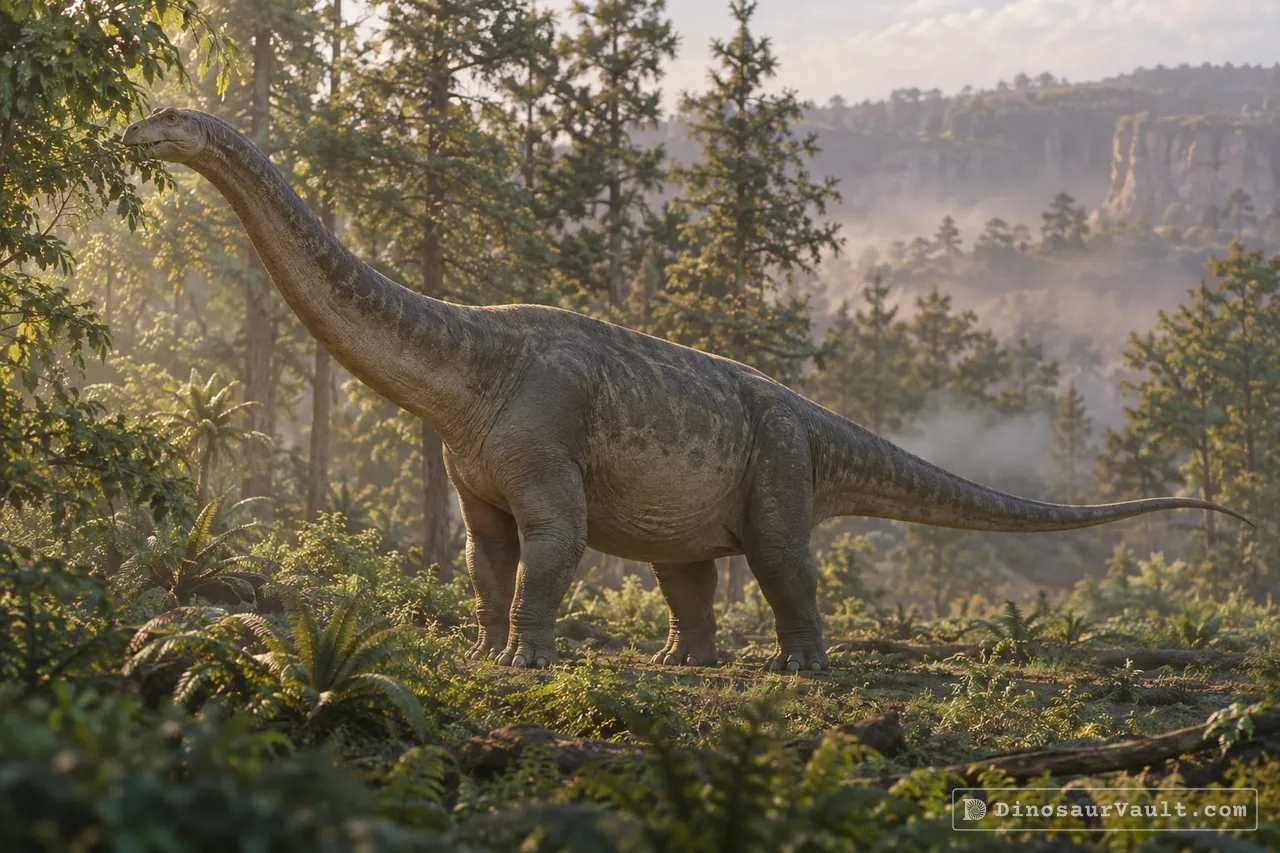
Lirainosaurus was a small titanosaur, a long-necked, four-legged plant eater. It had a slender build for a titanosaur, which gave it its name, and it may have had bony armor in its skin.
Its world
It lived in the Late Cretaceous in what is now northern Spain. Its bones come from the Vitoria and Sedano formations, where it shared the land with the plant eater Rhabdodon, the armored Struthiosaurus and the abelisaur Arcovenator.
How it was found
Sanz and colleagues named Lirainosaurus in 1999. Three finds are known.
Field gallery
More views of Lirainosaurus
Scenes reconstructed from the available fossil evidence.
1 of 2
Lived alongside
Found in the same rock formations


A rock formation can hold fossils laid down millions of years apart, so not every animal here met Lirainosaurus.
The evidence
The science behind Lirainosaurus
Which parts of the picture come from its own bones, and which come from its relatives.
From its own fossils
- The type specimen is a single tail vertebra. Braincases, teeth, backbone and limb bones from the same site come from several individuals.
- Upper arm bones referred to it from the same site have long, straight shafts, and the referred forearm and shin bones are slender.
- Growth marks inside its limb bones show pauses in bone growth.
Borrowed from relatives
- The missing face can be restored by comparison with Tapuiasaurus, a titanosaur known from a well-preserved skull.
- Neck, chest, hips and tail can be filled in from more complete titanosaurs such as Mnyamawamtuka.
Still unknown
- Some researchers have suggested its bone bed may hold more than one kind of titanosaur; which bones, if any, belong to another animal has not been worked out.
- Only two broken armor plates have been described, so how much bony armor it carried is unknown.
- Its place in the titanosaur family tree, which shifts from one analysis to the next.
Discovery timeline
- 1999Named itSanz et al.
- 2010Growing upCompany
- 2011SkullDíez Díaz, Pereda Suberbiola & Luis Sanz
- 2012Growing upDíez Díaz, Pereda Suberbiola & Sanz
- 2013Full descriptionDíez Díaz, Pereda Suberbiola & Sanz
Key papers
The research behind what we know of Lirainosaurus
Named it
Named a slender titanosaur from skull fragments, teeth, vertebrae and limb bones found in Spain.
Sauropod remains from the Upper Cretaceous of Laño (northcentral Spain). Titanosaur phylogenetic relationships. Estudios del Museo de Ciencias Naturales de Alava 14: 235-255
No link available
Growing up
Sections through limb bones showed growth pauses and extensive replacement of older bone tissue in adults.
Bone histology of the titanosaur Lirainosaurus astibiae (Dinosauria: Sauropoda) from the Latest Cretaceous of Spain. Naturwissenschaften 98: 67-78
Read the paper : Bone histology of the titanosaur Lirainosaurus astibiae (Dinosauria: Sauropoda) from the Latest Cretaceous of Spain (opens in a new tab)Skull
Described the braincase and used its bone joints and nerve openings to help place Lirainosaurus among titanosaurs.
Braincase Anatomy of the Titanosaurian SauropodLirainosaurus astibiaefrom the Late Cretaceous of the Iberian Peninsula. Acta Palaeontologica Polonica 56: 521-533
Read the paper : Braincase Anatomy of the Titanosaurian SauropodLirainosaurus astibiaefrom the Late Cretaceous of the Iberian Peninsula (opens in a new tab)Growing up
Compared small, smooth teeth with larger, more textured teeth and interpreted the differences as changes during growth.
Juvenile and adult teeth of the titanosaurian dinosaur Lirainosaurus (Sauropoda) from the Late Cretaceous of Iberia. Geobios 45: 265-274
Read the paper : Juvenile and adult teeth of the titanosaurian dinosaur Lirainosaurus (Sauropoda) from the Late Cretaceous of Iberia (opens in a new tab)Full description
Described its neck, back and tail vertebrae and ribs, and revised the tail features that set Lirainosaurus apart from other titanosaurs.
The axial skeleton of the titanosaur Lirainosaurus astibiae (Dinosauria: Sauropoda) from the latest Cretaceous of Spain. Cretaceous Research 43: 145-160
Read the paper : The axial skeleton of the titanosaur Lirainosaurus astibiae (Dinosauria: Sauropoda) from the latest Cretaceous of Spain (opens in a new tab)
Close relatives
Other members of Lirainosaurinae


Sources: Wikidata