Atsinganosaurus
- Lived
- 84 to 72 million years ago, Late Cretaceous
- Diet
- Herbivore
- Group
- Sauropods
- Found in
- France
- Named by
- Garcia et al. 2010
Where its fossils were found
The evidence
Today

80 million years ago
Habitat
Rivers crossed a floodplain surrounded by conifers and flowering plants in what is now southern France. Dry periods alternated with wet ones. Garrigatitan and Matheronodon also lived here.
Field notes
About Atsinganosaurus
What it was like
Atsinganosaurus was a small titanosaur, a long-necked, four-legged plant eater, known from part of the backbone, hips and limbs. It was related to Lirainosaurus from Spain.
Its world
It lived in the Late Cretaceous in what is now southern France.
How it was found
Garcia and colleagues named Atsinganosaurus in 2010. Its name refers to wandering peoples, because its ancestors may have traveled to Europe from elsewhere.
Field gallery
More views of Atsinganosaurus
Scenes reconstructed from the available fossil evidence.
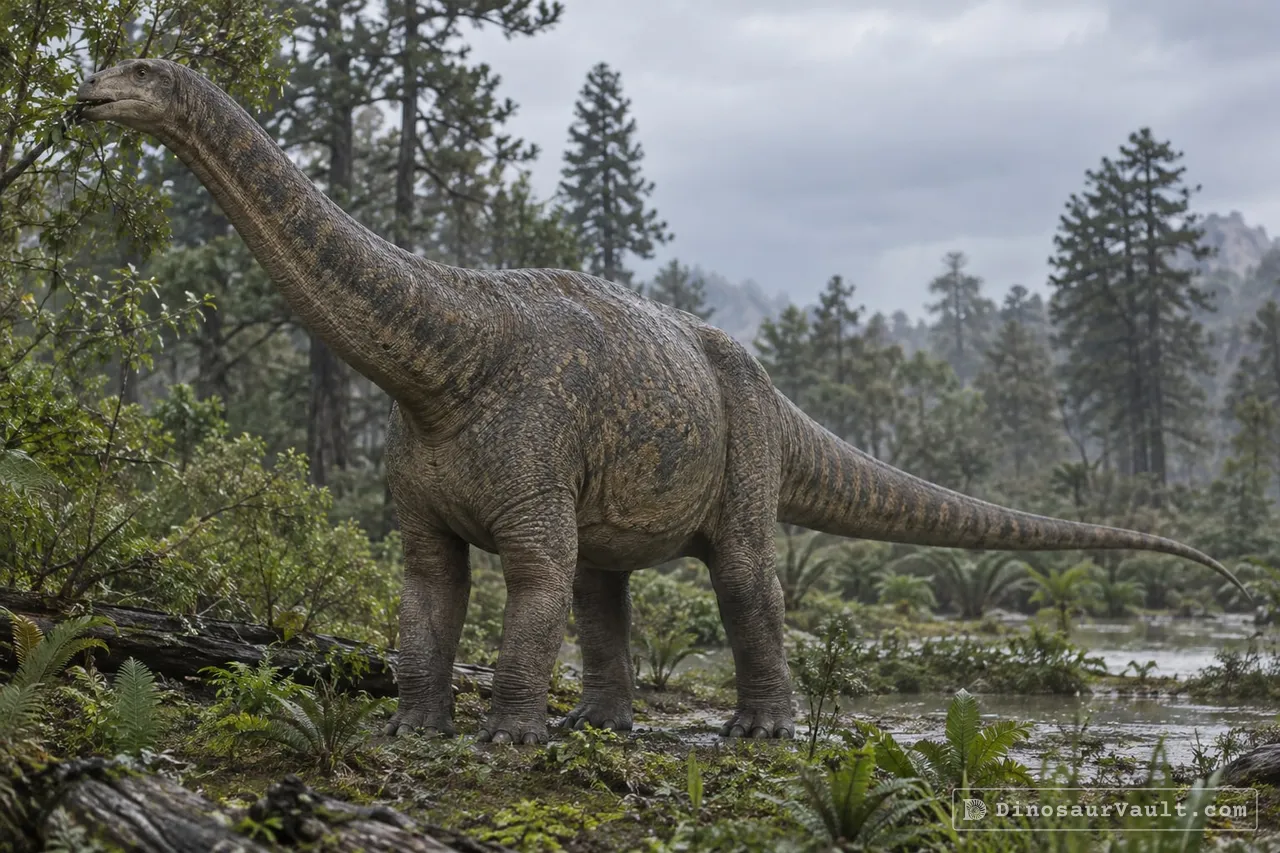
The evidence
The science behind Atsinganosaurus
Which parts of the picture come from its own bones, and which come from its relatives.
From its own fossils
- The type specimen is a row of linked back vertebrae. Other bones assigned to it from the same site come from several individuals and include a tentatively identified braincase, a probable palate bone, loose peg-shaped teeth, neck vertebrae, hips and limb bones.
- A hollow on part of the hip bone is bordered by sharp ridges, a feature used to distinguish this dinosaur.
- Thin sections of limb bones assigned to it show extensive rebuilding of the bone tissue, a sign of mature animals.
Borrowed from relatives
- Tapuiasaurus, a titanosaur known from a skull, provides a possible comparison for the missing front of the skull.
Still unknown
- The shape of its face and jaws. Only a few small pieces of the skull have been assigned to it.
- Its exact place among titanosaurs. It has been grouped with Lirainosaurus, but a later study found that its position changed with the method of analysis.
- Its full size. A second titanosaur, Garrigatitan, was found in the same quarry, and an early estimate of its length was later revised downward.
Discovery timeline
- 2010Named itGarcia et al.
- 2015Its worldCincotta et al.
- 2018Full descriptionDíez Díaz et al.
- 2025Family treeDíaz et al.
Key papers
The research behind what we know of Atsinganosaurus
Named it
Named a new titanosaur from well-preserved bones in southern France and compared it with other sauropods.
A new Titanosaur genus (Dinosauria, Sauropoda) from the Late Cretaceous of southern France and its paleobiogeographic implications. Bulletin de la Société Géologique de France 181: 269-277
Read the paper : A new Titanosaur genus (Dinosauria, Sauropoda) from the Late Cretaceous of southern France and its paleobiogeographic implications (opens in a new tab)Its world
Reconstructed a river and floodplain environment with conifers, flowering plants and a climate that alternated between dry and wet periods.
Integrated Paleoenvironmental Reconstruction and Taphonomy of a Unique Upper Cretaceous Vertebrate-Bearing Locality (Velaux, Southeastern France). PLOS ONE 10: e0134231
Read the paper : Integrated Paleoenvironmental Reconstruction and Taphonomy of a Unique Upper Cretaceous Vertebrate-Bearing Locality (Velaux, Southeastern France) (opens in a new tab)Full description
Described additional skull and body bones, identified mature individuals from bone tissue, and linked Atsinganosaurus with Ampelosaurus and Lirainosaurus.
The titanosaurian dinosaur Atsinganosaurus velauciensis (Sauropoda) from the Upper Cretaceous of southern France: New material, phylogenetic affinities, and palaeobiogeographical implications. Cretaceous Research 91: 429-456
Read the paper : The titanosaurian dinosaur Atsinganosaurus velauciensis (Sauropoda) from the Upper Cretaceous of southern France: New material, phylogenetic affinities, and palaeobiogeographical implications (opens in a new tab)Family tree
A family-tree analysis of European titanosaurs that placed Atsinganosaurus in different positions depending on how its characters were weighted.
Revision of Romanian sauropod dinosaurs reveals high titanosaur diversity and body-size disparity on the latest Cretaceous Haţeg Island, with implications for titanosaurian biogeography. Journal of Systematic Palaeontology 23
Read the paper : Revision of Romanian sauropod dinosaurs reveals high titanosaur diversity and body-size disparity on the latest Cretaceous Haţeg Island, with implications for titanosaurian biogeography (opens in a new tab)
Close relatives
Other members of Lirainosaurinae


Sources: Wikidata