Garrigatitan
Type species Garrigatitan meridionalis
- Lived
- 84 to 72 million years ago, Late Cretaceous
- Diet
- Herbivore
- Group
- Sauropods
- Found in
- France
- Named by
- Díez Díaz et al. 2021
Where its fossils were found
The evidence
Today

80 million years ago
Habitat
Rivers crossed a broad floodplain surrounded by conifers and flowering plants, with alternating dry and wet periods. Neighbors included Atsinganosaurus, Matheronodon and turtles.
Field notes
About Garrigatitan
What it was like
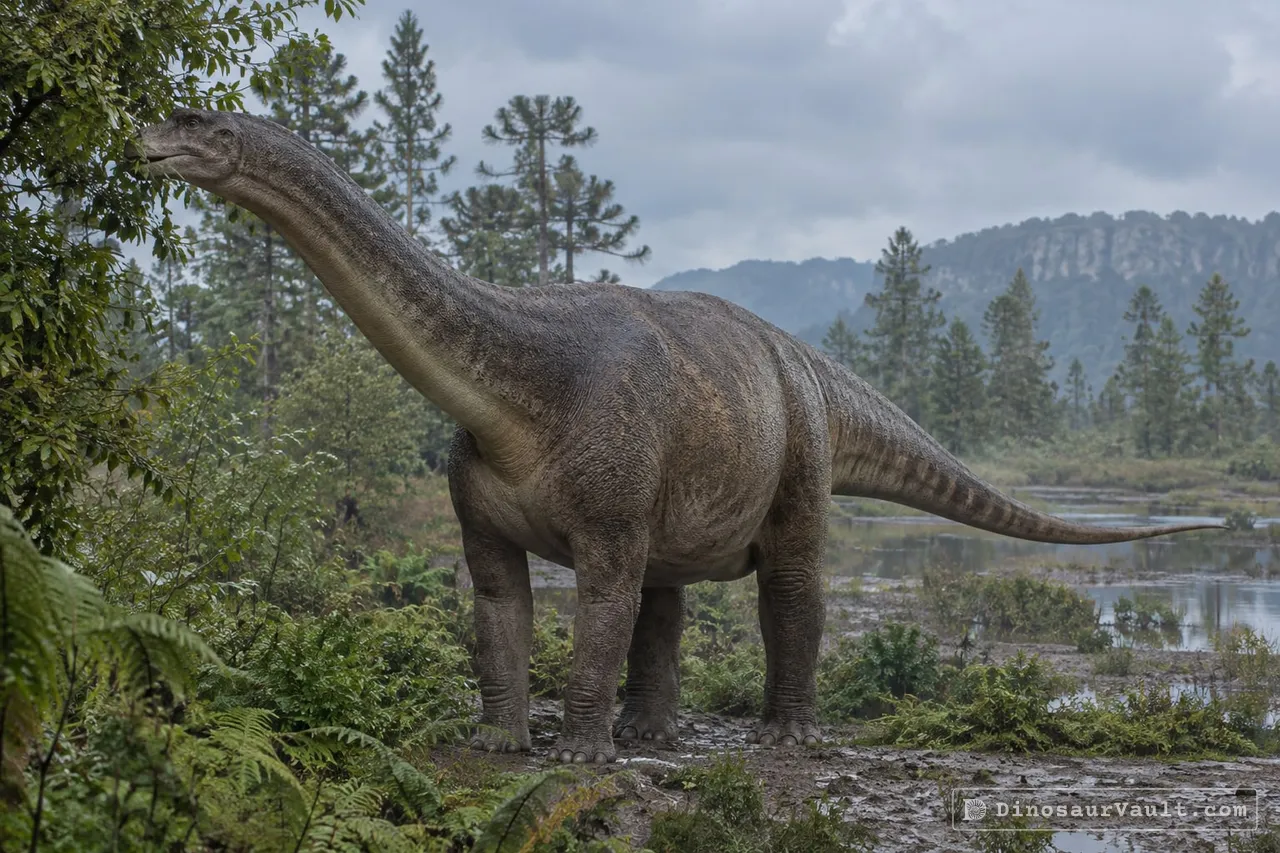
Garrigatitan was a titanosaur, a long-necked plant eater whose closest relatives remain uncertain. Different analyses place it on different branches of the titanosaur family tree. It is known from bones of several animals.
Its world
It lived in the Late Cretaceous, in what is now France. Europe was then a chain of islands.
How it was found
Díez Díaz and colleagues named Garrigatitan in 2021. The type species is Garrigatitan meridionalis. Its name comes from the dry scrubland of southern France.
Field gallery
More views of Garrigatitan
Scenes reconstructed from the available fossil evidence.
1 of 2
The evidence
The science behind Garrigatitan
Which parts of the picture come from its own bones, and which come from its relatives.
From its own fossils
- The type specimen is a sacrum with part of the left hip bone. A rear neck vertebra, two upper arm bones and other hip bones are assigned to it, and a neck rib, a third upper arm bone, a forearm bone and a thigh bone only tentatively.
- The upper arm bones assigned to Garrigatitan have an hourglass outline with broad ends and a narrow middle, more robust than in Atsinganosaurus but less than in Opisthocoelicaudia. A rounded hollow in the referred hip bone helps distinguish it from other titanosaurs.
- Microscopic sections of limb bones assigned to Garrigatitan show that the studied animals had reached skeletal maturity.
Borrowed from relatives
- The missing head is restored by comparison with Tapuiasaurus, and the rest of the neck by comparison with Futalognkosaurus.
- The body, legs and tail are compared with Mnyamawamtuka, and the hands with Camarasaurus and Apatosaurus.
Still unknown
- The shape of its skull and the length of its neck. None of the bones assigned to it come from the skull.
- Whether the largest titanosaur bones at its fossil site belong to Garrigatitan. The bones were found scattered, and their size differences could mean more than one kind of animal or differences between the sexes.
- Its closest relatives: it was first placed near Lirainosaurus, but a later analysis put it among the colossosaurians, a different branch of titanosaurs. That result may depend on incomplete material and which scattered bones are assigned to it.
Discovery timeline
- 2015Its worldCincotta et al.
- 2018Same rocksDíez Díaz et al.
- 2021Named itDíez Díaz et al.
- 2024Family treeMocho et al.
Key papers
The research behind what we know of Garrigatitan
Its world
Reconstructed rivers and a broad floodplain at its fossil site, with conifers, flowering plants and alternating dry and wet periods.
Integrated Paleoenvironmental Reconstruction and Taphonomy of a Unique Upper Cretaceous Vertebrate-Bearing Locality (Velaux, Southeastern France). PLOS ONE 10: e0134231
Read the paper : Integrated Paleoenvironmental Reconstruction and Taphonomy of a Unique Upper Cretaceous Vertebrate-Bearing Locality (Velaux, Southeastern France) (opens in a new tab)Same rocks
Described new Atsinganosaurus bones from the same fossil site, providing comparisons with another local titanosaur.
The titanosaurian dinosaur Atsinganosaurus velauciensis (Sauropoda) from the Upper Cretaceous of southern France: New material, phylogenetic affinities, and palaeobiogeographical implications. Cretaceous Research 91: 429-456
Read the paper : The titanosaurian dinosaur Atsinganosaurus velauciensis (Sauropoda) from the Upper Cretaceous of southern France: New material, phylogenetic affinities, and palaeobiogeographical implications (opens in a new tab)Named it
Distinguished Garrigatitan by its arm, hip and thigh bones, and found that the studied animals were skeletally mature.
A new titanosaur (Dinosauria: Sauropoda) from the Upper Cretaceous of Velaux-La-Bastide Neuve (southern France). Historical Biology 33: 2998-3017
Read the paper : A new titanosaur (Dinosauria: Sauropoda) from the Upper Cretaceous of Velaux-La-Bastide Neuve (southern France) (opens in a new tab)Family tree
Named a new Spanish titanosaur, and its family-tree analyses placed Garrigatitan among the colossosaurians rather than beside Lirainosaurus.
A Spanish saltasauroid titanosaur reveals Europe as a melting pot of endemic and immigrant sauropods in the Late Cretaceous. Communications Biology 7
Read the paper : A Spanish saltasauroid titanosaur reveals Europe as a melting pot of endemic and immigrant sauropods in the Late Cretaceous (opens in a new tab)
Close relatives
Other members of Lirainosaurinae


Sources: Wikidata