Kelmayisaurus
"Karamay lizard"
- Lived
- Early Cretaceous
- Diet
- Carnivore
- Group
- Theropods, Carcharodontosauridae
- Found in
- China
- Named by
- Dong 1973
Where its fossils were found
The evidence
Today

Habitat
It lived in northwestern China, on land now preserved in the Lianmuqin Formation. Wuerhosaurus and Psittacosaurus are among the dinosaurs recorded from the same rocks.
Field notes
About Kelmayisaurus
What it was like
Kelmayisaurus was a large two-legged predator known mainly from its jaws. Later studies suggest it was a carcharodontosaurid, a relative of Giganotosaurus and Carcharodontosaurus.
Its world
It lived in the Early Cretaceous in what is now northwestern China. Its bones come from the Lianmuqin Formation, where the plated Wuerhosaurus and the small horned Psittacosaurus also lived.
How it was found
Dong named Kelmayisaurus in 1973 from one find. It is named after a nearby city.
Field gallery
More views of Kelmayisaurus
Scenes reconstructed from the available fossil evidence.
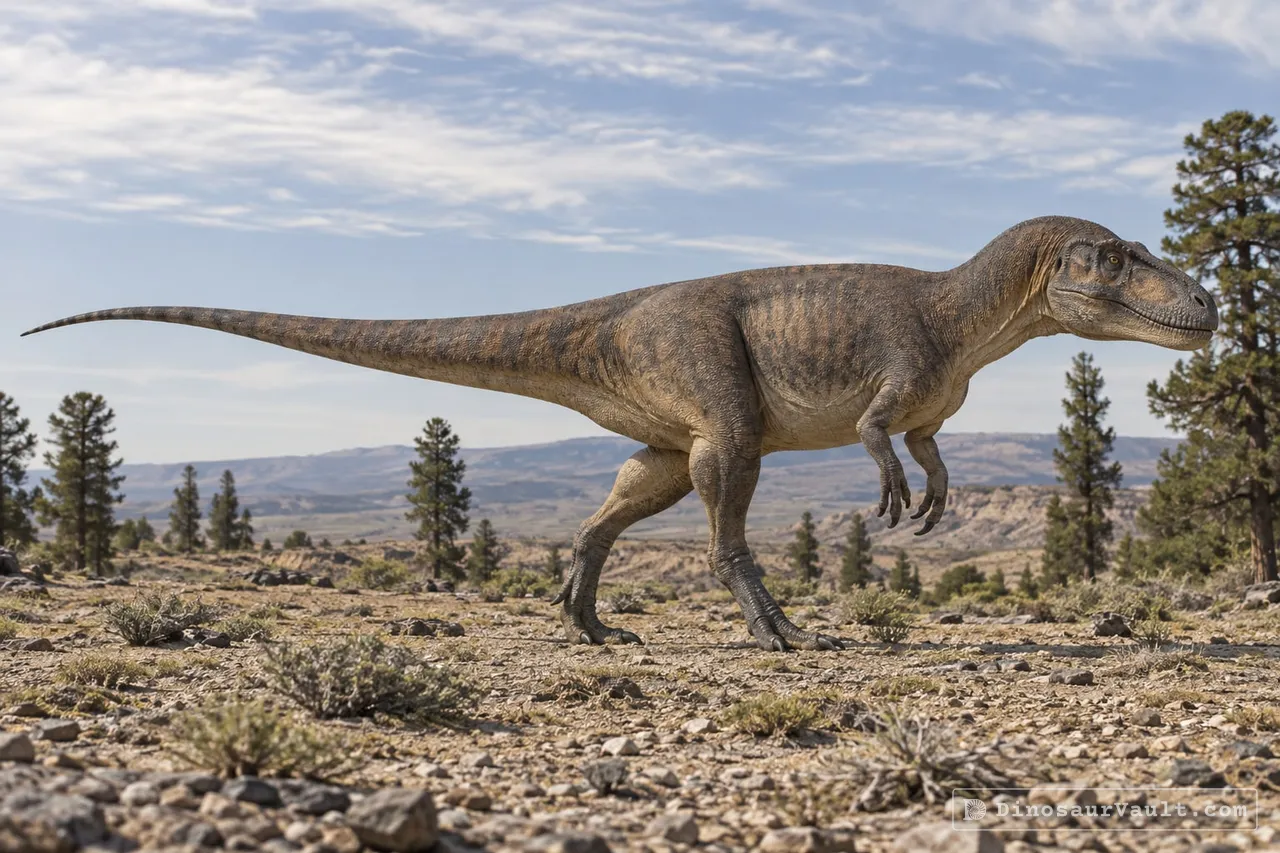
The evidence
The science behind Kelmayisaurus
Which parts of the picture come from its own bones, and which come from its relatives.
From its own fossils
- Parts of the upper jaw and left lower jaw show a large meat eater.
- A deep extra groove near the front of the lower jaw helps distinguish it from other theropods.
- The preserved lower jaw has a smooth outer surface and only a slight widening near the front.
Borrowed from relatives
- The missing body, arms and feet are modeled on other allosauroids, such as Acrocanthosaurus.
- Acrocanthosaurus also helps restore the missing upper snout and the back of the head.
Still unknown
- Its exact place among the allosauroids: different family trees place it in different groups.
- The complete shape of its skull and its body proportions.
- Its skin covering and color.
Often drawn wrong
- The groove in the jawbone should not appear as an open furrow in the living face.
- The tall back ridge of Acrocanthosaurus should not be copied onto Kelmayisaurus.
Discovery timeline
- 1973Named itDong
- 2012Full descriptionBrusatte, Benson & Xu
- 2025Family treeKellermann, Cuesta & Rauhut
Key papers
The research behind what we know of Kelmayisaurus
Named it
Named Kelmayisaurus from incomplete upper and lower jaws found in China.
[Dinosaurs from Wuerho]. Reports of Paleontological Expedition to Sinkiang (II): Pterosaurian Fauna from Wuerho, Sinkiang. Memoirs of the Institute of Vertebrate Paleontology and Paleoanthropology, Academia Sinica 11: 45-52
No link available
Full description
Restudied the jaws, confirmed that Kelmayisaurus is a distinct genus, and placed it among the carcharodontosaurids.
A Reassessment ofKelmayisaurus petrolicus, a Large Theropod Dinosaur from the Early Cretaceous of China. Acta Palaeontologica Polonica 57: 65-72
Read the paper : A Reassessment ofKelmayisaurus petrolicus, a Large Theropod Dinosaur from the Early Cretaceous of China (opens in a new tab)Family tree
Different family-tree analyses placed Kelmayisaurus in different allosauroid groups, reopening the question of its closest relatives.
Re-evaluation of the Bahariya Formation carcharodontosaurid (Dinosauria: Theropoda) and its implications for allosauroid phylogeny. PLOS ONE 20: e0311096
Read the paper : Re-evaluation of the Bahariya Formation carcharodontosaurid (Dinosauria: Theropoda) and its implications for allosauroid phylogeny (opens in a new tab)
Close relatives
Other members of Carcharodontosauridae


Sources: Wikidata