Jingiella
Type species Jingiella dongxingensis
- Lived
- 155 to 149 million years ago, Late Jurassic
- Diet
- Herbivore
- Group
- Sauropods, Mamenchisauridae
- Found in
- China
- Named by
- Ren et al. 2024
Where its fossils were found
The evidence
Today

150 million years ago
Habitat
It lived on land in southern China, where sand and mud became the Dongxing Formation. Meat-eating dinosaurs left teeth and footprints in the same rocks.
Field notes
About Jingiella
What it was like
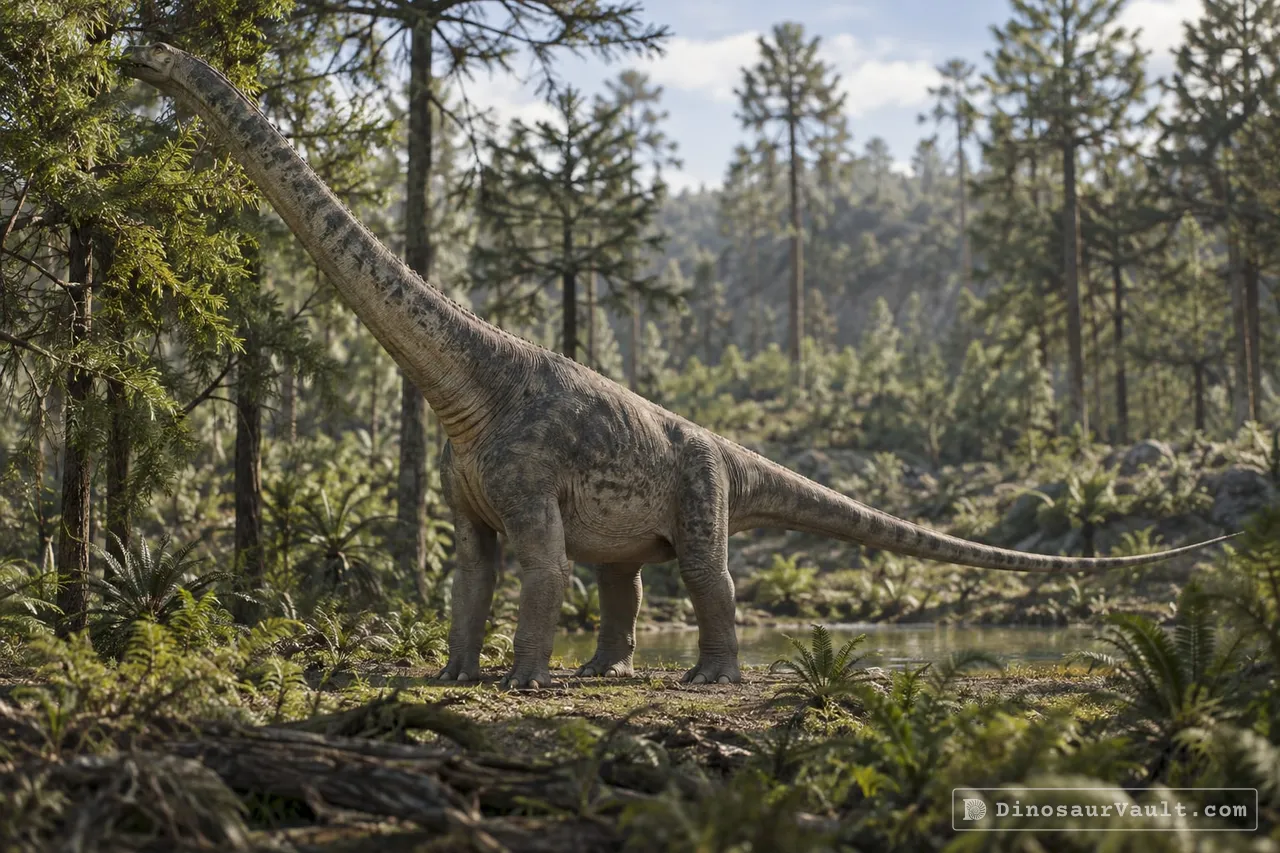
Jingiella was a long-necked, four-legged plant eater, a relative of Mamenchisaurus, known from backbones and limb bones.
Its world
It lived in the Late Jurassic in what is now southern China. Its bones come from the Dongxing Formation.
How it was found
Ren and colleagues named it in 2024. Its first name turned out to belong already to a moth, so it was given a new one.
Field gallery
More views of Jingiella
Scenes reconstructed from the available fossil evidence.
The evidence
The science behind Jingiella
Which parts of the picture come from its own bones, and which come from its relatives.
From its own fossils
- The partial skeleton includes back, hip and tail vertebrae, parts of both forearms and a thigh bone.
- The back vertebrae have tall, narrow bony spines, while the front tail vertebrae have hollowed joint surfaces at both ends.
- The lower end of the forearm bone is oval in cross-section, and the partial right thigh bone is straight, without a bulge along its outer edge.
Borrowed from relatives
- The missing skull is restored after Euhelopus, and the hands after Camarasaurus and Apatosaurus.
- The neck, trunk, legs and tail follow Mnyamawamtuka, a sauropod known from more of its skeleton.
- The feet are compared with Mnyamawamtuka and with Mamenchisaurus youngi, a relative from China whose few preserved toe claws are relatively small, thin, flat and triangular.
Still unknown
- Its neck length, skull shape, full size and body proportions.
- Its skin texture and color.
- Its exact place among the mamenchisaurids. The naming study placed it near Mamenchisaurus youngi, Wamweracaudia and Chuanjiesaurus under one way of weighting the evidence.
Discovery timeline
- 2023Close relativeMoore et al.
- 2024Named itRen et al.
- 2024Same rocksWang et al.
Key papers
The research behind what we know of Jingiella
Close relative
Restudied Mamenchisaurus sinocanadorum and traced how air-filled neck bones helped mamenchisaurids evolve very long necks.
Re-assessment of the Late Jurassic eusauropod Mamenchisaurus sinocanadorum Russell and Zheng, 1993, and the evolution of exceptionally long necks in mamenchisaurids. Journal of Systematic Palaeontology 21
Read the paper : Re-assessment of the Late Jurassic eusauropod Mamenchisaurus sinocanadorum Russell and Zheng, 1993, and the evolution of exceptionally long necks in mamenchisaurids (opens in a new tab)Named it
Described a partial skeleton with distinctive backbone and forearm features, placing it in the mamenchisaurid family.
The first mamenchisaurid from the Upper Jurassic Dongxing Formation of Guangxi, southernmost China. Historical Biology 37: 465-478
Read the paper : The first mamenchisaurid from the Upper Jurassic Dongxing Formation of Guangxi, southernmost China (opens in a new tab)Same rocks
Reported meat-eating dinosaur footprints and a tooth from the Dongxing Formation, adding to the animals known from its world.
First report of theropod dinosaur materials from the Upper Jurassic Dongxing Formation of Guangxi, southernmost China. China Geology 7: 1-2
Read the paper : First report of theropod dinosaur materials from the Upper Jurassic Dongxing Formation of Guangxi, southernmost China (opens in a new tab)
Close relatives
Other members of Mamenchisauridae


Sources: Wikidata