Vectidromeus
"Wight runner"
Type species Vectidromeus insularis
- Lived
- 126 to 121 million years ago, Early Cretaceous
- Diet
- Herbivore
- Group
- Ornithopods, Hypsilophodontidae
- Found in
- United Kingdom
- Named by
- Longrich et al. 2024
Where its fossils were found
The evidence
Today

125 million years ago
Habitat
It lived on a low floodplain crossed by winding rivers, with ponds and patches of woodland. Other dinosaurs from the same rock formation include Polacanthus, Iguanodon and Mantellisaurus.
Field notes
About Vectidromeus
What it was like
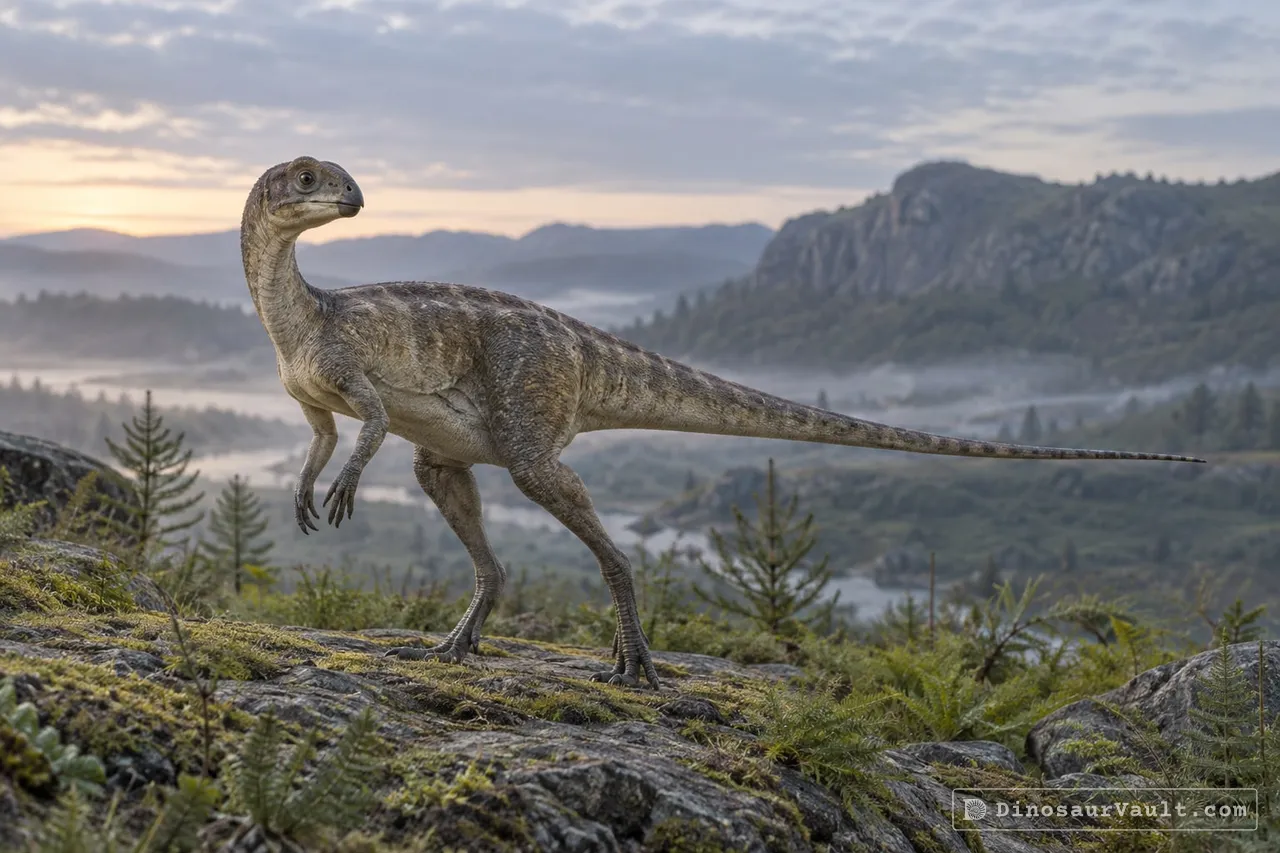
Vectidromeus was a small plant eater that ran on two legs, a close relative of Hypsilophodon. It is known from a partial skeleton of a young animal.
Its world
It lived in the Early Cretaceous, in what is now England.
How it was found
Longrich and colleagues named Vectidromeus in 2024. The type species is Vectidromeus insularis.
Field gallery
More views of Vectidromeus
Scenes reconstructed from the available fossil evidence.
1 of 2
The evidence
The science behind Vectidromeus
Which parts of the picture come from its own bones, and which come from its relatives.
From its own fossils
- The juvenile type includes bones from the back, hips, hind legs and tail, collected in separate blocks with differing degrees of association.
- The rear blade of the hip bone is short and deep, unlike that of Hypsilophodon.
- The hind legs have long, slender bones, and the left foot preserves connected metatarsals of the three main toes.
Borrowed from relatives
- The describers place it close to Hypsilophodon on shared hip and leg features.
- Thescelosaurus supplies a broader comparison for the missing skull roof and hands, and Fona for the missing tips of the hands and feet.
Still unknown
- How large a fully grown animal became, and the complete shape of its hands and feet.
- Its skin covering and color.
- No skull, neck or forelimbs are known.
Discovery timeline
- 2010Its worldSweetman & Insole
- 2024Named itLongrich et al.
- 2024Same rocksLockwood, Martill & Maidment
Key papers
The research behind what we know of Vectidromeus
Its world
Explained how floods carried plants and animal remains into hollows on the floodplain preserved in the same rock formation.
The plant debris beds of the Early Cretaceous (Barremian) Wessex Formation of the Isle of Wight, southern England: their genesis and palaeontological significance. Palaeogeography, Palaeoclimatology, Palaeoecology 292: 409-424
Read the paper : The plant debris beds of the Early Cretaceous (Barremian) Wessex Formation of the Isle of Wight, southern England: their genesis and palaeontological significance (opens in a new tab)Named it
Named a small plant eater from a juvenile skeleton with hip and leg features that distinguish it from Hypsilophodon.
Vectidromeus insularis, a new hypsilophodontid dinosaur from the Lower Cretaceous Wessex Formation of the Isle of Wight, England. Cretaceous Research 154: 105707
Read the paper : Vectidromeus insularis, a new hypsilophodontid dinosaur from the Lower Cretaceous Wessex Formation of the Isle of Wight, England (opens in a new tab)Same rocks
Described a nearly complete Comptonatus skeleton, adding another large plant eater to the dinosaurs known from the same rock formation.
Comptonatus chasei , a new iguanodontian dinosaur from the Lower Cretaceous Wessex Formation of the Isle of Wight, southern England. Journal of Systematic Palaeontology 22
Read the paper : Comptonatus chasei , a new iguanodontian dinosaur from the Lower Cretaceous Wessex Formation of the Isle of Wight, southern England (opens in a new tab)
Close relatives
Other members of Hypsilophodontidae


Sources: Wikidata