Daurosaurus
Type species Daurosaurus olovus
- Lived
- 168 to 165 million years ago, Middle Jurassic
- Diet
- Herbivore
- Group
- Ornithopods, Hypsilophodontidae
- Found in
- Russia
- Named by
- Alifanov and Saveliev 2014
Where its fossils were found
The evidence
Today

165 million years ago
Habitat
Its bones were buried in fine mud in a quiet-water setting in Russia, with conifers and ferns in the surrounding area. The same site preserves Kulindadromeus and bones named Kulindapteryx and Lepidocheirosaurus.
Field notes
About Daurosaurus
What it was like
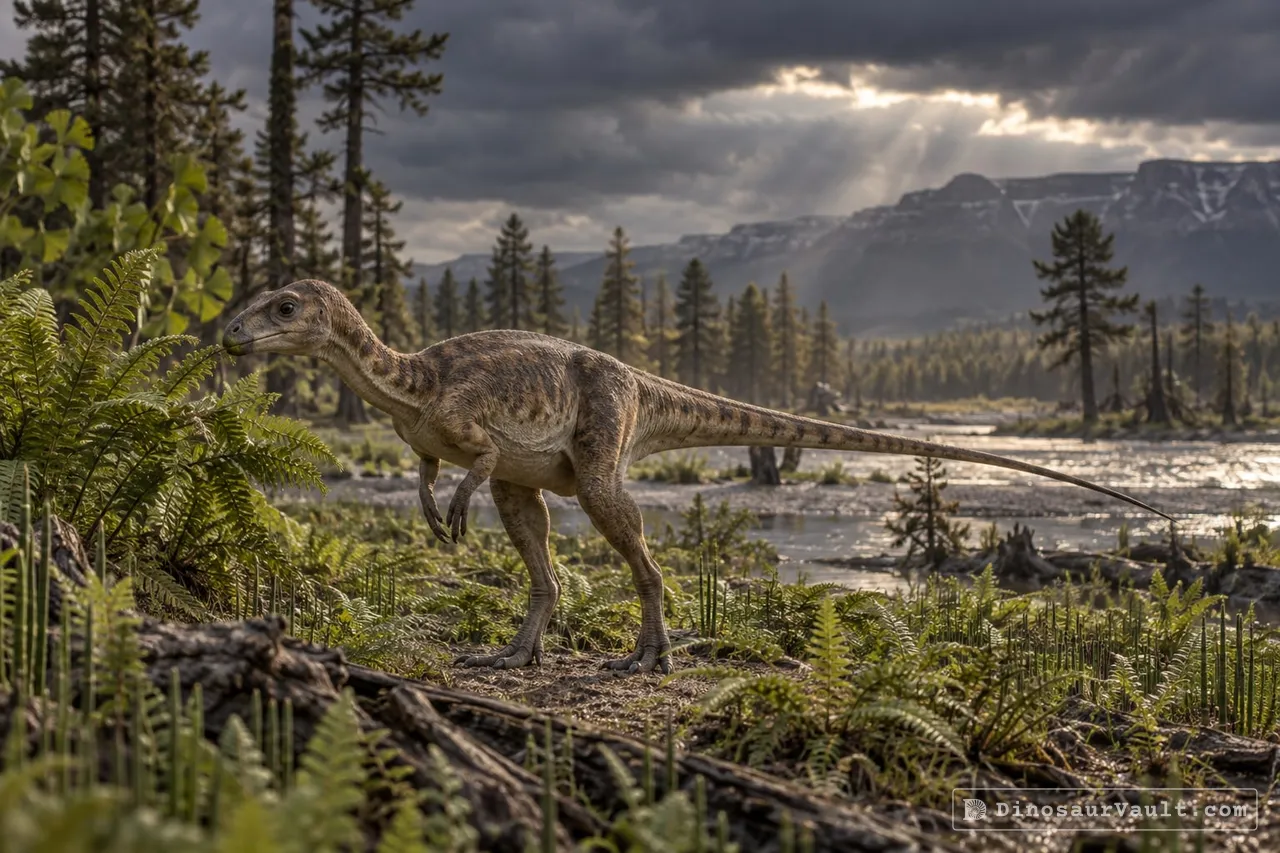
Daurosaurus was described as a small plant eater that ran on two legs. It is known from a few bones.
Its world
It lived in the Middle Jurassic, in what is now Russia. It comes from the Ukureyskaya Formation, the same site as the feathered plant eater Kulindadromeus.
How it was found
Alifanov and Saveliev named Daurosaurus in 2014. The type species is Daurosaurus olovus. Many scientists think its bones actually belong to Kulindadromeus.
Field gallery
More views of Daurosaurus
Scenes reconstructed from the available fossil evidence.
Lived alongside
Found in the same rock formations


A rock formation can hold fossils laid down millions of years apart, so not every animal here met Daurosaurus.
The evidence
The science behind Daurosaurus
Which parts of the picture come from its own bones, and which come from its relatives.
From its own fossils
- A few bones from Russia were described as a small plant-eating dinosaur.
Borrowed from relatives
- A restoration may follow Kulindadromeus, the better-known plant eater from the same site, with a light body and long hind legs.
- Kulindadromeus provides a comparison for a coat of featherlike filaments and patches of scales.
Still unknown
- Whether Daurosaurus is a separate dinosaur or another name for Kulindadromeus.
- The complete shape of the animal represented by its few bones.
- Its color.
Discovery timeline
- 2014Named itAlifanov & Saveliev
- 2014Same rocksGodefroit et al.
- 2019Fossil sitesCincotta et al.
- 2020Same rocksGodefroit et al.
Key papers
The research behind what we know of Daurosaurus
Named it
Named Daurosaurus and Kulindapteryx as small plant-eating dinosaurs from Russia and discussed their pelvic anatomy.
Two new ornithischian dinosaurs (Hypsilophodontia, Ornithopoda) from the Late Jurassic of Russia. Paleontological Journal 48: 414-425
Read the paper : Two new ornithischian dinosaurs (Hypsilophodontia, Ornithopoda) from the Late Jurassic of Russia (opens in a new tab)Same rocks
Described Kulindadromeus from the same site, with scales and simple and branched featherlike coverings.
A Jurassic ornithischian dinosaur from Siberia with both feathers and scales. Science 345: 451-455
Read the paper : A Jurassic ornithischian dinosaur from Siberia with both feathers and scales (opens in a new tab)Fossil sites
Dated the fossil beds to the Middle Jurassic and judged Daurosaurus likely to be another name for Kulindadromeus.
The rise of feathered dinosaurs: Kulindadromeus zabaikalicus , the oldest dinosaur with ‘feather-like’ structures. PeerJ 7: e6239
Read the paper : The rise of feathered dinosaurs: Kulindadromeus zabaikalicus , the oldest dinosaur with ‘feather-like’ structures (opens in a new tab)Same rocks
Described the skin coverings and fossil beds of Kulindadromeus, noting that young and subadult animals dominate the site.
Integumentary Structures in Kulindadromeus zabaikalicus, a Basal Neornithischian Dinosaur from the Jurassic of Siberia. Fascinating Life Sciences: 47-65
Read the paper : Integumentary Structures in Kulindadromeus zabaikalicus, a Basal Neornithischian Dinosaur from the Jurassic of Siberia (opens in a new tab)
Close relatives
Other members of Hypsilophodontidae


Sources: Wikidata