Kulindadromeus
"Kulinda runner"
- Lived
- 168 to 165 million years ago, Middle Jurassic
- Diet
- Herbivore
- Group
- Early ornithischians
- Found in
- Russia
- Named by
- Godefroit et al. 2014
Where its fossils were found
The evidence
Today

165 million years ago
Habitat
It probably lived near a freshwater lake in a region with volcanic activity. Fossil plants include conifers, ferns, horsetails and mosses, and the lake deposits also contain insect larvae and freshwater crustaceans.
Field notes
About Kulindadromeus
What it was like
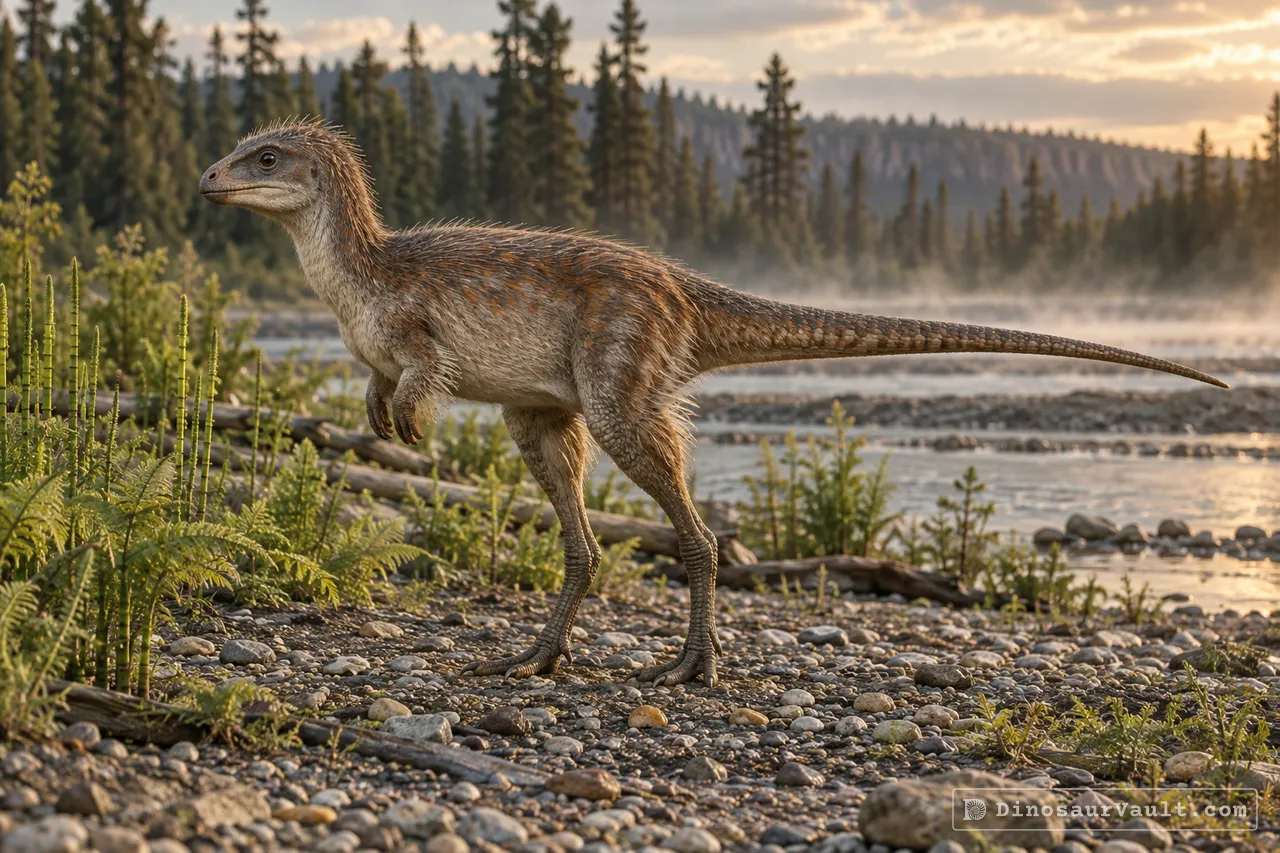
Kulindadromeus was a small, fast plant eater that ran on its hind legs. Its fossils preserve its body covering, and they surprised scientists: along with scales on its tail and legs, it had thin filaments and fuzz, a bit like simple feathers.
Since it was an ornithischian, far from the birds on the family tree, it suggests that early feathers or fuzz may have been common across many dinosaurs.
Its world
It lived in the Middle Jurassic, in what is now Russia. Its fossils come from the Ukureyskaya Formation.
How it was found
Godefroit and colleagues named Kulindadromeus in 2014, from many bones found in the same site.
Field gallery
More views of Kulindadromeus
Scenes reconstructed from the available fossil evidence.
1 of 3
Lived alongside
Found in the same rock formations


A rock formation can hold fossils laid down millions of years apart, so not every animal here met Kulindadromeus.
The evidence
The science behind Kulindadromeus
Which parts of the picture come from its own bones, and which come from its relatives.
From its own fossils
- Many scattered bones and partial skulls show a short head, short arms, long hind legs and a long tail.
- Simple filaments covered parts of the head and trunk, while bundles of filaments grew around the upper arms and thighs.
- Small scales covered parts of the lower legs and feet, and larger overlapping scales covered the tail.
Borrowed from relatives
- Much of its skeleton and body covering is known from its own fossils, so its fuzz comes directly from Kulindadromeus.
Still unknown
- Its color and the full pattern of its body covering.
- Whether its filaments and bird feathers share the same evolutionary origin.
- Whether it cared for its young.
Discovery timeline
- 2014Named itGodefroit et al.
- 2014SkinGodefroit et al.
- 2019Its worldCincotta et al.
- 2020Full descriptionGodefroit et al.
Key papers
The research behind what we know of Kulindadromeus
Named it
Described a small plant eater with both scales and feather-like filaments, showing that complex body coverings occurred beyond the theropod branch.
A Jurassic ornithischian dinosaur from Siberia with both feathers and scales. Science 345: 451-455
Read the paper : A Jurassic ornithischian dinosaur from Siberia with both feathers and scales (opens in a new tab)Skin
Argued that the shape and preservation of the filaments fit feather-like appendages better than decayed scales or collagen fibers.
Response to Comment on “A Jurassic ornithischian dinosaur from Siberia with both feathers and scales”. Science 346: 434-434
Read the paper : Response to Comment on “A Jurassic ornithischian dinosaur from Siberia with both feathers and scales” (opens in a new tab)Its world
Used minerals and fossil pollen to date the fossil beds to the Middle Jurassic, earlier than previous local estimates.
The rise of feathered dinosaurs: Kulindadromeus zabaikalicus , the oldest dinosaur with ‘feather-like’ structures. PeerJ 7: e6239
Read the paper : The rise of feathered dinosaurs: Kulindadromeus zabaikalicus , the oldest dinosaur with ‘feather-like’ structures (opens in a new tab)Full description
Reviewed the different scales and filaments and interpreted the bonebeds as containing one dinosaur species, mostly represented by young individuals.
Integumentary Structures in Kulindadromeus zabaikalicus, a Basal Neornithischian Dinosaur from the Jurassic of Siberia. Fascinating Life Sciences: 47-65
Read the paper : Integumentary Structures in Kulindadromeus zabaikalicus, a Basal Neornithischian Dinosaur from the Jurassic of Siberia (opens in a new tab)
Sources: Wikidata