Kulindapteryx
"Kulinda wing"
Type species Kulindapteryx ukureica
- Lived
- 168 to 165 million years ago, Middle Jurassic
- Diet
- Herbivore
- Group
- Early ornithischians, Jeholosauridae
- Found in
- Russia
- Named by
- Alifanov and Saveliev 2014
Where its fossils were found
The evidence
Today

165 million years ago
Habitat
Lake beds and volcanic sediments formed its home in what is now Russia, with conifers, ferns, horsetails and mosses. Dinosaurs from the same beds have also been named Kulindadromeus, Daurosaurus and Lepidocheirosaurus.
Field notes
About Kulindapteryx
What it was like
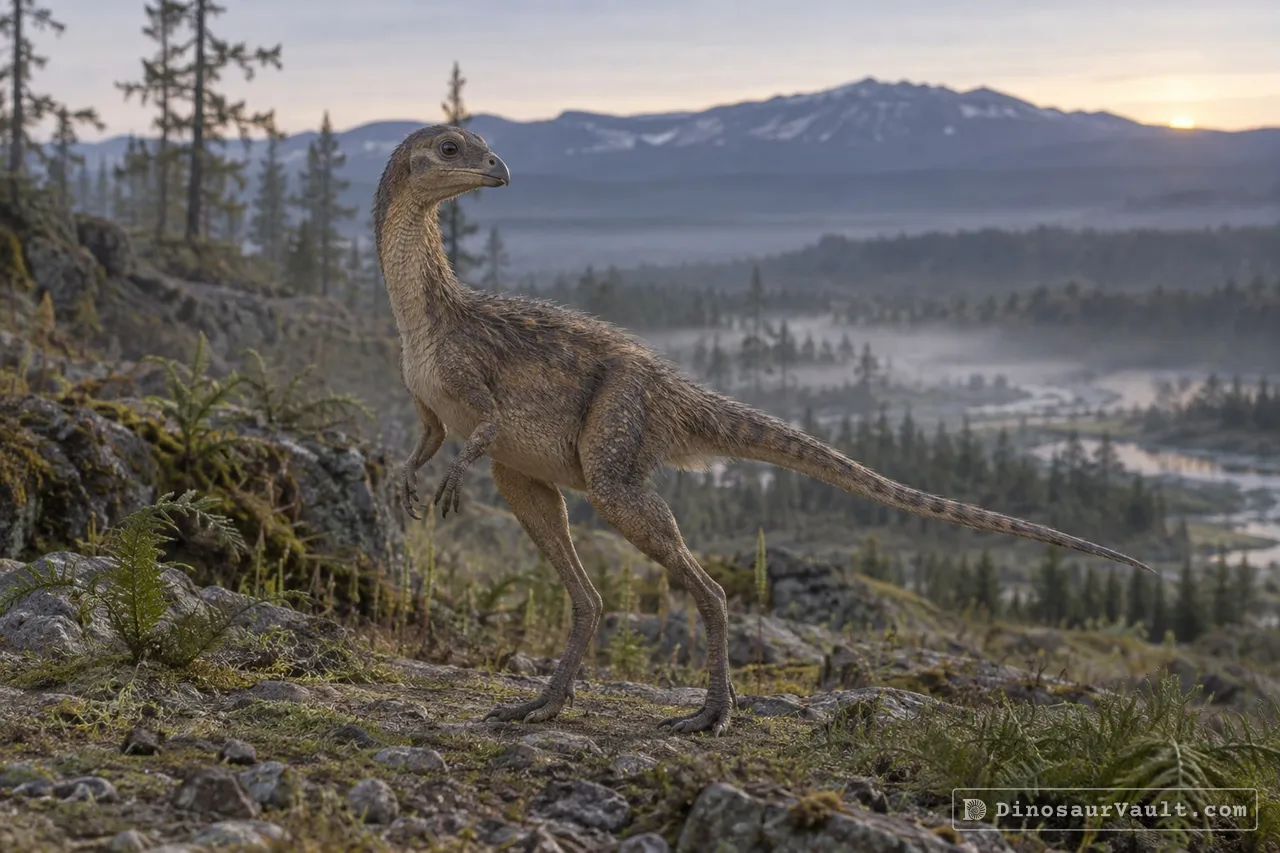
Kulindapteryx was a small, two-legged plant eater, known from a few bones.
Many scientists think it is the same animal as Kulindadromeus, a small plant eater from the same site that was covered in scales and simple, fuzzy filaments.
Its world
It lived in the Middle Jurassic in what is now Russia. Its bones come from the Ukureyskaya Formation, a site of lake beds and volcanic ash that holds the remains of many small plant eaters.
How it was found
Alifanov and Saveliev named Kulindapteryx in 2014, from a single find.
Field gallery
More views of Kulindapteryx
Scenes reconstructed from the available fossil evidence.
Lived alongside
Found in the same rock formations


A rock formation can hold fossils laid down millions of years apart, so not every animal here met Kulindapteryx.
The evidence
The science behind Kulindapteryx
Which parts of the picture come from its own bones, and which come from its relatives.
From its own fossils
- The specimen used to name Kulindapteryx includes a hip bone preserved as an impression in rock.
- The original authors separated it from Daurosaurus partly by features of that hip bone.
Borrowed from relatives
- If Kulindapteryx is the same animal as Kulindadromeus, that animal's long hind legs, short arms, scales and filaments would apply.
Still unknown
- Experts disagree over whether Kulindapteryx is a separate animal or another name for Kulindadromeus.
- Whether the hip differences reflect bone orientation rather than different species.
- Its body shape, covering and color if it is distinct from Kulindadromeus.
Discovery timeline
- 2014Named itAlifanov & Saveliev
- 2014Same rocksGodefroit et al.
- 2018Same rocksAlifanov
- 2019Fossil sitesCincotta et al.
Key papers
The research behind what we know of Kulindapteryx
Named it
Named Kulindapteryx and Daurosaurus, distinguishing their hip anatomy and discussing bristle-like coverings among small plant eaters.
Two new ornithischian dinosaurs (Hypsilophodontia, Ornithopoda) from the Late Jurassic of Russia. Paleontological Journal 48: 414-425
Read the paper : Two new ornithischian dinosaurs (Hypsilophodontia, Ornithopoda) from the Late Jurassic of Russia (opens in a new tab)Same rocks
Described Kulindadromeus with scales and feather-like filaments, interpreting the small plant-eating dinosaurs from the site as a single species.
A Jurassic ornithischian dinosaur from Siberia with both feathers and scales. Science 345: 451-455
Read the paper : A Jurassic ornithischian dinosaur from Siberia with both feathers and scales (opens in a new tab)Same rocks
Argued for several distinct dinosaurs at the site and challenged the interpretation of the distorted Kulindadromeus skull.
New Data on Ornithischian Dinosaurs from the Late Jurassic of Transbaikalia, Russia. Paleontological Journal 52: 1633-1636
Read the paper : New Data on Ornithischian Dinosaurs from the Late Jurassic of Transbaikalia, Russia (opens in a new tab)Fossil sites
Dated the site to the Middle Jurassic and argued that Kulindapteryx and Daurosaurus likely belong to Kulindadromeus.
The rise of feathered dinosaurs: Kulindadromeus zabaikalicus , the oldest dinosaur with ‘feather-like’ structures. PeerJ 7: e6239
Read the paper : The rise of feathered dinosaurs: Kulindadromeus zabaikalicus , the oldest dinosaur with ‘feather-like’ structures (opens in a new tab)
Sources: Wikidata