Chuanjiesaurus
"Chuanjie lizard"
- Lived
- 171 to 168 million years ago, Middle Jurassic
- Diet
- Herbivore
- Group
- Sauropods, Mamenchisauridae
- Found in
- China
- Named by
- Fang et al. 2000
Where its fossils were found
The evidence
Today

170 million years ago
Habitat
It lived in southwestern China. The Chuanjie Formation also preserves the sauropod Analong and the predator Shidaisaurus.
Field notes
About Chuanjiesaurus
What it was like
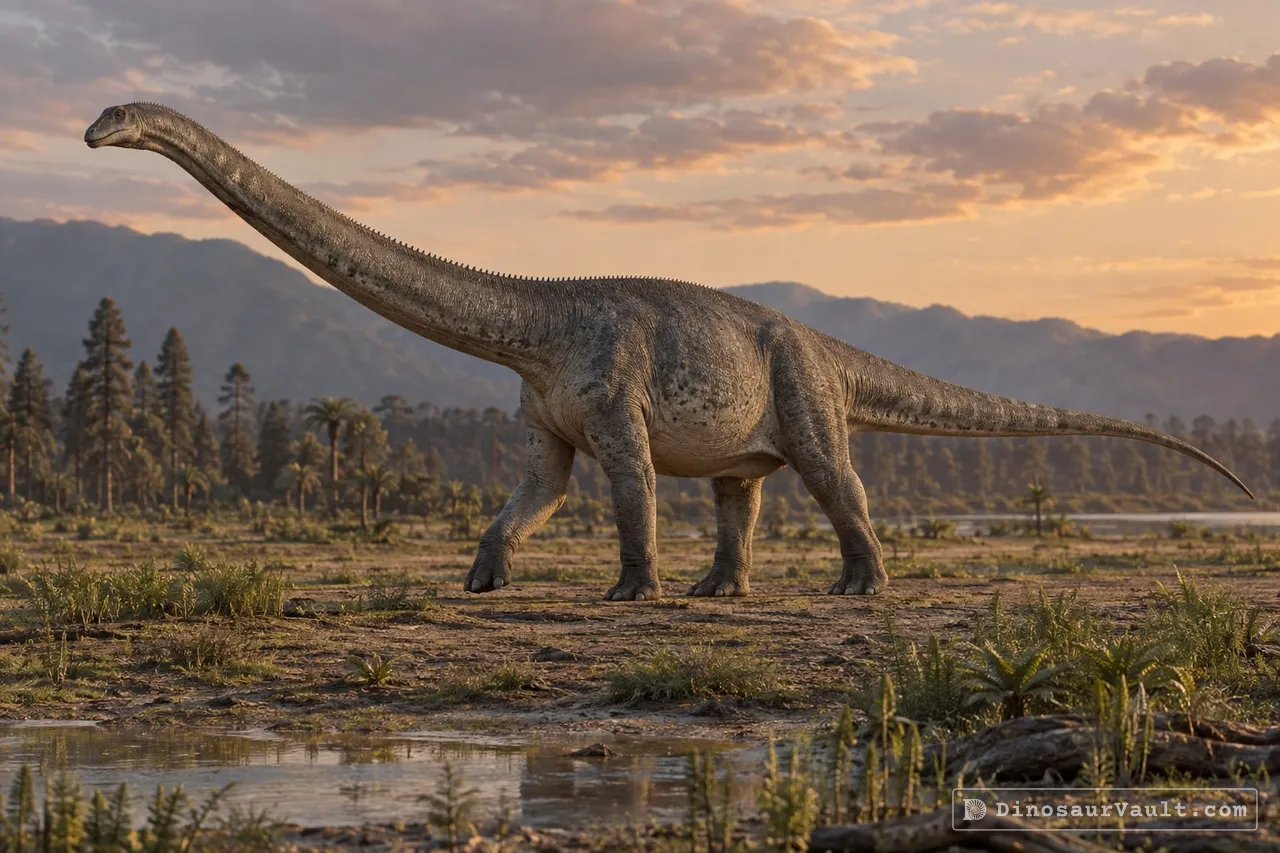
Chuanjiesaurus was a long-necked, four-legged plant eater, a relative of Mamenchisaurus, known from a partial skeleton.
Its world
It lived in the Middle Jurassic in what is now southwestern China. Its bones come from the Chuanjie Formation, where it shared the land with the hunter Shidaisaurus.
How it was found
Fang and colleagues named Chuanjiesaurus in 2000.
Field gallery
More views of Chuanjiesaurus
Scenes reconstructed from the available fossil evidence.
1 of 3
Lived alongside
Found in the same rock formations


A rock formation can hold fossils laid down millions of years apart, so not every animal here met Chuanjiesaurus.
The evidence
The science behind Chuanjiesaurus
Which parts of the picture come from its own bones, and which come from its relatives.
From its own fossils
- The type specimen includes a row of joined tail vertebrae, both shoulder blades, upper arm bones, a left forearm, a right thigh bone with the shin and ankle bones, and both ischia of the hip.
- The front tail vertebrae have socket-and-ball joints, with a strong ball at the back of each.
- The ulna of the forearm is short and robust, the radius is slender and slightly bowed, and the thigh bone has a straight shaft.
Borrowed from relatives
- The missing head, neck and feet are restored by comparison with Mamenchisaurus youngi, a relative known from a nearly articulated skeleton.
- The hand, which is not preserved, is restored from the hands of other sauropods such as Camarasaurus and Apatosaurus.
Still unknown
- The shape of its skull.
- Its neck. The neck vertebrae once described with it belong to the second skeleton now called Analong.
- Its skin covering and color.
Discovery timeline
- 2000Named itFang et al.
- 2021RedescriptionRen et al.
- 2023Close relativeMoore et al.
Key papers
The research behind what we know of Chuanjiesaurus
Named it
Named Chuanjiesaurus from a partial sauropod skeleton with tail vertebrae and substantial limb remains.
[Lower, Middle, and Upper Jurassic divisions of the Lufeng region of Yunnan province]. Proceedings of the Third National Stratigraphical Conference of China. Geological Publishing House, Beijing.
No link available
Redescription
Showed that a skeleton previously assigned to Chuanjiesaurus belonged to a different genus, Analong, using differences in the tail vertebrae and forearm.
A revision of the referred specimen of Chuanjiesaurus anaensis Fang et al., 2000: a new early branching mamenchisaurid sauropod from the Middle Jurassic of China. Historical Biology 33: 1872-1887
Read the paper : A revision of the referred specimen of Chuanjiesaurus anaensis Fang et al., 2000: a new early branching mamenchisaurid sauropod from the Middle Jurassic of China (opens in a new tab)Close relative
Restudied Mamenchisaurus and examined how extremely long necks evolved in the family that includes Chuanjiesaurus.
Re-assessment of the Late Jurassic eusauropod Mamenchisaurus sinocanadorum Russell and Zheng, 1993, and the evolution of exceptionally long necks in mamenchisaurids. Journal of Systematic Palaeontology 21
Read the paper : Re-assessment of the Late Jurassic eusauropod Mamenchisaurus sinocanadorum Russell and Zheng, 1993, and the evolution of exceptionally long necks in mamenchisaurids (opens in a new tab)
Close relatives
Other members of Mamenchisauridae


Sources: Wikidata