Anhuilong
"Anhui dragon"
- Lived
- 175 to 162 million years ago, Middle Jurassic
- Diet
- Herbivore
- Group
- Sauropods, Mamenchisauridae
- Found in
- China
- Named by
- Ren et al. 2018
Where its fossils were found
The evidence
Today

170 million years ago
Habitat
It lived in what is now eastern China during the Middle Jurassic. Huangshanlong also lived in the Hongqin Formation.
Field notes
About Anhuilong
What it was like
Anhuilong was a long-necked sauropod from the family of Mamenchisaurus. It is known from bones of a front leg.
Its world
It lived in the Middle Jurassic in what is now eastern China. Its bones come from the Hongqin Formation, where the sauropod Huangshanlong also lived.
How it was found
Ren and colleagues named it in 2018.
Field gallery
More views of Anhuilong
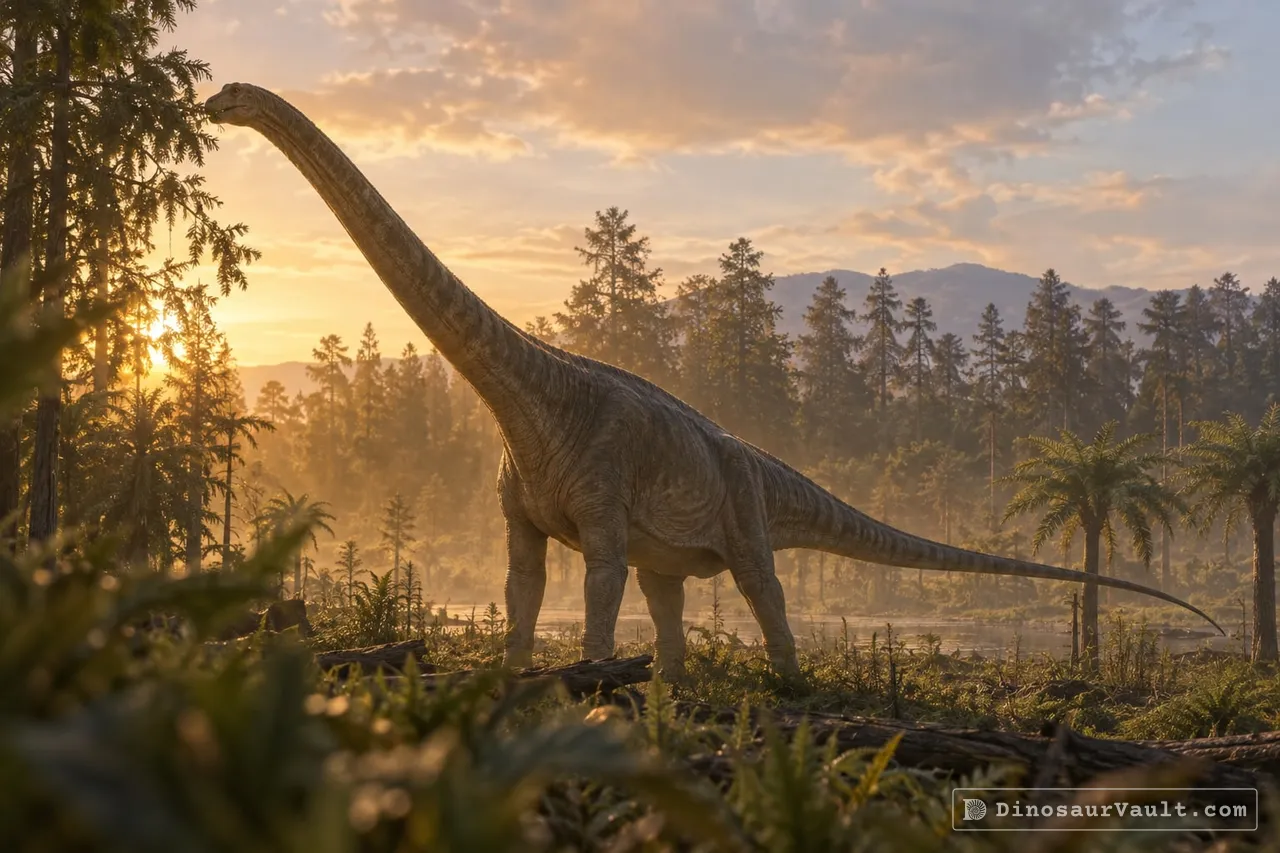
Scenes reconstructed from the available fossil evidence.
1 of 3
Lived alongside
Found in the same rock formations

A rock formation can hold fossils laid down millions of years apart, so not every animal here met Anhuilong.
The evidence
The science behind Anhuilong
Which parts of the picture come from its own bones, and which come from its relatives.
From its own fossils
- The type specimen is the complete upper arm and forearm bones of one left front leg, found together.
- The forearm is relatively short compared with the upper arm, distinguishing it from other members of its family.
- The upper arm bone is fairly slender, and the shaft of the ulna is oval in cross section.
Borrowed from relatives
- The missing head, neck, body, tail and legs are restored after Mamenchisaurus youngi, a more complete relative, but with Anhuilong's own shorter forearm.
Still unknown
- Its total body size and neck length.
- The shape of its skull and teeth.
- Its exact closest relative. The naming study paired it with Huangshanlong, near Omeisaurus.
Discovery timeline
- 2013Close relativeChristian et al.
- 2018Named itRen, Huang & You
- 2021Close relativeUpchurch et al.
- 2023Close relativeMoore et al.
Key papers
The research behind what we know of Anhuilong
Close relative
Studied the complete neck of Mamenchisaurus youngi and found that it probably browsed with its neck held close to horizontal.
Biomechanical Reconstructions and Selective Advantages of Neck Poses and Feeding Strategies of Sauropods with the Example of Mamenchisaurus youngi. PLoS ONE 8: e71172
Read the paper : Biomechanical Reconstructions and Selective Advantages of Neck Poses and Feeding Strategies of Sauropods with the Example of Mamenchisaurus youngi (opens in a new tab)Named it
Named a sauropod from a complete left upper arm and forearm, placing it close to Huangshanlong and Omeisaurus.
The second mamenchisaurid dinosaur from the Middle Jurassic of Eastern China. Historical Biology 32: 602-610
Read the paper : The second mamenchisaurid dinosaur from the Middle Jurassic of Eastern China (opens in a new tab)Close relative
Restudied Hudiesaurus and how very thick forearms evolved in sauropods, and noted that the radius of Anhuilong is short compared with that of Mamenchisaurus youngi.
Re-assessment of the Late Jurassic eusauropod dinosaur Hudiesaurus sinojapanorum Dong, 1997, from the Turpan Basin, China, and the evolution of hyper-robust antebrachia in sauropods. Journal of Vertebrate Paleontology 41
Read the paper : Re-assessment of the Late Jurassic eusauropod dinosaur Hudiesaurus sinojapanorum Dong, 1997, from the Turpan Basin, China, and the evolution of hyper-robust antebrachia in sauropods (opens in a new tab)Close relative
Showed how air-filled vertebrae and long neck ribs supported the exceptionally long neck of a relative, Mamenchisaurus.
Re-assessment of the Late Jurassic eusauropod Mamenchisaurus sinocanadorum Russell and Zheng, 1993, and the evolution of exceptionally long necks in mamenchisaurids. Journal of Systematic Palaeontology 21
Read the paper : Re-assessment of the Late Jurassic eusauropod Mamenchisaurus sinocanadorum Russell and Zheng, 1993, and the evolution of exceptionally long necks in mamenchisaurids (opens in a new tab)
Close relatives
Other members of Mamenchisauridae


Sources: Wikidata