Goyocephale
GOY-oh-SEF-a-lee
"decorated head"
- Lived
- 86 to 66 million years ago, Late Cretaceous
- Diet
- Herbivore
- Length
- about 2 m (7 ft)
- Group
- Pachycephalosaurs
- Found in
- Mongolia
- Named by
- Perle et al. 1982
Size comparison
To scale

Scale in metersOutline: typical pachycephalosaur shape
Where its fossils were found
The evidence
Today

75 million years ago
Habitat
It lived in Mongolia during the Late Cretaceous, and its skeleton was buried in red sand that became sandstone.
Field notes
About Goyocephale
What it was like
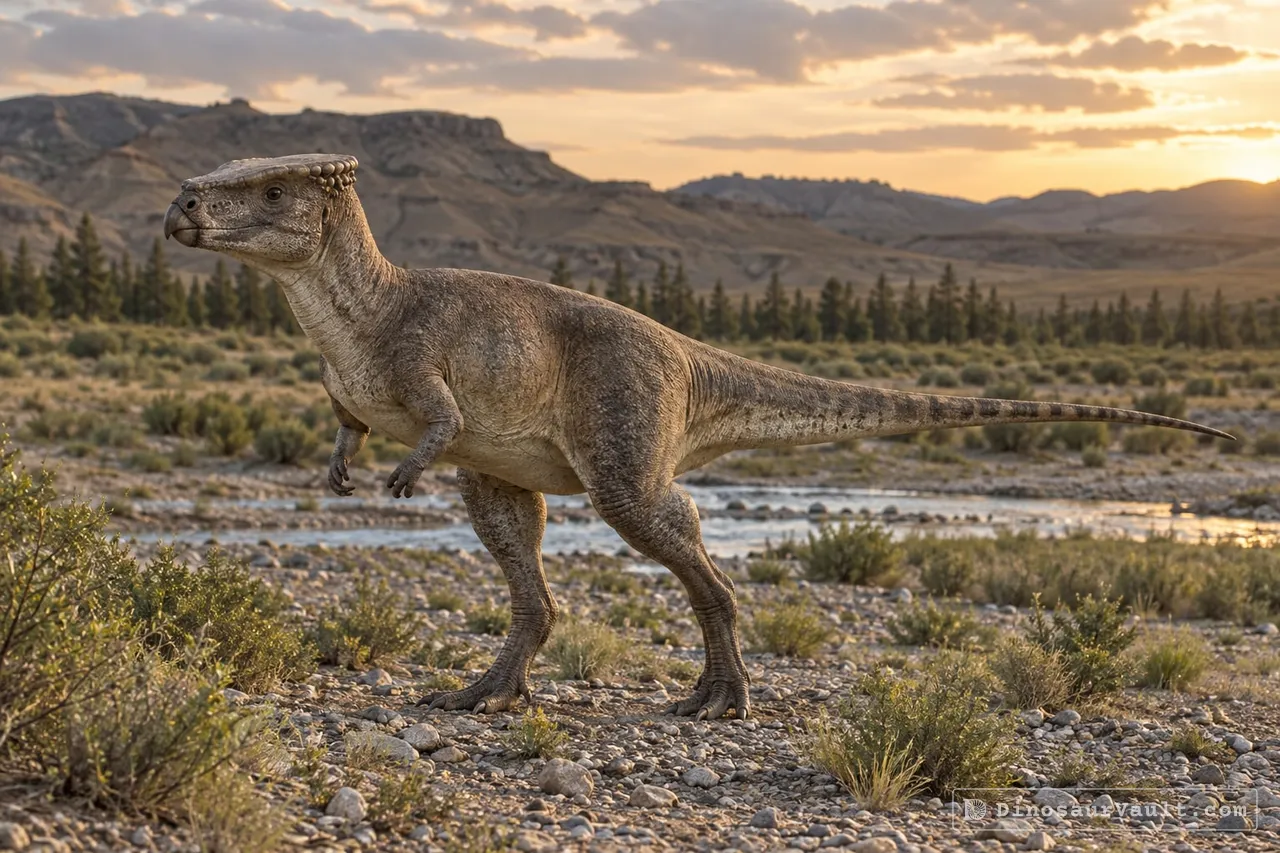
Goyocephale was a small bone-headed dinosaur about 2 meters (7 feet) long. Its skull was flat and thick rather than domed, with knobs around the edges. It had sharp, fang-like teeth at the front of its jaws, and plant-cutting teeth behind.
Its world
It lived in the Late Cretaceous in what is now Mongolia.
How it was found
Perle and colleagues named Goyocephale in 1982 from one partial skeleton with much of the skull.
Field gallery
More views of Goyocephale
Scenes reconstructed from the available fossil evidence.
1 of 3
The evidence
The science behind Goyocephale
Which parts of the picture come from its own bones, and which come from its relatives.
From its own fossils
- A partial skeleton preserves much of the skull, parts of the arms and legs, the hips and much of the tail.
- The skull roof is flat, with pointed bumps on the snout and knobs along its back edge.
- Large fang-like teeth at the front of the jaws fit beside smaller teeth with serrated edges.
Borrowed from relatives
- Missing parts of the neck and trunk are restored by comparison with pachycephalosaurs such as Homalocephale.
- The arrangement of bony rods around the tail follows the better-preserved tail of Homalocephale.
Still unknown
- Whether its flat skull belonged to a young animal or stayed flat in adults.
- Its skin covering and color.
- Exactly what it ate.
Discovery timeline
- 1982Named itPerle, Maryanska & Osmólska
- 2011Growing upSchott et al.
- 2012Full descriptionBrown & Russell
Key papers
The research behind what we know of Goyocephale
Named it
Described a flat skull with knobbed edges, fang-like front teeth and a partial skeleton from Mongolia.
Goyocephale lattimorei gen. et sp. n., a new flat-headed pachycephalosaur (Ornithischia, Dinosauria) from the Upper Cretaceous of Mongolia. Acta Palaeontologica Polonica 27: 115-127
No link available
Growing up
Tracked dome growth in Stegoceras and identified shared skull features that suggest flat-headed Goyocephale may also be young.
Cranial Ontogeny in Stegoceras validum (Dinosauria: Pachycephalosauria): A Quantitative Model of Pachycephalosaur Dome Growth and Variation. PLoS ONE 6: e21092
Read the paper : Cranial Ontogeny in Stegoceras validum (Dinosauria: Pachycephalosauria): A Quantitative Model of Pachycephalosaur Dome Growth and Variation (opens in a new tab)Full description
Reinterpreted the bony tail rods found in Goyocephale and other pachycephalosaurs as hardened sheets that separated tail muscles.
Homology and Architecture of the Caudal Basket of Pachycephalosauria (Dinosauria: Ornithischia): The First Occurrence of Myorhabdoi in Tetrapoda. PLoS ONE 7: e30212
Read the paper : Homology and Architecture of the Caudal Basket of Pachycephalosauria (Dinosauria: Ornithischia): The First Occurrence of Myorhabdoi in Tetrapoda (opens in a new tab)
Close relatives
Other members of Pachycephalosauria


Sources: Wikidata