Stenopelix
"narrow pelvis"
Type species Stenopelix valdensis
- Lived
- 139 to 137 million years ago, Early Cretaceous
- Diet
- Herbivore
- Length
- about 1.5 m (5 ft)
- Group
- Ceratopsians, Chaoyangsauridae
- Found in
- Germany
- Named by
- Meyer 1857
Size comparison
To scale

Scale in metersOutline: typical ceratopsian shape
Where its fossils were found
The evidence
Today

140 million years ago
Habitat
Sandy shores bordered shallow lagoons and swamps in what is now Germany. Iguanodon and Hylaeosaurus are also recorded from the region's Early Cretaceous rocks.
Field notes
About Stenopelix
What it was like
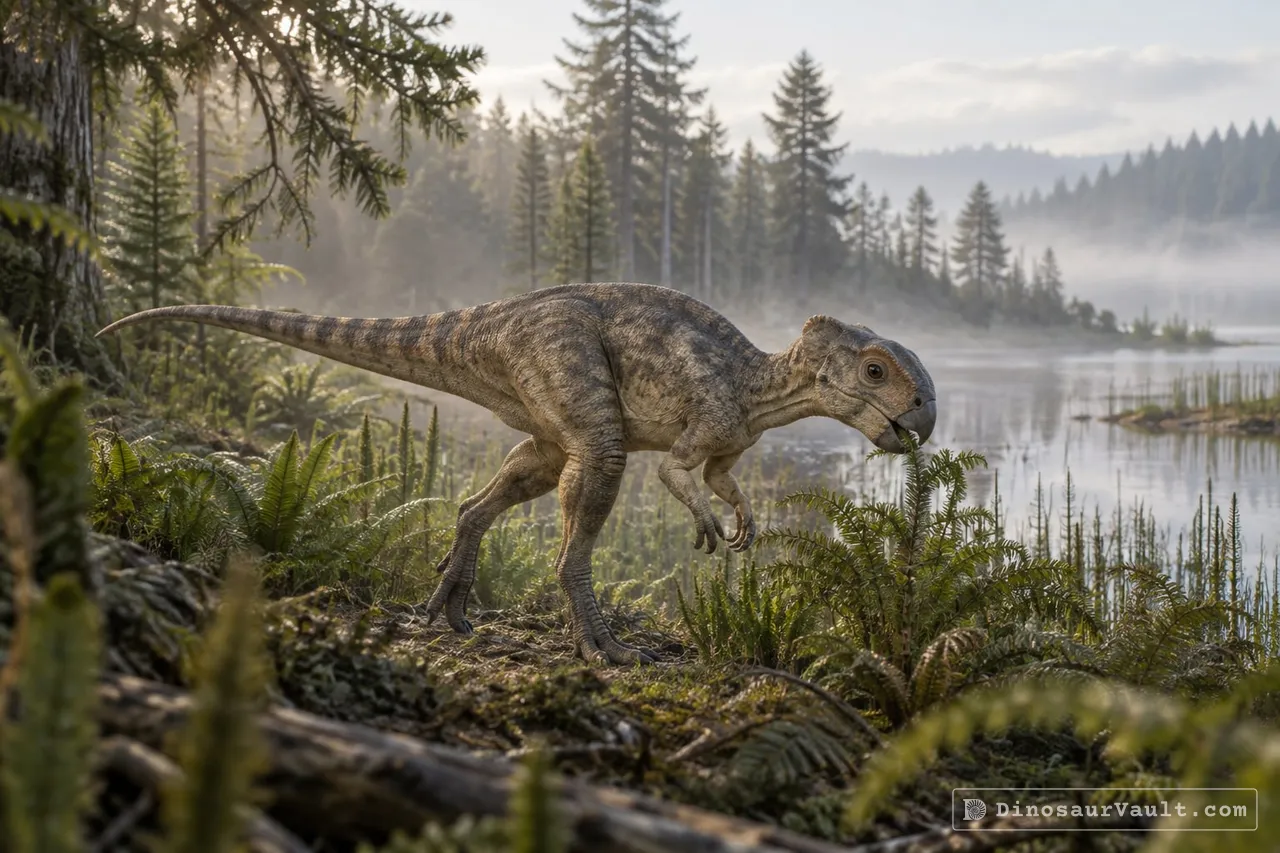
Stenopelix was a small, two-legged plant eater about 1.5 meters (5 feet) long. It is known from a partial skeleton without a skull, preserved as an impression in rock. Its hips suggest it was an early horned dinosaur, but some scientists think it was a bone-headed dinosaur instead.
Its world
It lived in the Early Cretaceous in what is now Germany. Its fossil comes from the Bückeberg Formation, a land of lagoons and swamps.
How it was found
Meyer named Stenopelix in 1857. The type species is Stenopelix valdensis.
Field gallery
More views of Stenopelix
Scenes reconstructed from the available fossil evidence.
1 of 3
Lived alongside
Found in the same rock formations


A rock formation can hold fossils laid down millions of years apart, so not every animal here met Stenopelix.
The evidence
The science behind Stenopelix
Which parts of the picture come from its own bones, and which come from its relatives.
From its own fossils
- A single partial skeleton preserves much of the body and tail as impressions in sandstone.
- The hips include an unusually bent lower hip bone and a tapering upper hip bone.
Borrowed from relatives
- Its missing head is often restored by comparison with early ceratopsians such as Yinlong.
- A small beak would probably have been present if its proposed relationship to Yinlong is correct.
Still unknown
- The shape of its skull.
- Its exact place among early ceratopsians and their relatives.
- Its skin covering and color.
Discovery timeline
- 1857Named itMeyer
- 2009RedescriptionButler & Sullivan
- 2020Family treeYu et al.
Key papers
The research behind what we know of Stenopelix
Named it
Named Stenopelix from the small partial skeleton found in Germany.
Beiträge zur näheren Kenntniss fossiler Reptilien [Contributions to the detailed knowledge of fossil reptiles]. Neues Jahrbuch für Mineralogie, Geognosie, Geologie und Petrefakten-Kunde 1857: 532-543
No link available
Redescription
Reexamined the skeleton and questioned the features used to place Stenopelix among bone-headed dinosaurs.
The Phylogenetic Position of the Ornithischian DinosaurStenopelix valdensisfrom the Lower Cretaceous of Germany and the Early Fossil Record of Pachycephalosauria. Acta Palaeontologica Polonica 54: 21-34
Read the paper : The Phylogenetic Position of the Ornithischian DinosaurStenopelix valdensisfrom the Lower Cretaceous of Germany and the Early Fossil Record of Pachycephalosauria (opens in a new tab)Family tree
A family-tree analysis grouped Stenopelix with Yinlong and other early ceratopsians.
A neoceratopsian dinosaur from the early Cretaceous of Mongolia and the early evolution of ceratopsia. Communications Biology 3
Read the paper : A neoceratopsian dinosaur from the early Cretaceous of Mongolia and the early evolution of ceratopsia (opens in a new tab)
Close relatives
Other members of Chaoyangsauridae


Sources: Wikidata