Chaoyangsaurus
"Chaoyang lizard"
- Lived
- 152 to 133 million years ago, Late Jurassic to Early Cretaceous
- Diet
- Herbivore
- Length
- about 1.1 m (4 ft)
- Group
- Ceratopsians, Chaoyangsauridae
- Found in
- China
- Named by
- Zhao et al. 1999
Size comparison
To scale

Scale in metersOutline: typical ceratopsian shape
Where its fossils were found
The evidence
Today

140 million years ago
Habitat
Rivers and lakes crossed a dry landscape, with conifer trees recorded in parts of the Tuchengzi Formation. Xuanhuaceratops is another small ceratopsian from these rocks, which also preserve tracks of sauropods and meat eaters.
Field notes
About Chaoyangsaurus
What it was like
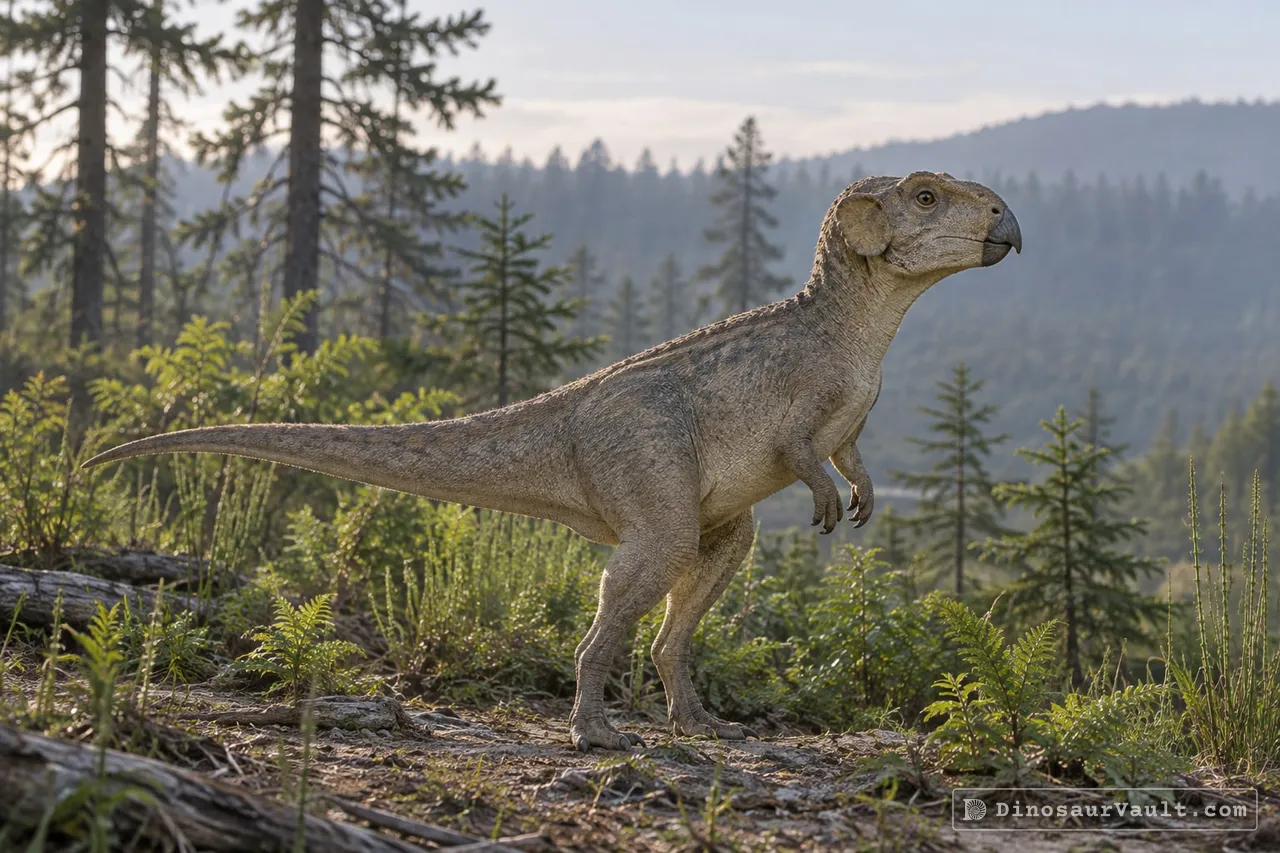
Chaoyangsaurus was a small, early horned dinosaur about 1.1 meters (4 feet) long. It had a parrot-like beak and ran on its hind legs, but it had no real frill or horns yet.
It is one of the oldest known ceratopsians and helps show how the group began.
Its world
It lived in the Late Jurassic or Early Cretaceous in what is now northeastern China. Its bones come from the Tuchengzi Formation, which has also produced the small ceratopsian Xuanhuaceratops.
How it was found
Zhao and colleagues named Chaoyangsaurus in 1999, from a single partial skeleton.
Field gallery
More views of Chaoyangsaurus
Scenes reconstructed from the available fossil evidence.
Lived alongside
Found in the same rock formations

A rock formation can hold fossils laid down millions of years apart, so not every animal here met Chaoyangsaurus.
The evidence
The science behind Chaoyangsaurus
Which parts of the picture come from its own bones, and which come from its relatives.
From its own fossils
- A partial skeleton includes skull bones and an almost complete lower jaw.
- The upper snout retained teeth ahead of the cheek tooth rows.
- Scans reveal replacement teeth growing beside the roots of teeth already in use.
Borrowed from relatives
- Yinlong, a more completely known early ceratopsian, provides a comparison for the missing body parts.
Still unknown
- Its skin covering and color.
- Exactly which plants it ate.
- How its body proportions changed during growth.
Discovery timeline
- 1999Named itZhao, Cheng & Xu
- 2015Family treeHan et al.
- 2015Same rocksXing et al.
- 2022How it fedHu et al.
Key papers
The research behind what we know of Chaoyangsaurus
Named it
Described a small early ceratopsian from a partial skeleton with distinctive jaw and skull bones.
The earliest ceratopsian from the Tuchengzi Formation of Liaoning, China. Journal of Vertebrate Paleontology 19: 681-697
No link available
Family tree
Named Hualianceratops and grouped it with Chaoyangsaurus, Yinlong and Xuanhuaceratops near the base of the ceratopsian family tree.
A New Taxon of Basal Ceratopsian from China and the Early Evolution of Ceratopsia. PLOS ONE 10: e0143369
Read the paper : A New Taxon of Basal Ceratopsian from China and the Early Evolution of Ceratopsia (opens in a new tab)Same rocks
Described dinosaur tracks in the Tuchengzi Formation and reconstructed river and lakeshore habitats affected by volcanic activity.
Hints of the Early Jehol Biota: Important Dinosaur Footprint Assemblages from the Jurassic-Cretaceous Boundary Tuchengzi Formation in Beijing, China. PLOS ONE 10: e0122715
Read the paper : Hints of the Early Jehol Biota: Important Dinosaur Footprint Assemblages from the Jurassic-Cretaceous Boundary Tuchengzi Formation in Beijing, China (opens in a new tab)How it fed
Scanned its jaws and compared tooth replacement with Yinlong and Hualianceratops, revealing a simpler system than in later horned dinosaurs.
Computed tomographic analysis of the dental system of three Jurassic ceratopsians and implications for the evolution of tooth replacement pattern and diet in early-diverging ceratopsians. eLife 11
Read the paper : Computed tomographic analysis of the dental system of three Jurassic ceratopsians and implications for the evolution of tooth replacement pattern and diet in early-diverging ceratopsians (opens in a new tab)
Close relatives
Other members of Chaoyangsauridae


Sources: Wikidata