Xuanhuaceratops
"Xuanhua horned face"
- Lived
- 152 to 133 million years ago, Late Jurassic to Early Cretaceous
- Diet
- Herbivore
- Group
- Ceratopsians, Chaoyangsauridae
- Found in
- China
- Named by
- Zhao et al. 2006
Where its fossils were found
The evidence
Today

140 million years ago
Habitat
The Tuchengzi Formation records hot, relatively dry inland basins with rivers and shallow lakes. Chaoyangsaurus also lived in this region, alongside sauropods and meat-eating dinosaurs known from tracks.
Field notes
About Xuanhuaceratops
What it was like
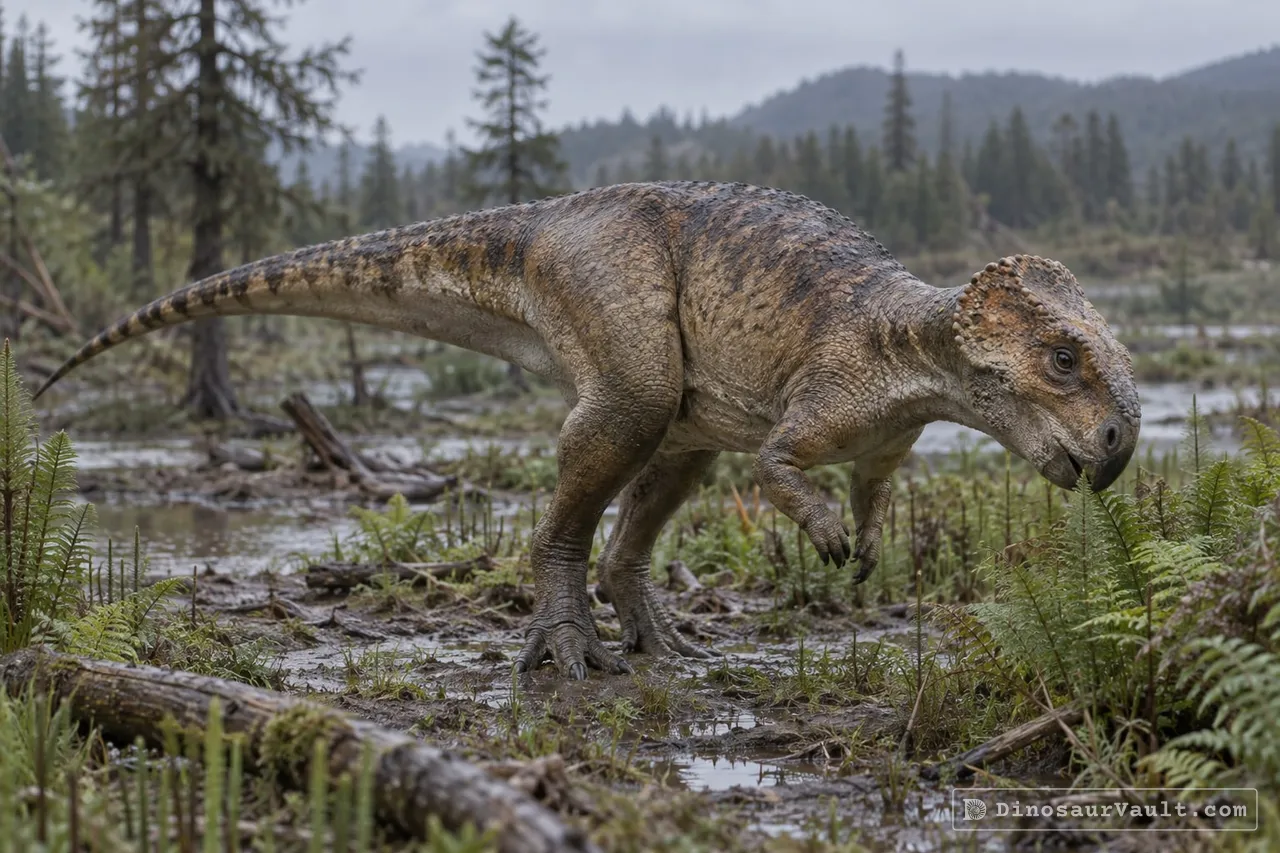
Xuanhuaceratops was one of the earliest horned dinosaurs, a small plant eater that probably walked on two legs. It had a narrow beak but no horns or large frill.
Its world
It lived around the end of the Jurassic in what is now northern China. Its bones come from the Tuchengzi Formation, where the early horned dinosaur Chaoyangsaurus also lived.
How it was found
Zhao and colleagues named it in 2006 from one find.
Field gallery
More views of Xuanhuaceratops
Scenes reconstructed from the available fossil evidence.
Lived alongside
Found in the same rock formations

A rock formation can hold fossils laid down millions of years apart, so not every animal here met Xuanhuaceratops.
The evidence
The science behind Xuanhuaceratops
Which parts of the picture come from its own bones, and which come from its relatives.
From its own fossils
- Fragmentary skeletons from several animals preserve parts of the skull and body; the cheek and lower-jaw bones are strongly grooved.
- The front upper jaw carries a single tooth on each side.
- Details of the jaw joint and shoulder blade distinguish it from Chaoyangsaurus.
Borrowed from relatives
- Its missing face, neck, trunk and upper arms are restored after Yinlong.
Still unknown
- The complete outline of its skull and body, including the shape of the rear skull roof.
- Its skin covering and color.
- Its precise place among the earliest ceratopsians.
Discovery timeline
- 2006Named itZhao et al.
- 2015Family treeHan et al.
- 2015Its worldXing et al.
Key papers
The research behind what we know of Xuanhuaceratops
Named it
Named Xuanhuaceratops from fragmentary specimens and separated it from Chaoyangsaurus by a single front tooth and details of the jaw joint and shoulder blade.
A new ceratopsian from the Upper Jurassic Houcheng Formation of Hebei, China. Acta Geologica Sinica 80: 467-473
No link available
Family tree
Described Hualianceratops and tested where Xuanhuaceratops and Chaoyangsaurus fall among early ceratopsians.
A New Taxon of Basal Ceratopsian from China and the Early Evolution of Ceratopsia. PLOS ONE 10: e0143369
Read the paper : A New Taxon of Basal Ceratopsian from China and the Early Evolution of Ceratopsia (opens in a new tab)Its world
Described dinosaur tracks from river and lake-margin deposits of the Tuchengzi Formation.
Hints of the Early Jehol Biota: Important Dinosaur Footprint Assemblages from the Jurassic-Cretaceous Boundary Tuchengzi Formation in Beijing, China. PLOS ONE 10: e0122715
Read the paper : Hints of the Early Jehol Biota: Important Dinosaur Footprint Assemblages from the Jurassic-Cretaceous Boundary Tuchengzi Formation in Beijing, China (opens in a new tab)
Close relatives
Other members of Chaoyangsauridae


Sources: Wikidata