Amygdalodon
"almond tooth"
Type species Amygdalodon patagonicus
- Lived
- 193 to 183 million years ago, Early Jurassic
- Diet
- Herbivore
- Group
- Sauropods
- Found in
- Argentina
- Named by
- Cabrera 1947
Where its fossils were found
The evidence
Today

190 million years ago
Habitat
It lived in what is now Argentina. Its bones come from sandstone and layers of volcanic ash in the Cerro Carnerero Formation.
Field notes
About Amygdalodon
What it was like
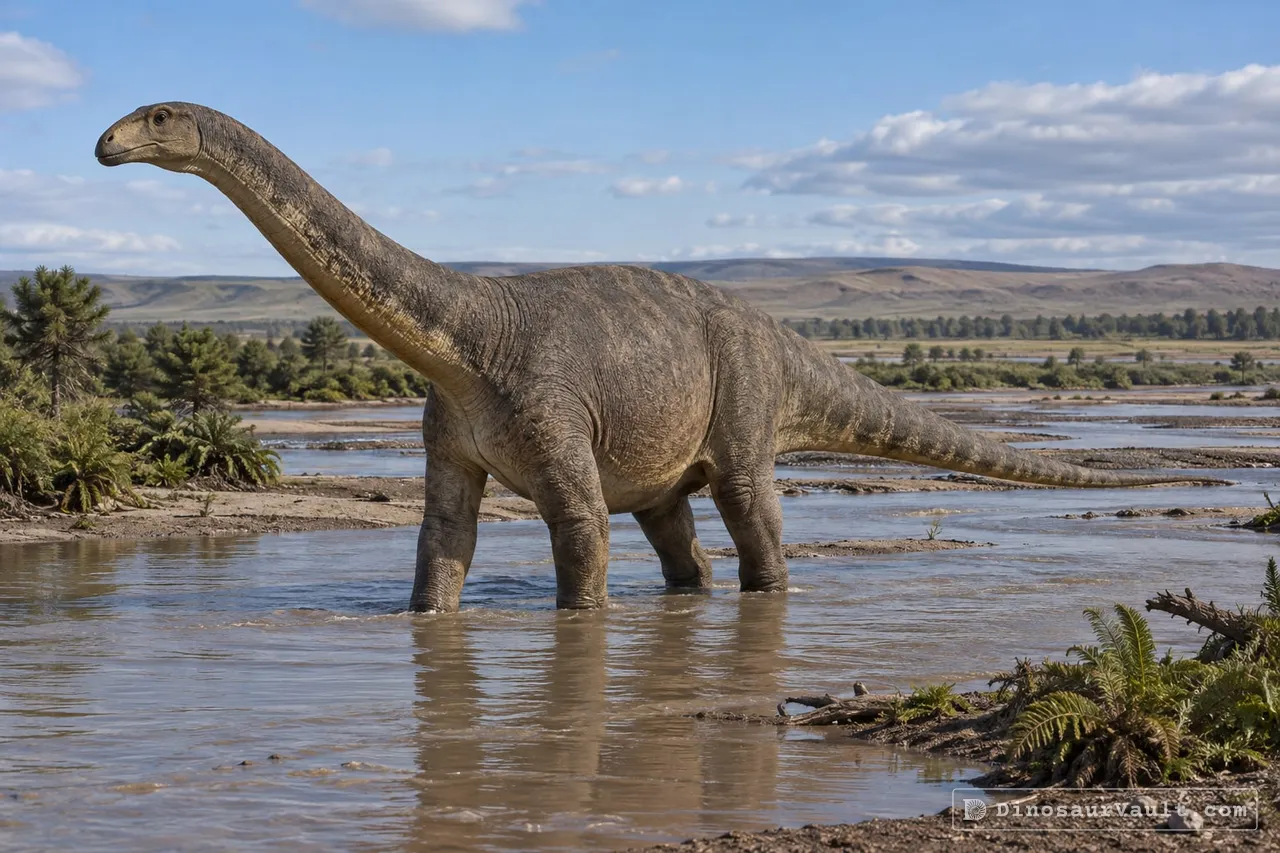
Amygdalodon was an early sauropod, a long-necked plant eater known from a few bones and teeth. Its teeth were shaped like almonds, which gave it its name.
Its world
It lived in the Early Jurassic in what is now Argentina. Its bones come from the Cerro Carnerero Formation.
How it was found
Cabrera named it in 1947. The type species is Amygdalodon patagonicus. It is one of very few Jurassic sauropods known from South America.
Field gallery
More views of Amygdalodon
Scenes reconstructed from the available fossil evidence.
1 of 3
The evidence
The science behind Amygdalodon
Which parts of the picture come from its own bones, and which come from its relatives.
From its own fossils
- Back vertebrae have a distinctive bend in the passage for the spinal cord, with its walls flaring outward toward the rear.
- Teeth assigned to Amygdalodon have broad, spoon-shaped crowns with grooves and pits in their enamel.
Borrowed from relatives
- The missing head and body are restored using early long-necked dinosaurs such as Tazoudasaurus and the more distant Plateosaurus.
Still unknown
- Whether all the teeth and bones assigned to it belong to the same species.
- Its complete head shape and body proportions.
- Its skin covering and color.
Discovery timeline
- 1947Named itCabrera
- 2003RedescriptionRauhut
- 2010How it fedCarballido & Pol
Key papers
The research behind what we know of Amygdalodon
Named it
Named an early long-necked dinosaur from fragmentary bones and teeth found in Argentina.
Un saurópodo nuevo del Jurásico de Patagonia. Instituto del Museo de la Universidad Nacional de La Plata, Notas del Mueso de La Plata, Paleontología 12: 1-17
No link available
Redescription
Recognized bones from several animals in the original collection and chose a distinctive back vertebra to anchor the species name.
Revision of <i>Amygdalodon patagonicus</i> Cabrera, 1947 (Dinosauria, Sauropoda). Fossil Record 6: 173-181
Read the paper : Revision of <i>Amygdalodon patagonicus</i> Cabrera, 1947 (Dinosauria, Sauropoda) (opens in a new tab)How it fed
Described broad teeth with distinctive enamel and wear marks showing that opposing teeth rubbed against each other.
The dentition of Amygdalodon patagonicus (Dinosauria: Sauropoda) and the dental evolution in basal sauropods. Comptes Rendus Palevol 9: 83-93
Read the paper : The dentition of Amygdalodon patagonicus (Dinosauria: Sauropoda) and the dental evolution in basal sauropods (opens in a new tab)
Close relatives
Other members of Gravisauria


Sources: Wikidata