Barapasaurus
ba-RAH-pa-SORE-us
"big leg lizard"
Type species Barapasaurus tagorei
- Lived
- 200 to 184 million years ago, Early Jurassic
- Diet
- Herbivore
- Length
- about 14 m (46 ft)
- Group
- Sauropods
- Found in
- India
- Named by
- Jain et al. 1975
Size comparison
To scale


Scale in metersOutline: typical sauropod shape
Where its fossils were found
The evidence
Today

190 million years ago
Habitat
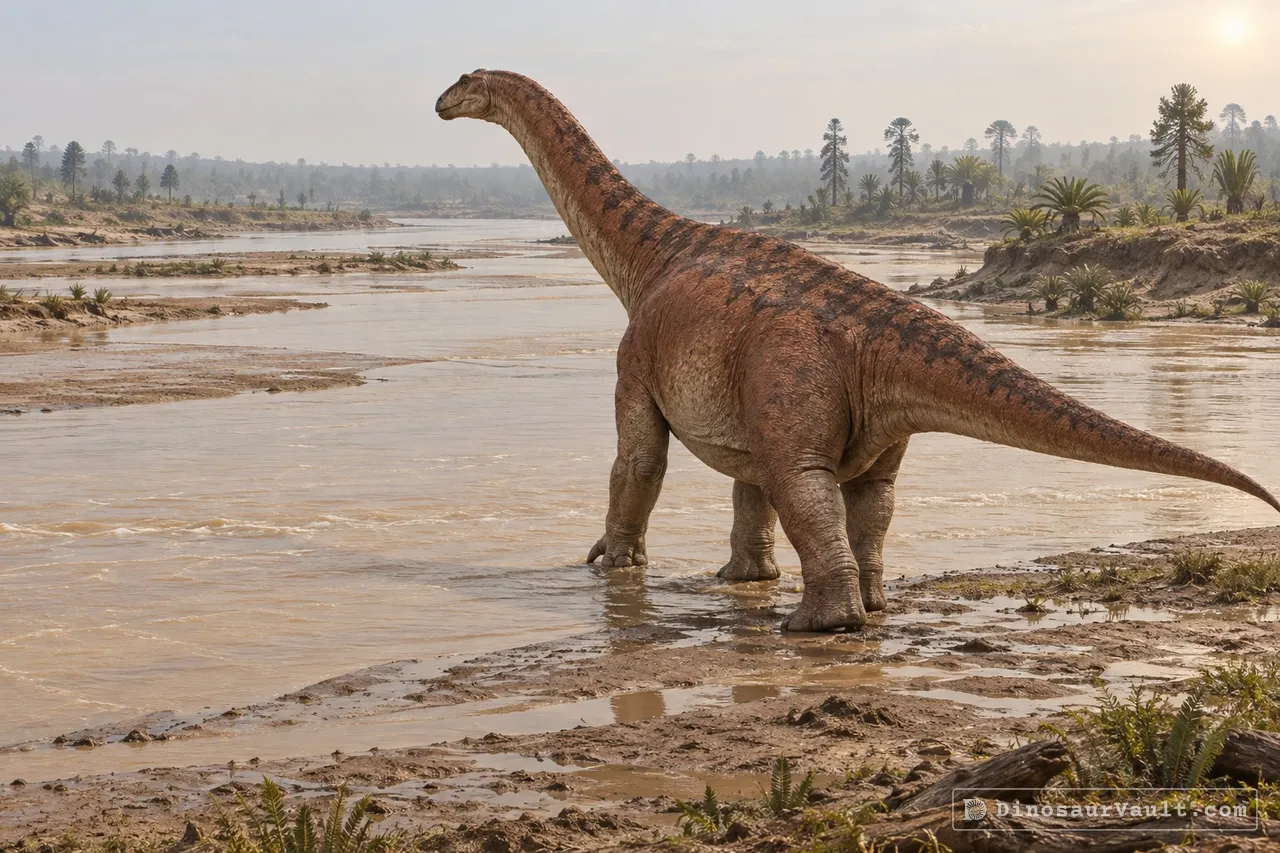
Rivers and lakes lay among conifer forests in the landscape preserved by the Kota Formation. Kotasaurus was another sauropod in the region. Campylognathoides, a pterosaur, is also reported from these rocks.
Field notes
About Barapasaurus
What it was like
Barapasaurus was one of the earliest true sauropods, a long-necked plant eater about 14 meters (46 feet) long. It had long, straight legs, a long neck and spoon-shaped teeth with rough edges. No skull has been found.
Its world
It lived in the Early Jurassic, in what is now India. Its bones come from the Kota Formation, where it shared the land with the smaller sauropod Kotasaurus.
How it was found
Jain and colleagues named Barapasaurus in 1975. The type species is Barapasaurus tagorei. Hundreds of bones from several animals were found together, so most of its skeleton is known.
Field gallery
More views of Barapasaurus
Scenes reconstructed from the available fossil evidence.
1 of 3
Lived alongside
Found in the same rock formations

A rock formation can hold fossils laid down millions of years apart, so not every animal here met Barapasaurus.
The evidence
The science behind Barapasaurus
Which parts of the picture come from its own bones, and which come from its relatives.
From its own fossils
- Hundreds of bones from several animals preserve much of the backbone, shoulders, hips and limbs.
- Spoon-shaped teeth have wrinkled enamel and rough edges.
- Claw bones show that it had a curved claw on the inner finger of each hand.
Borrowed from relatives
- Most of the body is known from its own bones.
- Shunosaurus provides a comparison for the missing skull, with broad teeth suited to eating plants.
- Other early sauropods help restore the missing front of the neck.
Still unknown
- The full shape of its skull and front of the neck.
- Its skin texture and color.
- Whether the animals buried together lived in a herd.
Discovery timeline
- 1975Named itJain et al.
- 2002Close relativeChatterjee & Zheng
- 2010Full descriptionBANDYOPADHYAY et al.
Key papers
The research behind what we know of Barapasaurus
Named it
Named Barapasaurus from a large collection of bones belonging to an early long-necked plant eater from India.
The sauropod dinosaur from the Lower Jurassic Kota formation of India. Proceedings of the Royal Society of London. Series B. Biological Sciences 188: 221-228
Read the paper : The sauropod dinosaur from the Lower Jurassic Kota formation of India (opens in a new tab)Close relative
Described the skull and broad teeth of Shunosaurus, providing a comparison for the missing head of Barapasaurus.
Cranial anatomy of Shunosaurus, a basal sauropod dinosaur from the Middle Jurassic of China. Zoological Journal of the Linnean Society 136: 145-169
Read the paper : Cranial anatomy of Shunosaurus, a basal sauropod dinosaur from the Middle Jurassic of China (opens in a new tab)Full description
Described the backbone, limbs and teeth in detail, showing how Barapasaurus combined early sauropod features with changes toward a large, four-legged body.
Osteology of Barapasaurus tagorei (Dinosauria: Sauropoda) from the Early Jurassic of India. Palaeontology 53: 533-569
Read the paper : Osteology of Barapasaurus tagorei (Dinosauria: Sauropoda) from the Early Jurassic of India (opens in a new tab)
Close relatives
Other members of Gravisauria


Sources: Wikidata