Ruehleia
Type species Ruehleia bedheimensis
- Lived
- 227 to 206 million years ago, Late Triassic
- Group
- Early sauropodomorphs, Plateosauridae
- Found in
- Germany
- Named by
- Galton 2001
Where its fossils were found
The evidence
Today

220 million years ago
Habitat
It lived on a floodplain in what is now Germany, alongside Plateosaurus and the predator Liliensternus.
Field notes
About Ruehleia
What it was like
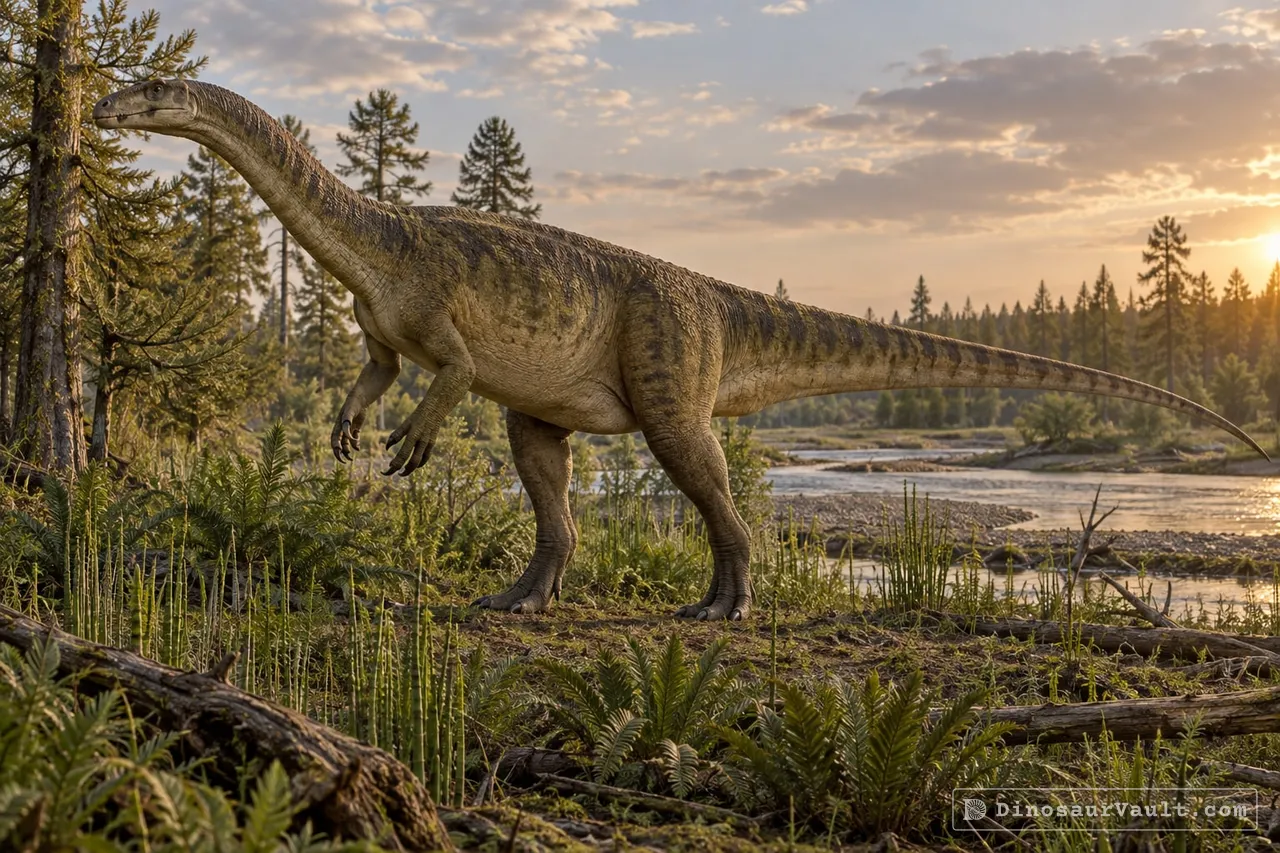
Ruehleia was a plant eater related to Plateosaurus, with a long neck and small head. It is known from one nearly complete skeleton without a skull.
Its world
It lived in the Late Triassic, in what is now Germany, alongside Plateosaurus and the predator Liliensternus.
How it was found
Galton named Ruehleia in 2001. The type species is Ruehleia bedheimensis. The skeleton had been found decades earlier and was first thought to be Plateosaurus.
Field gallery
More views of Ruehleia
Scenes reconstructed from the available fossil evidence.
Lived alongside
Found in the same rock formations


A rock formation can hold fossils laid down millions of years apart, so not every animal here met Ruehleia.
The evidence
The science behind Ruehleia
Which parts of the picture come from its own bones, and which come from its relatives.
From its own fossils
- The main skeleton preserves neck, back and tail vertebrae, ribs and hip bones.
- Its thigh bones have straighter shafts than those of Plateosaurus.
Borrowed from relatives
- Plateosaurus supplies a model for the missing skull, with a rounded, tooth-bearing snout.
- The grasping hands and missing foot details in restorations follow Plateosaurus.
Still unknown
- The shape of its skull.
- Its exact walking posture and complete tail length.
- Its skin covering and color.
Often drawn wrong
- A toothless beak replaces the toothed snout suggested by Plateosaurus.
- Straight thigh bones alone are no reason to give it the column-like stance of a giant sauropod.
Discovery timeline
- 2001Named itGalton
- 2020Family treeLefebvre et al.
- 2025Full descriptionBeeston et al.
Key papers
The research behind what we know of Ruehleia
Named it
Recognized a skeleton previously assigned to Plateosaurus as a distinct early sauropodomorph and named Ruehleia.
The prosauropod dinosaur Plateosaurus Meyer, 1837 (Saurischia: Sauropodomorpha; Upper Triassic). II. Notes on the referred species. Revue Paléobiologie, Genève 20: 435-502
No link available
Family tree
Compared limb shapes and found that the main Ruehleia skeleton has straighter thigh bones than Plateosaurus.
Disentangling biological variability and taphonomy: shape analysis of the limb long bones of the sauropodomorph dinosaur Plateosaurus. PeerJ 8: e9359
Read the paper : Disentangling biological variability and taphonomy: shape analysis of the limb long bones of the sauropodomorph dinosaur Plateosaurus (opens in a new tab)Full description
Examined Ruehleia vertebrae alongside other early sauropodomorphs to trace the origins of air spaces inside dinosaur bones.
New information on Late Triassic sauropodomorph dinosaurs provides support for the independent acquisition of postcranial skeletal pneumaticity in avemetatarsalian lineages. Journal of Anatomy 248: 541-578
Read the paper : New information on Late Triassic sauropodomorph dinosaurs provides support for the independent acquisition of postcranial skeletal pneumaticity in avemetatarsalian lineages (opens in a new tab)
Close relatives
Other members of Plateosauridae


Sources: Wikidata