Austroposeidon
"southern Poseidon"
- Lived
- 84 to 66 million years ago, Late Cretaceous
- Diet
- Herbivore
- Group
- Sauropods
- Found in
- Brazil
- Named by
- Bandeira et al. 2016
Where its fossils were found
The evidence
Today

75 million years ago
Habitat
It lived on a floodplain in what is now Brazil. The Presidente Prudente Formation also preserves fish, turtles and crocodile relatives.
Field notes
About Austroposeidon
What it was like
Austroposeidon was a titanosaur, a long-necked plant eater. It is known from bones of the neck and back, and it was one of the largest dinosaurs found in Brazil.
Its world
It lived in the Late Cretaceous in what is now Brazil. Its bones come from the Presidente Prudente Formation. Its closest relatives include Futalognkosaurus and Mendozasaurus from Argentina.
How it was found
Bandeira and colleagues named it in 2016. Scans of the bones showed that they were filled with air spaces, which kept the huge skeleton light.
Field gallery
More views of Austroposeidon
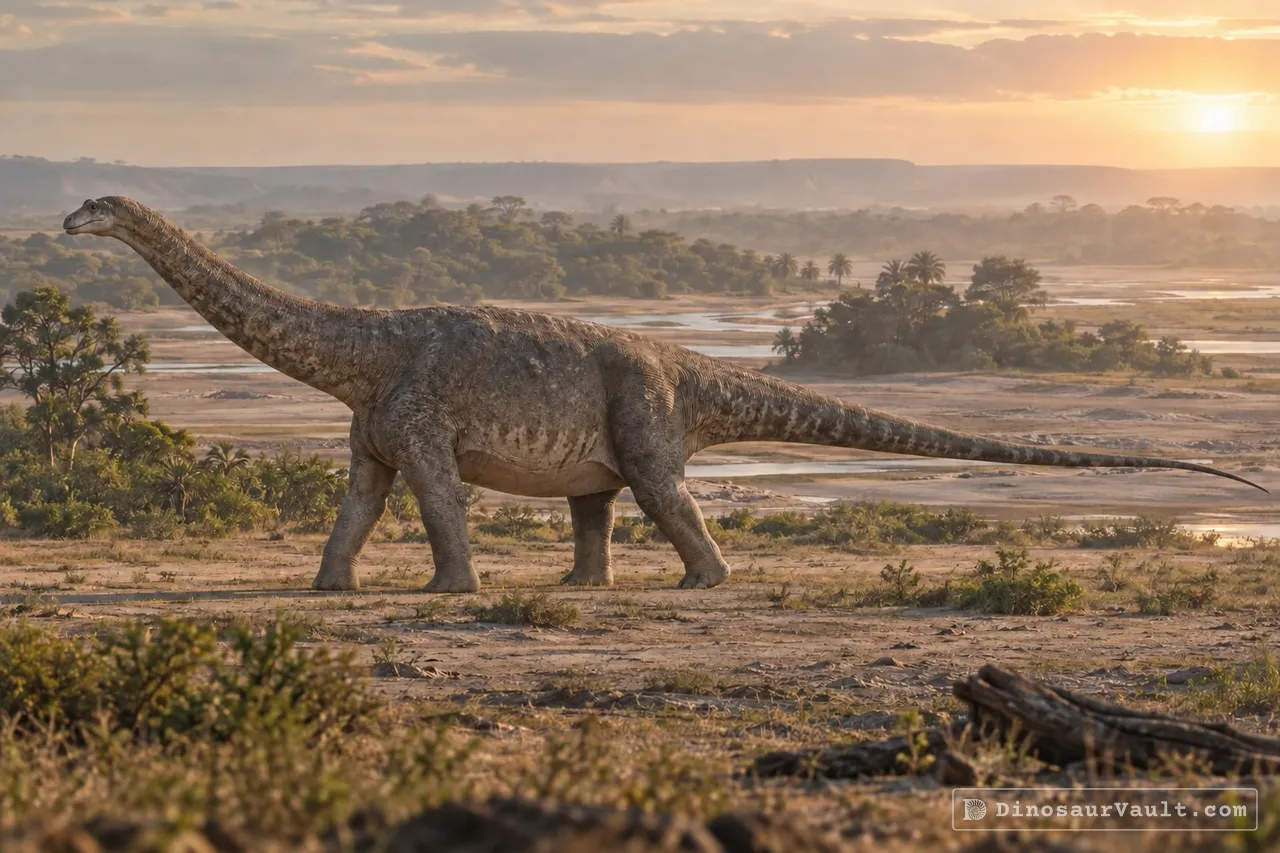
Scenes reconstructed from the available fossil evidence.
1 of 3
The evidence
The science behind Austroposeidon
Which parts of the picture come from its own bones, and which come from its relatives.
From its own fossils
- Parts of the neck and back vertebrae, a neck rib and a fragment from the hips belong to a single large animal.
- Scans show a honeycomb of small air chambers inside its vertebrae.
- Its neck vertebrae have tall spines and strong bony ridges.
Borrowed from relatives
- The head, limbs and tail are restored from other titanosaurs, including relatives such as Mendozasaurus and Futalognkosaurus.
Still unknown
- Its complete body length and weight.
- The proportions of its head, neck, limbs and tail.
- Its skin covering and color.
Discovery timeline
- 2007Close relativeCalvo et al.
- 2016Named itBandeira et al.
- 2018Close relativeGonzàlez Riga et al.
Key papers
The research behind what we know of Austroposeidon
Close relative
Described the extensive skeleton of Futalognkosaurus and grouped it with Mendozasaurus, relatives used to compare Austroposeidon's fragmentary bones.
A new Cretaceous terrestrial ecosystem from Gondwana with the description of a new sauropod dinosaur. Anais da Academia Brasileira de Ciências 79: 529-541
Read the paper : A new Cretaceous terrestrial ecosystem from Gondwana with the description of a new sauropod dinosaur (opens in a new tab)Named it
Named a giant Brazilian titanosaur and used scans to reveal the air chambers inside its neck bones.
A New Giant Titanosauria (Dinosauria: Sauropoda) from the Late Cretaceous Bauru Group, Brazil. PLOS ONE 11: e0163373
Read the paper : A New Giant Titanosauria (Dinosauria: Sauropoda) from the Late Cretaceous Bauru Group, Brazil (opens in a new tab)Close relative
Described Mendozasaurus in detail, including its neck bones and hind foot, providing comparisons for less complete giant titanosaurs.
Osteology of the Late Cretaceous Argentinean sauropod dinosaur Mendozasaurus neguyelap: implications for basal titanosaur relationships. Zoological Journal of the Linnean Society 184: 136-181
Read the paper : Osteology of the Late Cretaceous Argentinean sauropod dinosaur Mendozasaurus neguyelap: implications for basal titanosaur relationships (opens in a new tab)
Close relatives
Other members of Lognkosauria


Sources: Wikidata