Proceratosaurus
PRO-seh-RAT-oh-SORE-us
"before Ceratosaurus"
- Lived
- 168 to 165 million years ago, Middle Jurassic
- Diet
- Carnivore
- Length
- estimates range from 3 to 4.1 m (10 to 13 ft)
- Group
- Theropods, Proceratosauridae
- Found in
- United Kingdom
- Named by
- Huene 1926
Where its fossils were found
The evidence
Today

165 million years ago
Habitat
Low islands bordered by warm, shallow seas in what is now England. Megalosaurus and Cetiosaurus lived in the wider region.
Field notes
About Proceratosaurus
What it was like
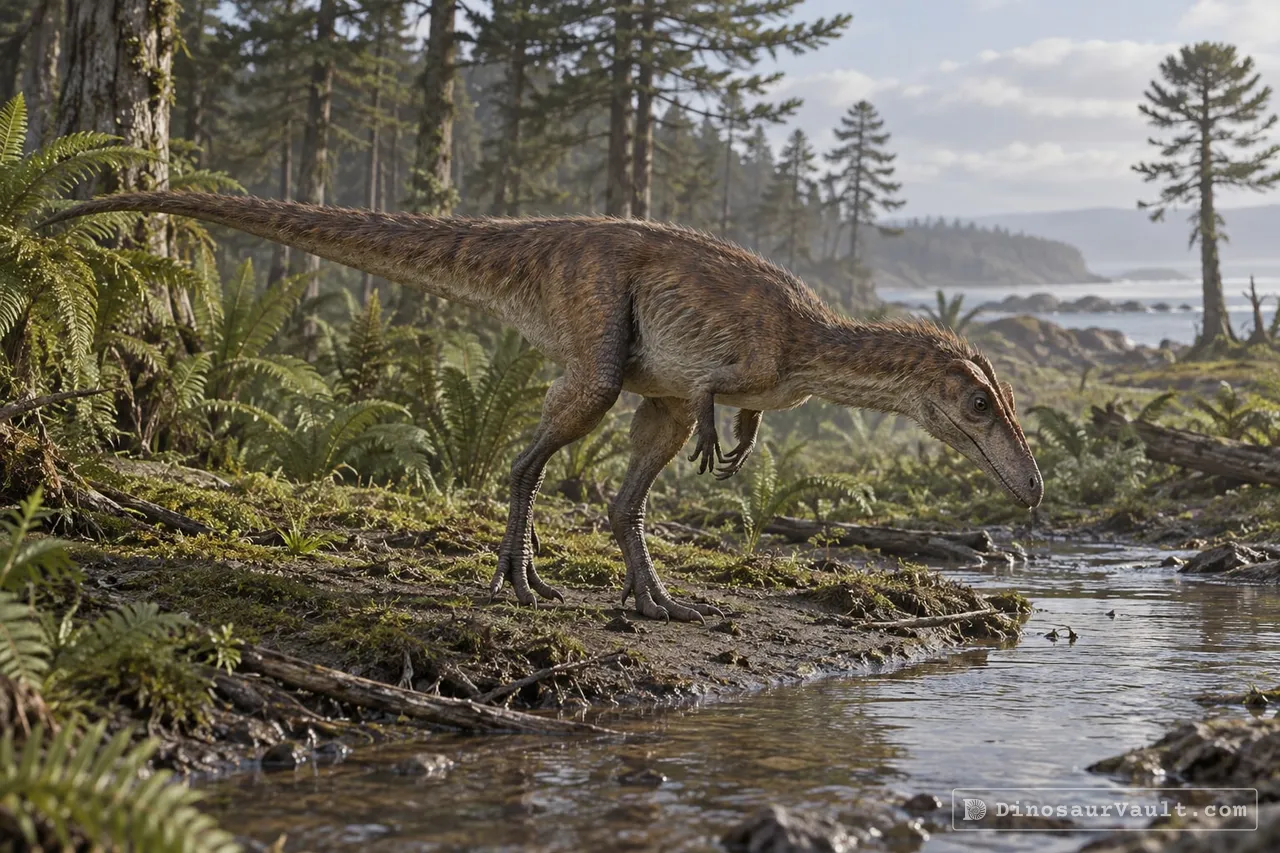
Proceratosaurus was a small meat eater between 3 and 4.1 meters (10 to 13 feet) long, known from a single skull. It had a thin crest on its snout, which is why it was first thought to be related to Ceratosaurus.
It is now known to be an early relative of Tyrannosaurus, part of a group of crested hunters that includes Guanlong from China.
Its world
It lived in the Middle Jurassic, about 168 to 165 million years ago, in what is now England. Its skull comes from the White Limestone, rock formed in warm, shallow seas around low islands.
How it was found
Huene named Proceratosaurus in 1926. The skull had been found years earlier and first placed in Megalosaurus.
Field gallery
More views of Proceratosaurus
Scenes reconstructed from the available fossil evidence.
1 of 3
The evidence
The science behind Proceratosaurus
Which parts of the picture come from its own bones, and which come from its relatives.
From its own fossils
- A single partial skull preserves a long, low snout and a shallow lower jaw.
- Large bony openings housed the nostrils, and a broken crest base rises along the middle of the snout.
Borrowed from relatives
- Guanlong helps restore a thin crest along the middle of the skull.
- Dilong suggests a slender body, long arms with three fingers, and a covering of simple feather-like filaments.
Still unknown
- The full height and outline of its crest.
- Its body proportions and whether it had feathers.
- Its color and the purpose of the crest.
Often drawn wrong
- The short, two-fingered arms of Tyrannosaurus are a poor model for this early relative.
- Copying the huge crest of Guanlong gives it a shape beyond the preserved crest base.
Discovery timeline
- 1926Named itvon Huene
- 2004SkinXu et al.
- 2006Close relativeXu et al.
- 2010SkullRAUHUT, MILNER & MOORE-FAY
Key papers
The research behind what we know of Proceratosaurus
Named it
Gave a previously described skull its own genus name, reflecting a proposed connection with Ceratosaurus.
LX.—On several known and unknown reptiles of the order Saurischia from England and France. Annals and Magazine of Natural History 17: 473-489
Read the paper : LX.—On several known and unknown reptiles of the order Saurischia from England and France (opens in a new tab)Skin
Described Dilong with long, three-fingered arms and feather-like filaments, useful comparisons for the missing body of Proceratosaurus.
Basal tyrannosauroids from China and evidence for protofeathers in tyrannosauroids. Nature 431: 680-684
Read the paper : Basal tyrannosauroids from China and evidence for protofeathers in tyrannosauroids (opens in a new tab)Close relative
Described Guanlong, an early tyrannosauroid with a large, thin crest that helps interpret the broken crest of Proceratosaurus.
A basal tyrannosauroid dinosaur from the Late Jurassic of China. Nature 439: 715-718
Read the paper : A basal tyrannosauroid dinosaur from the Late Jurassic of China (opens in a new tab)Skull
Restudied the skull and identified Proceratosaurus as an early tyrannosauroid closely related to Guanlong.
Cranial osteology and phylogenetic position of the theropod dinosaurProceratosaurus bradleyi(Woodward, 1910) from the Middle Jurassic of England. Zoological Journal of the Linnean Society 158: 155-195
Read the paper : Cranial osteology and phylogenetic position of the theropod dinosaurProceratosaurus bradleyi(Woodward, 1910) from the Middle Jurassic of England (opens in a new tab)
Close relatives
Other members of Proceratosauridae


Sources: Wikidata