Kileskus
- Lived
- 168 to 165 million years ago, Middle Jurassic
- Diet
- Carnivore
- Group
- Theropods, Proceratosauridae
- Found in
- Russia
- Named by
- Averianov et al. 2010
Where its fossils were found
The evidence
Today

165 million years ago
Habitat
It lived in what is now Russia, in the landscape preserved by the Itat Formation. The same rocks contain fishes, salamanders, turtles, crocodile relatives and small mammals.
Field notes
About Kileskus
What it was like
Kileskus was an early relative of the tyrannosaurs, a small two-legged predator. It is known from pieces of the skull and jaws and a few bones from the hands and feet. Its closest relatives include Guanlong and Proceratosaurus, which had crests on their snouts.
Its world
It lived about 168 to 165 million years ago, in the Middle Jurassic, in what is now Russia. Its bones come from the Itat Formation.
How it was found
Averianov and colleagues named it in 2010. Its name means "lizard" in a local language of the region.
Field gallery
More views of Kileskus
Scenes reconstructed from the available fossil evidence.
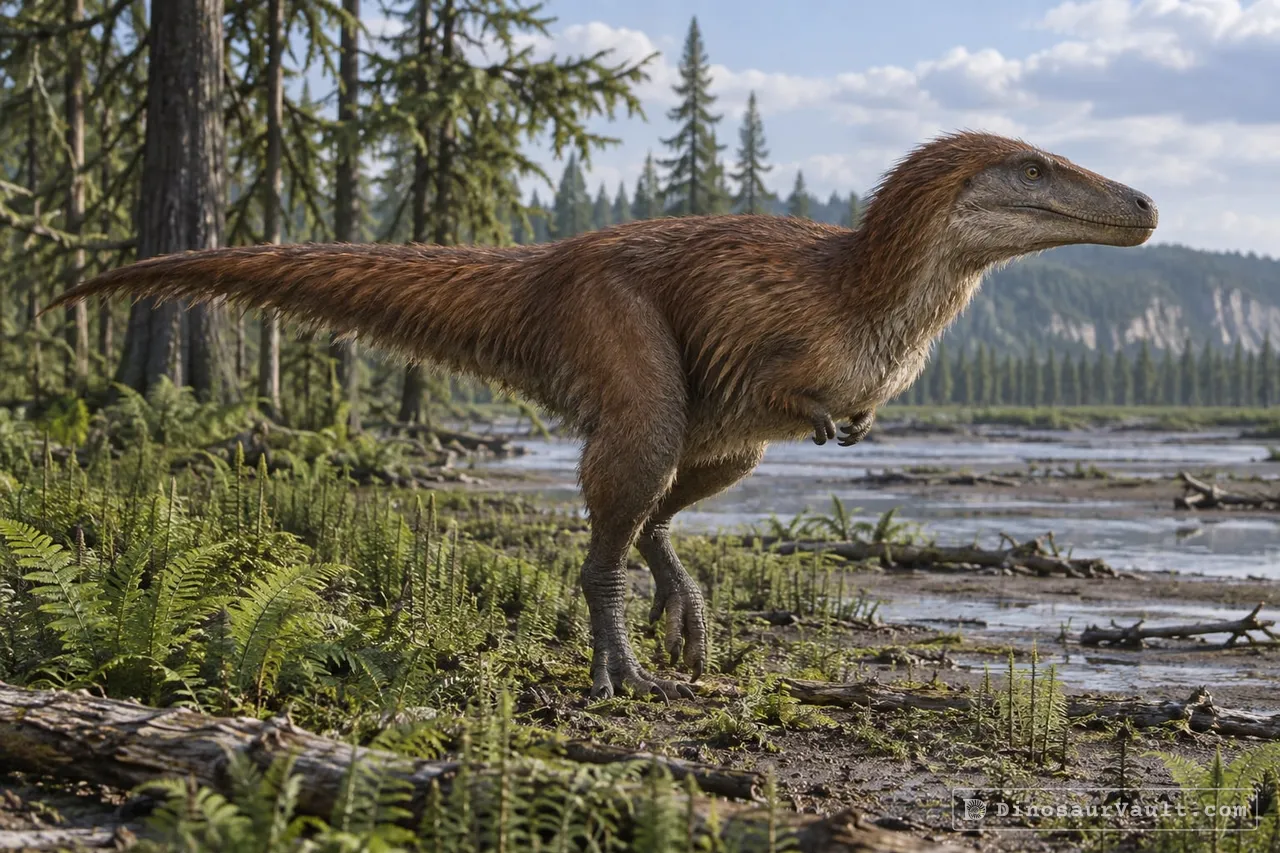
1 of 2
The evidence
The science behind Kileskus
Which parts of the picture come from its own bones, and which come from its relatives.
From its own fossils
- Pieces of the upper jaw and the back of the lower jaw show a long, low snout with a gently curved tooth row.
- Hand and foot bones found nearby include a slender finger bone and a long central foot bone.
- Later finds include neck and tail vertebrae, a bone from beneath the tail, and part of the lower leg.
Borrowed from relatives
- Guanlong helps restore the missing body and head, with fairly long arms and clawed fingers.
- Feathery filaments in early tyrannosauroids such as Dilong suggest that Kileskus may have had a similar covering.
Still unknown
- Whether it had a crest, and what shape that crest took.
- Whether all the nearby hand and foot bones belong to the same animal as the jaws.
- Its exact feather covering and color.
Often drawn wrong
- Tiny arms like those of Tyrannosaurus are a poor fit for this early relative.
- The tall crest of Guanlong should not be presented as a known feature of Kileskus.
Discovery timeline
- 2004SkinXu et al.
- 2006Close relativeXu et al.
- 2010Named itAverianov, Krasnolutskii & Ivantsov
- 2019New findO. Averianov et al.
Key papers
The research behind what we know of Kileskus
Skin
Described Dilong and feathery filaments in a closely related specimen, showing that early tyrannosauroids could have feather coverings.
Basal tyrannosauroids from China and evidence for protofeathers in tyrannosauroids. Nature 431: 680-684
Read the paper : Basal tyrannosauroids from China and evidence for protofeathers in tyrannosauroids (opens in a new tab)Close relative
Described Guanlong, a crested early tyrannosauroid whose more complete skeleton helps restore missing parts of Kileskus.
A basal tyrannosauroid dinosaur from the Late Jurassic of China. Nature 439: 715-718
Read the paper : A basal tyrannosauroid dinosaur from the Late Jurassic of China (opens in a new tab)Named it
Described Kileskus from jaw fragments and nearby limb bones, identifying an early relative of the tyrannosaurs.
A new basal coelurosaur (Dinosauria: Theropoda) from the Middle Jurassic of Siberia. Proceedings of the Zoological Institute RAS 314: 42-57
Read the paper : A new basal coelurosaur (Dinosauria: Theropoda) from the Middle Jurassic of Siberia (opens in a new tab)New find
Described additional neck, tail and lower-leg bones that strengthened the link between Kileskus and other early tyrannosauroids.
New data on the tyrannosauroid dinosaurKileskusfrom the Middle Jurassic of Siberia, Russia. Historical Biology 33: 897-903
Read the paper : New data on the tyrannosauroid dinosaurKileskusfrom the Middle Jurassic of Siberia, Russia (opens in a new tab)
Close relatives
Other members of Proceratosauridae


Sources: Wikidata