Proa
"prow"
- Lived
- 113 to 110 million years ago, Early Cretaceous
- Diet
- Herbivore
- Group
- Ornithopods
- Found in
- Spain
- Named by
- McDonald et al. 2012
Where its fossils were found
The evidence
Today

110 million years ago
Habitat
Proa lived in a wet lowland in Spain where plant-rich mud and peat accumulated. Europelta, turtles and crocodilians also inhabited this landscape.
Field notes
About Proa
What it was like
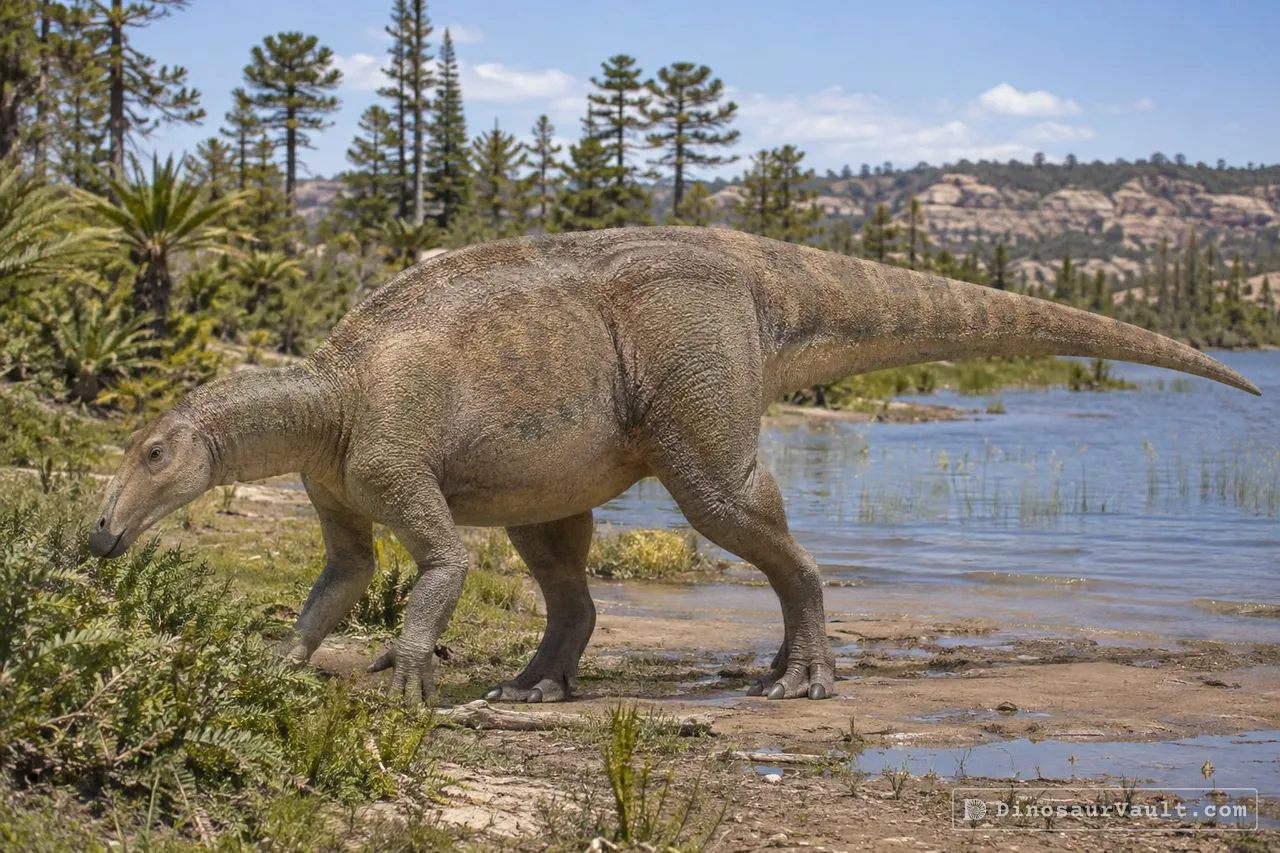
Proa was a plant eater related to Iguanodon, known from parts of several animals. The front of its lower jaw was pointed and shaped like the bow of a ship, which gave it its name.
Its world
It lived in the Early Cretaceous in what is now northeastern Spain. Its bones come from the Escucha Formation, where it shared the land with the nodosaur Europelta.
How it was found
McDonald and colleagues named Proa in 2012. Like Europelta, it was found in a coal mine.
Field gallery
More views of Proa
Scenes reconstructed from the available fossil evidence.
1 of 3
Lived alongside
Found in the same rock formations

A rock formation can hold fossils laid down millions of years apart, so not every animal here met Proa.
The evidence
The science behind Proa
Which parts of the picture come from its own bones, and which come from its relatives.
From its own fossils
- Skull and body bones from several individuals show a stocky plant eater with a large head.
- The toothless bone at the front of the lower jaw comes to a point, like the bow of a boat.
- Scans of its braincases reveal the shape of the space that held the brain.
Borrowed from relatives
- Its brain cavity resembles that of the related iguanodont Sirindhorna.
- Comparisons with Iguanodon help restore missing parts of the body.
Still unknown
- Its skin color and markings.
- Whether it lived in groups or cared for its young.
- Exactly which plants it ate.
Discovery timeline
- 2012Named itMCDONALD et al.
- 2013Same rocksKirkland et al.
- 2021SkullKnoll et al.
Key papers
The research behind what we know of Proa
Named it
Described skull and body bones from several individuals and identified the pointed bone at the front of the lower jaw.
An unusual new basal iguanodont (Dinosauria: Ornithopoda) from the Lower Cretaceous of Teruel, Spain. Zootaxa 3595
Read the paper : An unusual new basal iguanodont (Dinosauria: Ornithopoda) from the Lower Cretaceous of Teruel, Spain (opens in a new tab)Same rocks
Described the armored dinosaur Europelta and the plant-rich fossil beds that also contain Proa.
The Basal Nodosaurid Ankylosaur Europelta carbonensis n. gen., n. sp. from the Lower Cretaceous (Lower Albian) Escucha Formation of Northeastern Spain. PLoS ONE 8: e80405
Read the paper : The Basal Nodosaurid Ankylosaur Europelta carbonensis n. gen., n. sp. from the Lower Cretaceous (Lower Albian) Escucha Formation of Northeastern Spain (opens in a new tab)Skull
Used scans to reconstruct the brain cavities of Proa and compare them with those of other iguanodonts.
Palaeoneurology of the early cretaceous iguanodont Proa valdearinnoensis and its bearing on the parallel developments of cognitive abilities in theropod and ornithopod dinosaurs. Journal of Comparative Neurology 529: 3922-3945
Read the paper : Palaeoneurology of the early cretaceous iguanodont Proa valdearinnoensis and its bearing on the parallel developments of cognitive abilities in theropod and ornithopod dinosaurs (opens in a new tab)
Close relatives
Other members of Hadrosauriformes


Sources: Wikidata