Perijasaurus
"Perijá lizard"
Type species Perijasaurus lapaz
- Lived
- 180 to 171 million years ago, Early Jurassic to Middle Jurassic
- Diet
- Herbivore
- Group
- Sauropods
- Found in
- Colombia
- Named by
- Rincón et al. 2022
Where its fossils were found
The evidence
Today

175 million years ago
Habitat
It lived in wooded lowlands near a river in what is now Colombia. Leaf fragments occur in the sediments at its fossil site, while Laquintasaura is known from other rocks of the La Quinta Formation.
Field notes
About Perijasaurus
What it was like
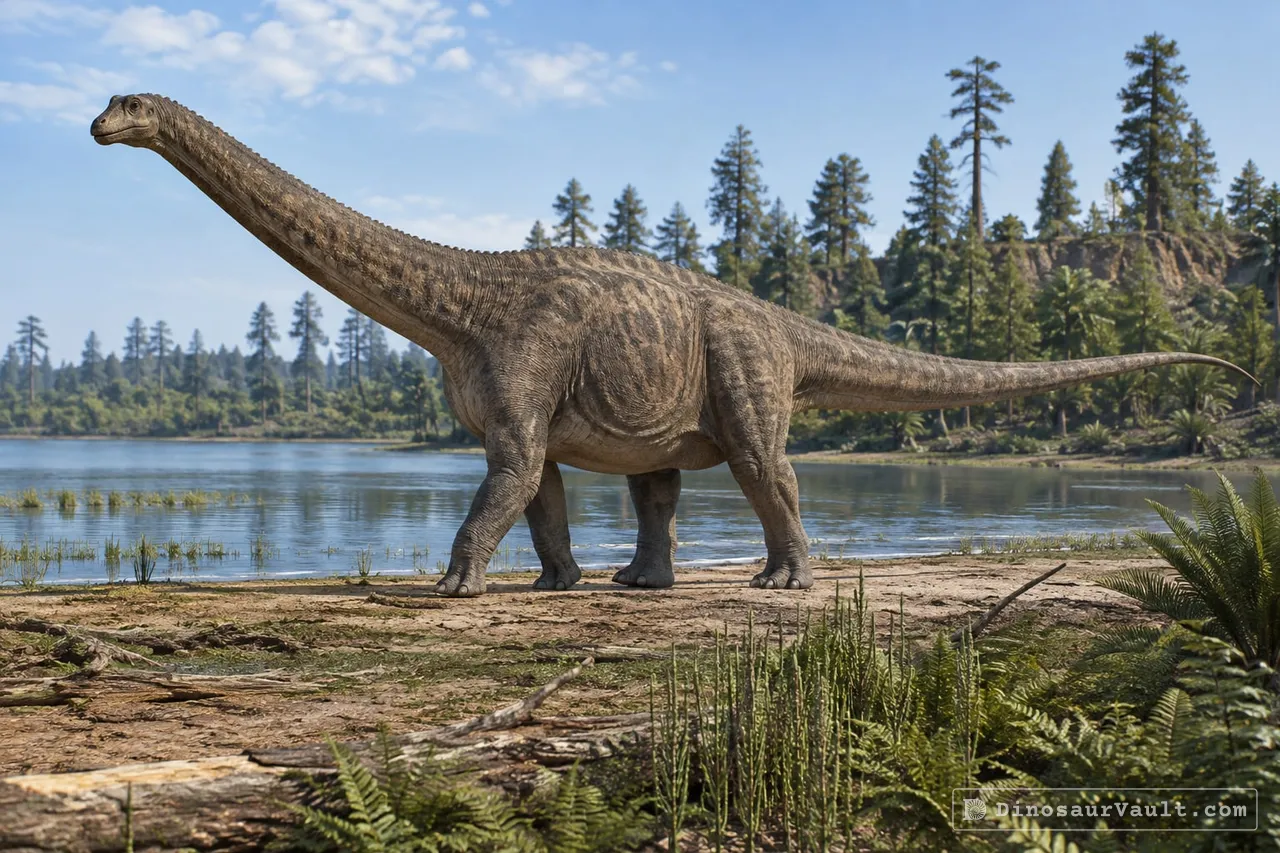
Perijasaurus was an early long-necked, four-legged plant eater, known from a single backbone.
Its world
It lived in the Jurassic, around 175 million years ago, in what is now northeastern Colombia. Its bone comes from the La Quinta Formation, which has also produced the small plant eater Laquintasaura.
How it was found
Rincón and colleagues named Perijasaurus in 2022. The bone had been found decades earlier.
Field gallery
More views of Perijasaurus
Scenes reconstructed from the available fossil evidence.
1 of 3
The evidence
The science behind Perijasaurus
Which parts of the picture come from its own bones, and which come from its relatives.
From its own fossils
- A single vertebra from the back is the only known bone.
- A distinctive arrangement of bony ridges around the spinal canal separates it from other sauropods.
- The bony spine above the vertebra widens from side to side.
Borrowed from relatives
- Bagualia provides a comparison for the missing head, neck, limbs and tail.
Still unknown
- Its total length, weight and closest relatives among early sauropods.
- The shape of its skull and teeth.
- Its skin covering and color.
Discovery timeline
- 2020Its worldPol et al.
- 2021Close relativeGomez, Carballido & Pol
- 2022Named itRincón et al.
Key papers
The research behind what we know of Perijasaurus
Its world
Linked the rise of early sauropods in Argentina with warming, plant extinctions and the spread of conifers.
Extinction of herbivorous dinosaurs linked to Early Jurassic global warming event. Proceedings of the Royal Society B: Biological Sciences 287: 20202310
Read the paper : Extinction of herbivorous dinosaurs linked to Early Jurassic global warming event (opens in a new tab)Close relative
Described Bagualia neck, back and tail bones, tracing changes that helped early sauropods develop long necks and large bodies.
The axial skeleton of Bagualia alba (Dinosauria: Eusauropoda) from the Early Jurassic of Patagonia. Palaeontologia Electronica
Read the paper : The axial skeleton of Bagualia alba (Dinosauria: Eusauropoda) from the Early Jurassic of Patagonia (opens in a new tab)Named it
Named an early sauropod from a distinctive back vertebra and placed it among early members of Eusauropoda.
A sauropod from the Lower Jurassic La Quinta Formation (Dept. Cesar, Colombia) and the initial diversification of eusauropods at low latitudes. Journal of Vertebrate Paleontology 42
Read the paper : A sauropod from the Lower Jurassic La Quinta Formation (Dept. Cesar, Colombia) and the initial diversification of eusauropods at low latitudes (opens in a new tab)
Close relatives
Other members of Eusauropoda


Sources: Wikidata