Nebulasaurus
"cloud lizard"
Type species Nebulasaurus taito
- Lived
- 175 to 168 million years ago, Middle Jurassic
- Diet
- Herbivore
- Group
- Sauropods
- Found in
- China
- Named by
- Xing et al. 2015
Where its fossils were found
The evidence
Today

170 million years ago
Habitat
It lived in southern China during the Middle Jurassic. The Zhanghe Formation also preserves Yuanmousaurus, Eomamenchisaurus and Yuanmouraptor.
Field notes
About Nebulasaurus
What it was like
Nebulasaurus was a long-necked sauropod known only from a braincase. It seems to be an early member of the eusauropods, the group that includes nearly all later sauropods.
Its world
It lived in the Middle Jurassic in what is now southern China. Its fossil comes from the Zhanghe Formation, where the predator Yuanmouraptor and the sauropods Yuanmousaurus and Eomamenchisaurus also lived.
How it was found
Xing and colleagues named it in 2015. The type species is Nebulasaurus taito. Its name refers to the province where it was found, whose name means "south of the clouds".
Field gallery
More views of Nebulasaurus
Scenes reconstructed from the available fossil evidence.
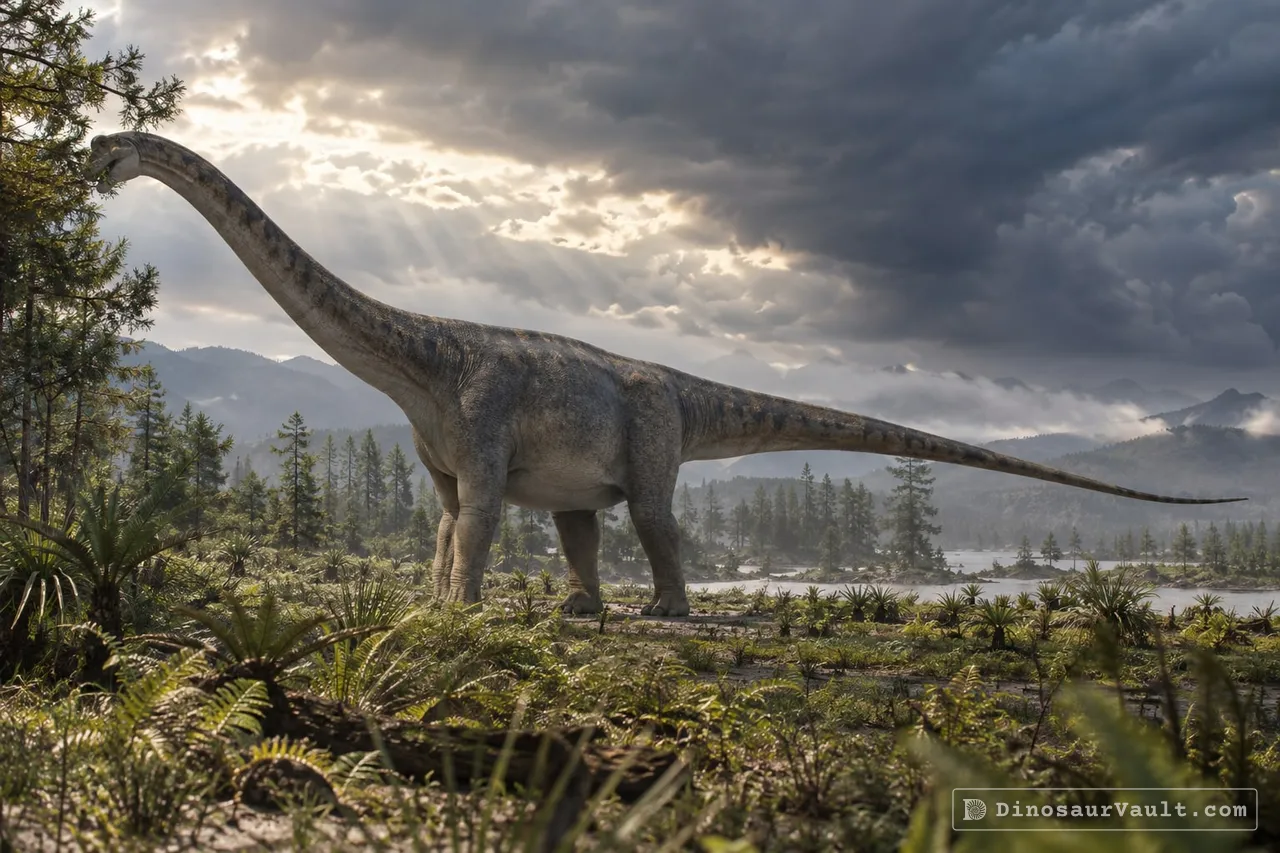
1 of 3
Lived alongside
Found in the same rock formations


A rock formation can hold fossils laid down millions of years apart, so not every animal here met Nebulasaurus.
The evidence
The science behind Nebulasaurus
Which parts of the picture come from its own bones, and which come from its relatives.
From its own fossils
- Nebulasaurus is known from a single well-preserved braincase, the part of the skull that surrounds the brain, broken off at the front.
- At the back of the braincase, the bones beside the opening for the spinal cord nearly meet above it.
- The roof at the back of the skull is broad, with a gently folded crest and a narrow midline ridge that has no knob on top.
Borrowed from relatives
- The long neck, body, limbs and tail are inferred from early sauropods such as Spinophorosaurus, its closest relative in the naming study.
Still unknown
- Its body size and proportions.
- The shape of its snout and teeth.
- Its exact place among early sauropods: a later study grouped it with Spinophorosaurus, Bagualia and Patagosaurus without settling which is its closest relative.
Discovery timeline
- 2009Close relativeRemes et al.
- 2012SkullKnoll et al.
- 2015Named itXing et al.
- 2021Family treeGomez, Carballido & Pol
Key papers
The research behind what we know of Nebulasaurus
Close relative
Described the much more complete Spinophorosaurus, offering a comparison for the missing body of Nebulasaurus.
A New Basal Sauropod Dinosaur from the Middle Jurassic of Niger and the Early Evolution of Sauropoda. PLoS ONE 4: e6924
Read the paper : A New Basal Sauropod Dinosaur from the Middle Jurassic of Niger and the Early Evolution of Sauropoda (opens in a new tab)Skull
Examined the braincase and inner ear of Spinophorosaurus, providing detailed comparisons for the braincase of Nebulasaurus.
The Braincase of the Basal Sauropod Dinosaur Spinophorosaurus and 3D Reconstructions of the Cranial Endocast and Inner Ear. PLoS ONE 7: e30060
Read the paper : The Braincase of the Basal Sauropod Dinosaur Spinophorosaurus and 3D Reconstructions of the Cranial Endocast and Inner Ear (opens in a new tab)Named it
Named Nebulasaurus from its distinctive braincase and found it closely related to Spinophorosaurus.
A new basal eusauropod from the Middle Jurassic of Yunnan, China, and faunal compositions and transitions of Asian sauropodomorph dinosaurs. Acta Palaeontologica Polonica 60: 145-154
No link available
Family tree
Described the backbone of Bagualia and placed Nebulasaurus in an unresolved group of early eusauropods alongside Bagualia, Spinophorosaurus and Patagosaurus.
The axial skeleton of Bagualia alba (Dinosauria: Eusauropoda) from the Early Jurassic of Patagonia. Palaeontologia Electronica
Read the paper : The axial skeleton of Bagualia alba (Dinosauria: Eusauropoda) from the Early Jurassic of Patagonia (opens in a new tab)
Close relatives
Other members of Eusauropoda


Sources: Wikidata