Nanosaurus
NAN-oh-SORE-us
"small lizard"
- Lived
- Late Jurassic
- Diet
- Herbivore
- Group
- Early ornithischians
- Named by
- Marsh 1877
Where its fossils were found
The evidence
Fossil record
Morrison Formation, Colorado, United States
Late Jurassic
The original fossils do not distinguish Nanosaurus from other small plant eaters. More complete skeletons assigned to it need restudy, so those old referrals cannot establish a secure geographic or numerical age range.
No finds with map coordinates are recorded yet.
Habitat
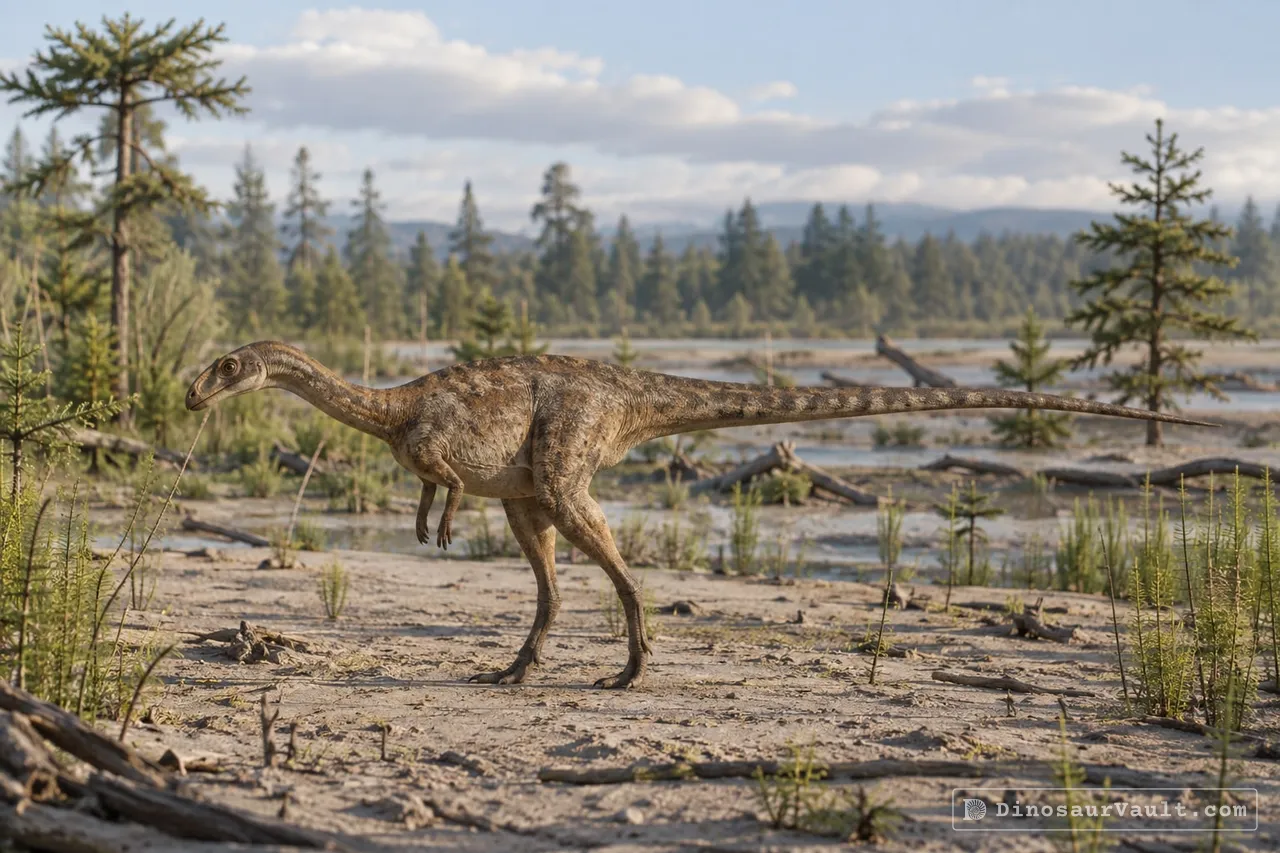
Rivers crossed the floodplains of the Morrison Formation, with conifers and ferns growing nearby. Stegosaurus, Diplodocus and Allosaurus lived in the same region.
Field notes
About Nanosaurus
What it was like
Nanosaurus was a small, fast plant eater that ran on two legs. It had short arms, a long tail for balance and leaf-shaped teeth.
Its classification has a long, tangled history. A recent study found that the original fossils are too incomplete to distinguish Nanosaurus from other small plant eaters, and that more complete skeletons assigned to it need to be studied again.
Its world
The original fossils come from the Late Jurassic Morrison Formation of Colorado. Skeletons from other places have been assigned to Nanosaurus, but those identifications need restudy.
How it was found
Marsh named Nanosaurus in 1877 from fragmentary fossils found in Colorado.
Field gallery
More views of Nanosaurus
Scenes reconstructed from the available fossil evidence.
The evidence
The science behind Nanosaurus
Which parts of the picture come from its own bones, and which come from its relatives.
From its own fossils
- The original find preserves a fragmentary lower jaw, teeth and parts of the hips and hind legs.
- Its cheek teeth have leaf-shaped crowns with small serrations.
Borrowed from relatives
- The overall shape of the body is restored by comparison with small plant eaters such as Dryosaurus.
Still unknown
- Which of the more complete skeletons assigned to Nanosaurus really belong to it.
- Whether its original bones distinguish it from other small plant eaters.
- Its color and body covering.
Discovery timeline
- 1877Named itMarsh
- 2018RedescriptionCarpenter & Galton
- 2025RedescriptionBarrett & Maidment
Key papers
The research behind what we know of Nanosaurus
Named it
Named Nanosaurus from small, fragmentary fossils found in Colorado.
Notice of some new vertebrate fossils. American Journal of Science s3-14: 249-256
Read the paper : Notice of some new vertebrate fossils (opens in a new tab)Redescription
Compared small plant eaters from the Morrison Formation and proposed combining several previously separate genera under Nanosaurus.
A photo documentation of bipedal ornithischian dinosaurs from the Upper Jurassic Morrison Formation, USA. Geology of the Intermountain West 5: 167-207
Read the paper : A photo documentation of bipedal ornithischian dinosaurs from the Upper Jurassic Morrison Formation, USA (opens in a new tab)Redescription
Reexamined the original fossils and concluded that Nanosaurus and several other old names cannot reliably identify distinct dinosaurs.
A Review of Nanosaurus agilis Marsh and Other Small-Bodied Morrison Formation “Ornithopods”. Bulletin of the Peabody Museum of Natural History 66: 25-50
Read the paper : A Review of Nanosaurus agilis Marsh and Other Small-Bodied Morrison Formation “Ornithopods” (opens in a new tab)
Close relatives
Other members of Neornithischia


Sources: Wikidata