Jinchuanloong
"Jinchuan dragon"
Type species Jinchuanloong niedu
- Lived
- 168 to 165 million years ago, Middle Jurassic
- Diet
- Herbivore
- Group
- Sauropods
- Found in
- China
- Named by
- Li et al. 2025
Where its fossils were found
The evidence
Today

165 million years ago
Habitat
A landscape with lakes in what is now northwestern China. The Xinhe Formation also contains turtles and freshwater plesiosaurs.
Field notes
About Jinchuanloong
What it was like
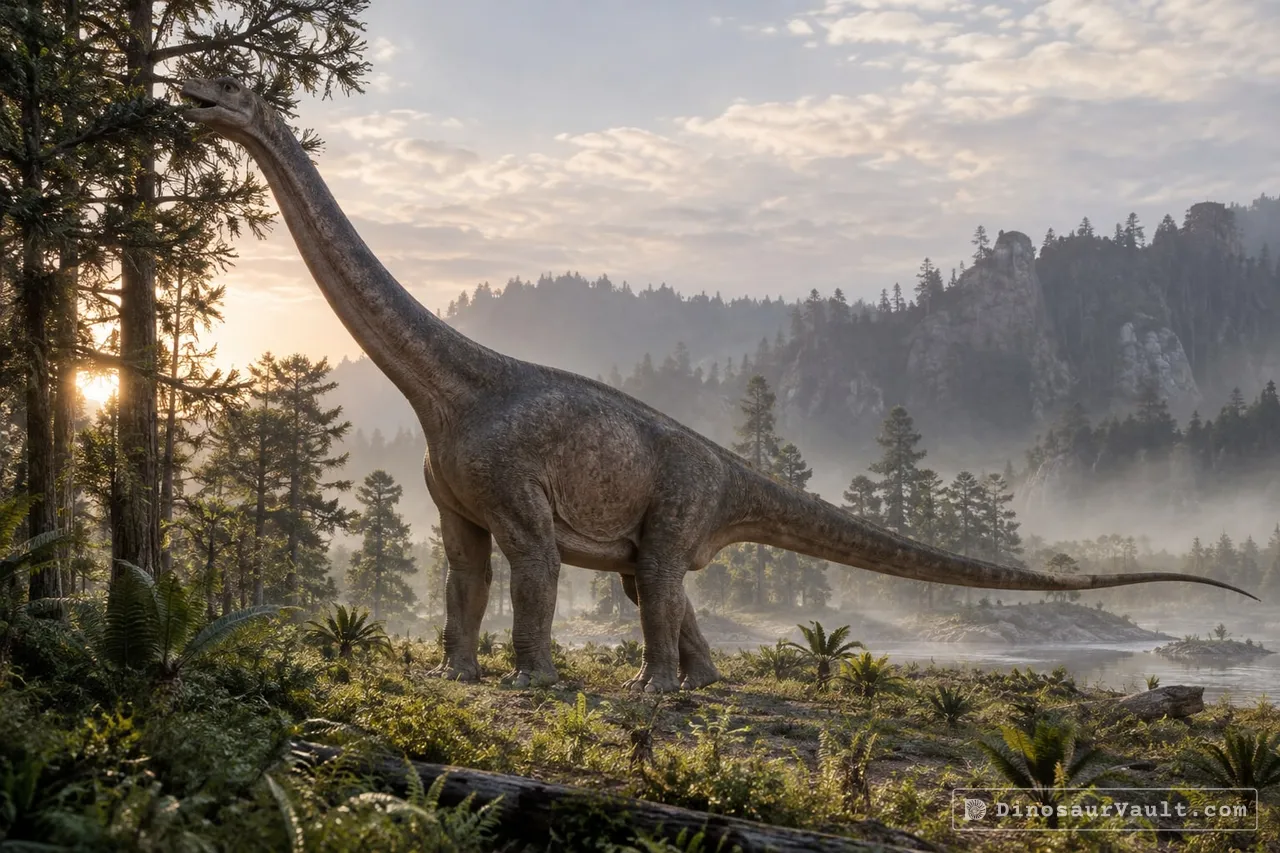
Jinchuanloong was a long-necked, four-legged plant eater, known from a partial skeleton with a nearly complete skull. It is one of the early sauropods that show how the group looked in the Middle Jurassic.
Its world
It lived in the Middle Jurassic in what is now northwestern China. Its bones come from the Xinhe Formation.
How it was found
Li and colleagues named Jinchuanloong in 2025, from a single find.
Field gallery
More views of Jinchuanloong
Scenes reconstructed from the available fossil evidence.
1 of 3
The evidence
The science behind Jinchuanloong
Which parts of the picture come from its own bones, and which come from its relatives.
From its own fossils
- A nearly complete skull with the lower jaws, the beginning of the neck and a long connected series of tail vertebrae.
- The upper-jaw teeth have broad, spoon-shaped crowns.
- Impressions of the hips and backbone at the hips lie between the preserved neck and tail.
Borrowed from relatives
- The missing limbs and trunk are restored from early eusauropods such as Shunosaurus and Mamenchisaurus.
Still unknown
- The length of its complete neck and the proportions of its legs.
- Its skin covering and color.
- Its fully grown size.
Discovery timeline
- 2018Growing upMoore et al.
- 2024Close relativeGomez, Carballido & Pol
- 2025Named itLi et al.
Key papers
The research behind what we know of Jinchuanloong
Growing up
Described juvenile Bellusaurus skull bones and examined how sauropod skulls changed during growth, providing context for comparisons with Jinchuanloong.
Cranial anatomy of Bellusaurus sui (Dinosauria: Eusauropoda) from the Middle-Late Jurassic Shishugou Formation of northwest China and a review of sauropod cranial ontogeny. PeerJ 6: e4881
Read the paper : Cranial anatomy of Bellusaurus sui (Dinosauria: Eusauropoda) from the Middle-Late Jurassic Shishugou Formation of northwest China and a review of sauropod cranial ontogeny (opens in a new tab)Close relative
Described the skull of Bagualia, providing comparisons for the jaws and skull bones of early eusauropods such as Jinchuanloong.
Cranial anatomy of Bagualia alba (Dinosauria, Eusauropoda) from the Early Jurassic of Patagonia and the implications for sauropod cranial evolution. Journal of Systematic Palaeontology 22
Read the paper : Cranial anatomy of Bagualia alba (Dinosauria, Eusauropoda) from the Early Jurassic of Patagonia and the implications for sauropod cranial evolution (opens in a new tab)Named it
Described the skull, neck and tail of Jinchuanloong and placed it on an earlier branch than the group containing Diplodocus and Brachiosaurus.
A new eusauropod (Dinosauria, Sauropodomorpha) from the Middle Jurassic of Gansu, China. Scientific Reports 15
Read the paper : A new eusauropod (Dinosauria, Sauropodomorpha) from the Middle Jurassic of Gansu, China (opens in a new tab)
Close relatives
Other members of Eusauropoda


Sources: Wikidata