Haestasaurus
- Lived
- 139 to 133 million years ago, Early Cretaceous
- Diet
- Herbivore
- Group
- Sauropods
- Found in
- United Kingdom
- Named by
- Upchurch et al. 2015
Where its fossils were found
The evidence
Today

135 million years ago
Habitat
Rivers, swamps and lakes covered the landscape, with conifers, ferns and horsetails on dry ground. Barilium and Hypselospinus also occur in the Hastings Beds.
Field notes
About Haestasaurus
What it was like
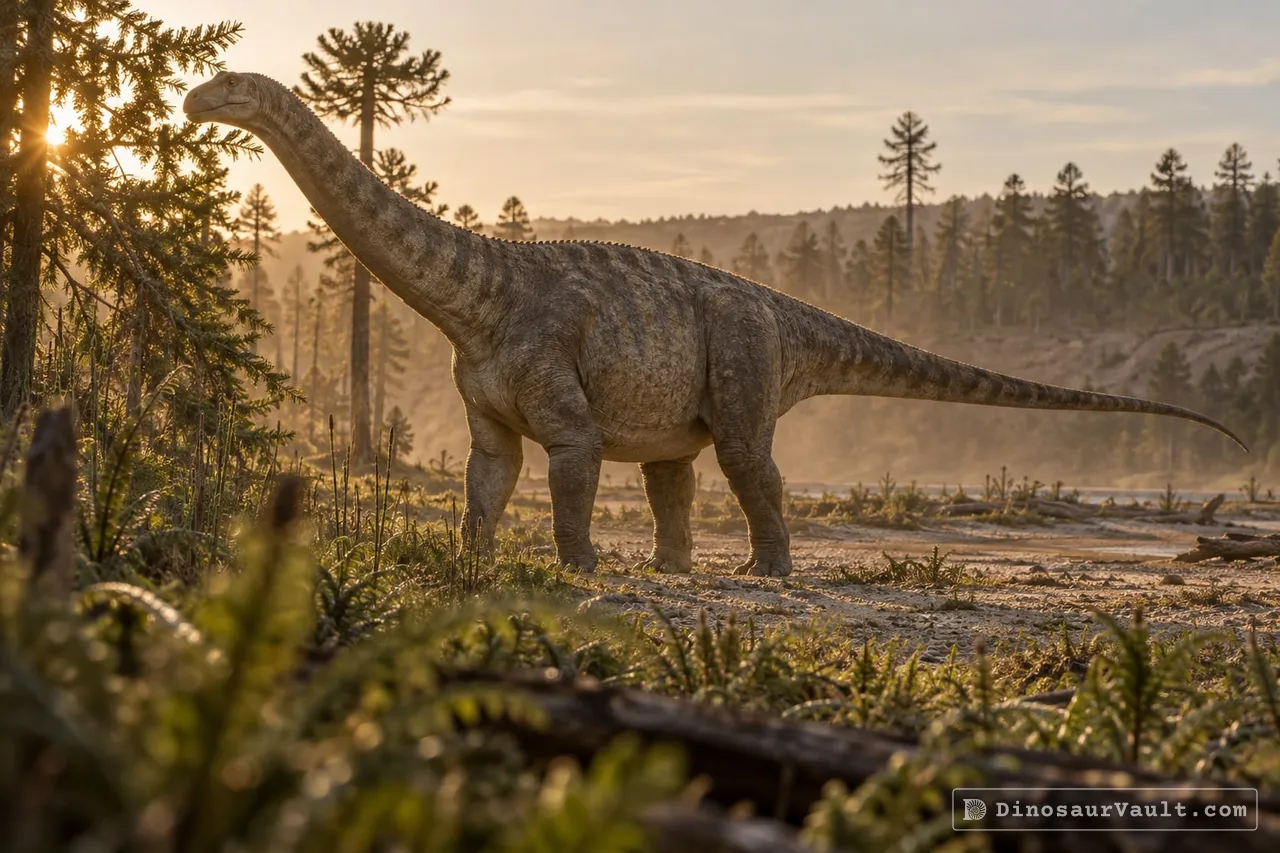
Haestasaurus was a long-necked sauropod known from bones of a front leg. A patch of skin impression was found with the bones, one of the first pieces of dinosaur skin ever found.
Its world
It lived about 139 to 133 million years ago, in the Early Cretaceous, in what is now England. Its bones come from the Hastings Beds.
How it was found
Its bones were found long ago and were first placed in another genus. Upchurch and colleagues gave it its own name in 2015. The name comes from an old leader for whom the town of Hastings is named.
Field gallery
More views of Haestasaurus
Scenes reconstructed from the available fossil evidence.
1 of 2
The evidence
The science behind Haestasaurus
Which parts of the picture come from its own bones, and which come from its relatives.
From its own fossils
- A stout upper arm bone and both forearm bones preserve part of its left front leg.
- Its forearm combines a stout ulna with a more slender radius.
- Skin from the same block has rounded and polygonal scales with tiny bumps on some scale surfaces.
Borrowed from relatives
- Camarasaurus provides comparisons for its missing head, hands and hindfeet.
Still unknown
- Its skull shape, full neck length and the anatomy of its hands and hindfeet.
- Its skin color, the orientation of the preserved skin and the pattern of scales across its body.
- Its exact place in the sauropod family tree; one study linked it with Janenschia and Bellusaurus, while others placed it among different sauropod groups.
Discovery timeline
- 2015Named itUpchurch, Mannion & Taylor
- 2016SkullButton, Barrett & Rayfield
- 2019Family treeMannion et al.
- 2022SkinPittman et al.
Key papers
The research behind what we know of Haestasaurus
Named it
Restudied the forelimb and skin impression and recognized a separate genus from Pelorosaurus.
The Anatomy and Phylogenetic Relationships of “Pelorosaurus“ becklesii (Neosauropoda, Macronaria) from the Early Cretaceous of England. PLOS ONE 10: e0125819
Read the paper : The Anatomy and Phylogenetic Relationships of “Pelorosaurus“ becklesii (Neosauropoda, Macronaria) from the Early Cretaceous of England (opens in a new tab)Skull
Reconstructed the skull of a young Camarasaurus, a broader sauropod comparison for the missing head.
Comparative cranial myology and biomechanics of Plateosaurus and Camarasaurus and evolution of the sauropod feeding apparatus. Palaeontology 59: 887-913
Read the paper : Comparative cranial myology and biomechanics of Plateosaurus and Camarasaurus and evolution of the sauropod feeding apparatus (opens in a new tab)Family tree
One analysis grouped Haestasaurus with Janenschia and Bellusaurus.
Taxonomic affinities of the putative titanosaurs from the Late Jurassic Tendaguru Formation of Tanzania: phylogenetic and biogeographic implications for eusauropod dinosaur evolution. Zoological Journal of the Linnean Society 185: 784-909
Read the paper : Taxonomic affinities of the putative titanosaurs from the Late Jurassic Tendaguru Formation of Tanzania: phylogenetic and biogeographic implications for eusauropod dinosaur evolution (opens in a new tab)Skin
Laser imaging revealed additional scales and tiny bumps on their surfaces.
Newly detected data from Haestasaurus and review of sauropod skin morphology suggests Early Jurassic origin of skin papillae. Communications Biology 5
Read the paper : Newly detected data from Haestasaurus and review of sauropod skin morphology suggests Early Jurassic origin of skin papillae (opens in a new tab)
Close relatives
Other members of Eusauropoda


Sources: Wikidata