Convolosaurus
"flocking lizard"
- Lived
- 120 to 113 million years ago, Early Cretaceous
- Diet
- Herbivore
- Group
- Ornithopods, Tenontosauridae
- Found in
- United States
- Named by
- Andrzejewski et al. 2019
Where its fossils were found
The evidence
Today

115 million years ago
Habitat
Rivers crossed a floodplain in what is now Texas, leaving sand and red mud. Acrocanthosaurus, Sauroposeidon and Tenontosaurus also lived in the Twin Mountains Formation.
Field notes
About Convolosaurus
What it was like
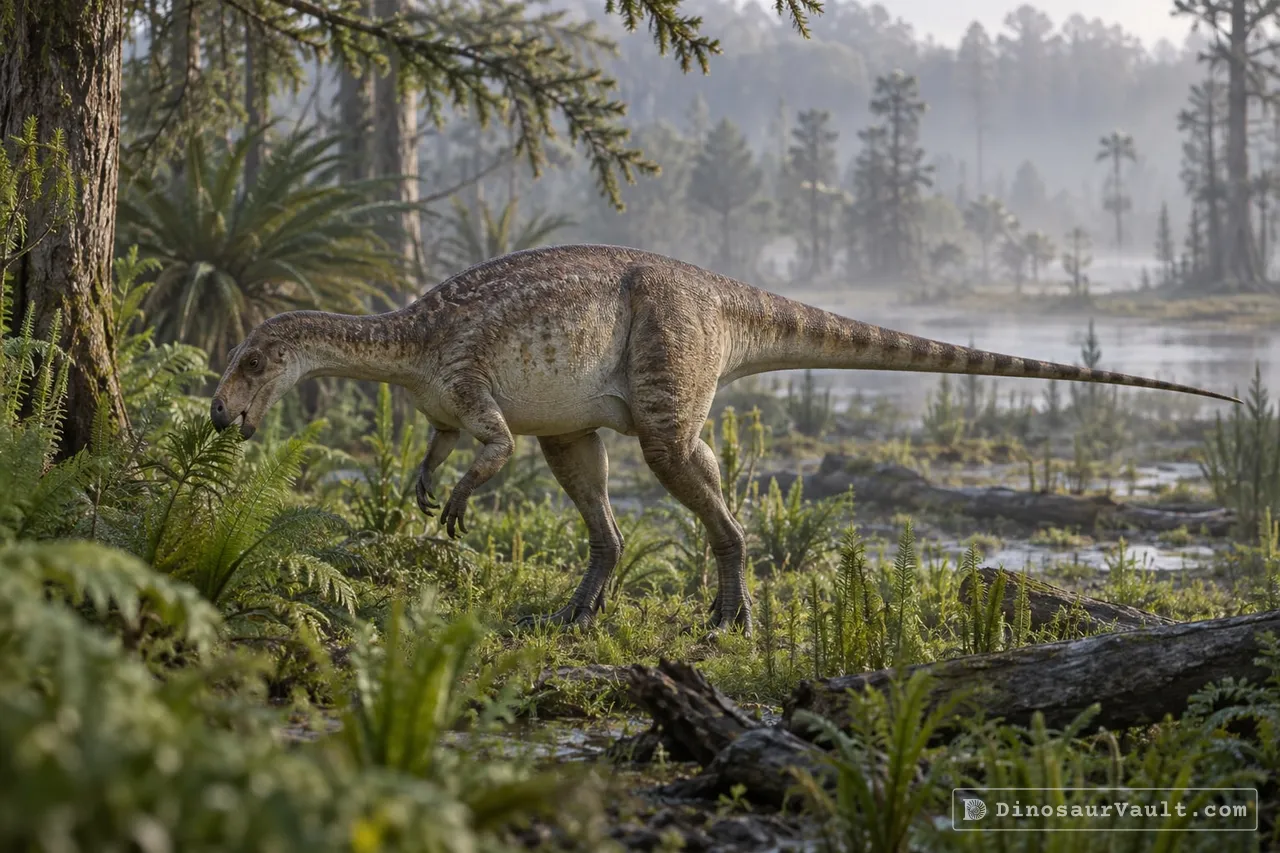
Convolosaurus was a small plant eater that walked on two legs. It is known from bones of several young animals found together, which gave it its name.
Its world
It lived in the Early Cretaceous, in what is now Texas. It comes from the Twin Mountains Formation, where it shared the land with the big predator Acrocanthosaurus, the tall sauropod Sauroposeidon and the plant eater Tenontosaurus.
How it was found
Andrzejewski and colleagues named Convolosaurus in 2019.
Field gallery
More views of Convolosaurus
Scenes reconstructed from the available fossil evidence.
1 of 3
Lived alongside
Found in the same rock formations


A rock formation can hold fossils laid down millions of years apart, so not every animal here met Convolosaurus.
The evidence
The science behind Convolosaurus
Which parts of the picture come from its own bones, and which come from its relatives.
From its own fossils
- Many skeletons together preserve almost the whole skeleton, including skulls, limbs and tails.
- Teeth grew at the front of its upper jaw as well as along its cheeks.
- Bony rods stiffened parts of the backbone and tail.
Borrowed from relatives
- Almost the whole body is known from its own bones, so little of the skeleton needs to be borrowed from relatives.
Still unknown
- Its full adult size.
- Its color and skin covering.
- Whether the clusters of young animals represent lasting social groups.
Discovery timeline
- 2019Named itAndrzejewski, Winkler & Jacobs
- 2023Close relativeZanno et al.
- 2024Family treeFonseca et al.
Key papers
The research behind what we know of Convolosaurus
Named it
Described many young skeletons, named Convolosaurus, and traced changes in teeth and limb proportions as the animals grew.
A new basal ornithopod (Dinosauria: Ornithischia) from the Early Cretaceous of Texas. PLOS ONE 14: e0207935
Read the paper : A new basal ornithopod (Dinosauria: Ornithischia) from the Early Cretaceous of Texas (opens in a new tab)Close relative
Described Iani and compared its skull with Convolosaurus, including features of the bones around the eyes.
An early-diverging iguanodontian (Dinosauria: Rhabdodontomorpha) from the Late Cretaceous of North America. PLOS ONE 18: e0286042
Read the paper : An early-diverging iguanodontian (Dinosauria: Rhabdodontomorpha) from the Late Cretaceous of North America (opens in a new tab)Family tree
Combined and revised anatomical comparisons to test the relationships of early plant-eating dinosaurs, including Convolosaurus.
A comprehensive phylogenetic analysis on early ornithischian evolution. Journal of Systematic Palaeontology 22
Read the paper : A comprehensive phylogenetic analysis on early ornithischian evolution (opens in a new tab)
Close relatives
Other members of Tenontosauridae

Sources: Wikidata