Sarcosaurus
"flesh lizard"
Type species Sarcosaurus woodi
- Lived
- 201 to 193 million years ago, Early Jurassic
- Diet
- Carnivore
- Length
- about 3 m (10 ft)
- Group
- Theropods
- Found in
- United Kingdom
- Named by
- Andrews 1921
Size comparison
To scale

Scale in metersOutline: typical theropod shape
Where its fossils were found
The evidence
Today

195 million years ago
Habitat
Sarcosaurus probably lived on land near a shallow sea, where its bones were buried in mud and limestone. Dracoraptor and the armored Scelidosaurus also occur in the Blue Lias rocks.
Field notes
About Sarcosaurus
What it was like
Sarcosaurus was a meat eater about 3 meters (10 feet) long, one of the earliest Jurassic theropods known. It was a lightly built, two-legged hunter related to Coelophysis.
Its world
It lived about 201 to 193 million years ago, in the Early Jurassic, in what is now England. Its bones come from the Blue Lias, rocks laid down in a shallow sea, so its body probably washed in from land nearby.
How it was found
Andrews named Sarcosaurus in 1921. Only two finds are known, and it is one of very few theropods from the start of the Jurassic, when dinosaurs were spreading after the extinctions at the end of the Triassic.
Field gallery
More views of Sarcosaurus
Scenes reconstructed from the available fossil evidence.
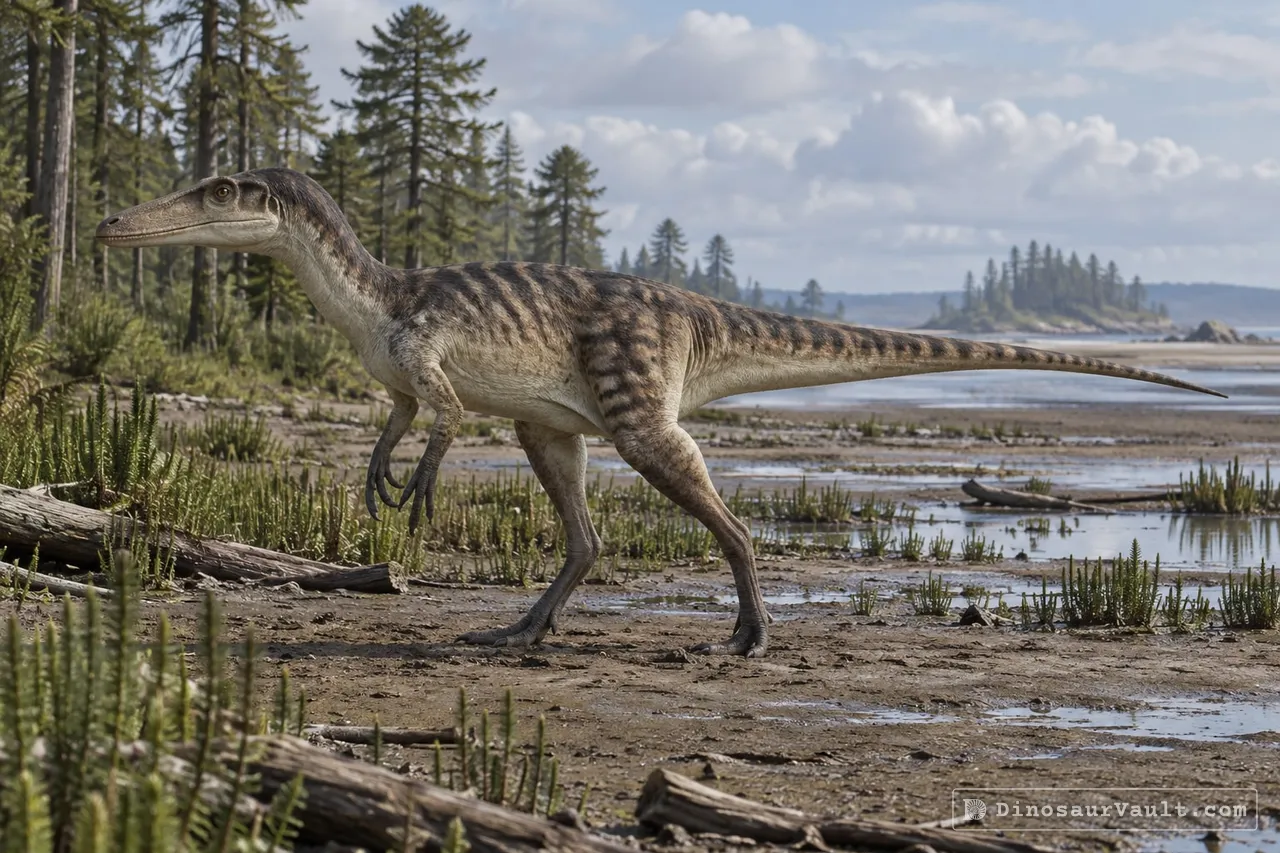
1 of 3
Lived alongside
Found in the same rock formations

A rock formation can hold fossils laid down millions of years apart, so not every animal here met Sarcosaurus.
The evidence
The science behind Sarcosaurus
Which parts of the picture come from its own bones, and which come from its relatives.
From its own fossils
- The original find includes part of the backbone, hip bones and a thigh bone.
- Other skeleton fragments assigned to Sarcosaurus add tail vertebrae, lower legs and parts of the feet.
Borrowed from relatives
- Dilophosaurus provides a comparison for the missing head, neck, arms and much of the tail.
- The missing fingertips and toe claws are restored from other early theropods, including Dilophosaurus.
Still unknown
- The shape of its skull and whether it had head ornaments.
- Its skin covering and color.
- Exactly where it branches from other early theropods.
Often drawn wrong
- Its hands should face inward rather than hang with the palms turned toward the ground.
Discovery timeline
- 1921Named itAndrews
- 2020RedescriptionEzcurra et al.
- 2020Close relativeMarsh & Rowe
Key papers
The research behind what we know of Sarcosaurus
Named it
Named Sarcosaurus from hip, thigh and backbone fragments found in England.
LVI.—On some ramins of a Theropodous dinosaur from the Lower Lias of Barrow-on-Soa. Annals and Magazine of Natural History 8: 570-576
Read the paper : LVI.—On some ramins of a Theropodous dinosaur from the Lower Lias of Barrow-on-Soa (opens in a new tab)Redescription
Compared the known bones, united previously separate finds under Sarcosaurus woodi and reassessed its place among early theropods.
A revision of the early neotheropod genusSarcosaurusfrom the Early Jurassic (Hettangian–Sinemurian) of central England. Zoological Journal of the Linnean Society 191: 113-149
Read the paper : A revision of the early neotheropod genusSarcosaurusfrom the Early Jurassic (Hettangian–Sinemurian) of central England (opens in a new tab)Close relative
Described Dilophosaurus in detail, providing comparisons for the arms, head and feet missing from Sarcosaurus.
A comprehensive anatomical and phylogenetic evaluation of Dilophosaurus wetherilli (Dinosauria, Theropoda) with descriptions of new specimens from the Kayenta Formation of northern Arizona. Journal of Paleontology 94: 1-103
Read the paper : A comprehensive anatomical and phylogenetic evaluation of Dilophosaurus wetherilli (Dinosauria, Theropoda) with descriptions of new specimens from the Kayenta Formation of northern Arizona (opens in a new tab)
Close relatives
Other members of Coelophysoidea


Sources: Wikidata